


What Is Surveillance Pricing? The Hidden Way Companies Set Prices Based on Your Data
Imagine walking into a grocery store. You pick up a carton of milk, glance at the digital price tag, and see $3.49. The person next to you — same milk, same store, same moment — sees $2.89 on their phone. The difference? Their browsing history suggests they’re more price-sensitive than you. Yours suggests you’ll pay the higher price without thinking twice.
This isn’t a hypothetical. It’s called surveillance pricing, and by 2026 it has triggered a wave of legislation, FTC investigations, and consumer backlash across the United States. Here’s what it actually means, how it works, and why electronic shelf labels — the digital price tags appearing in stores everywhere — have become the unlikely flashpoint of this debate.
What Is Surveillance Pricing?
A Simple Definition
The Federal Trade Commission defines surveillance pricing as “pricing products and services that incorporate data about consumers’ characteristics and behavior” (FTC, 2025). In plain language: a company uses personal data they’ve collected about you — your browsing history, your location, your device, your purchase patterns — to set a price specifically for you, rather than offering the same price to everyone.
Cornell Law School’s Legal Information Institute puts it more sharply: surveillance pricing is personalized pricing powered by surveillance — the systematic collection and algorithmic processing of individual consumer data (Cornell LII).
The critical word is surveillance. This isn’t about market-level price changes, like airline tickets getting more expensive during holidays. It’s about you — who you are, what you’ve clicked on, where you live, and what an algorithm has decided you’re willing to pay.
Real-World Examples That Made Headlines
The concept stops being abstract when you see the receipts:
- Target paid a $5 million settlement in California after its app charged shoppers higher prices when it detected they were physically near a Target store. One customer saw a TV priced $100 higher in the app while standing in the parking lot than when browsing from home.
- Instacart charged some customers up to 23% more for identical grocery items at the same time. The FTC’s preliminary 6(b) study traced the discrepancies to algorithmic pricing variables tied to user profiles.
- Orbitz systematically showed Mac users more expensive hotel options than Windows users, based on data suggesting Mac owners had higher average spending patterns.
- Staples varied its online prices based on whether a competitor’s physical store was located within 20 miles of the shopper’s ZIP code — charging more when the shopper had fewer alternatives nearby.
These aren’t isolated bugs. They’re the output of systems designed to estimate, for each individual shopper, the maximum price they’d accept before walking away.
The Core Characteristics That Define Surveillance Pricing
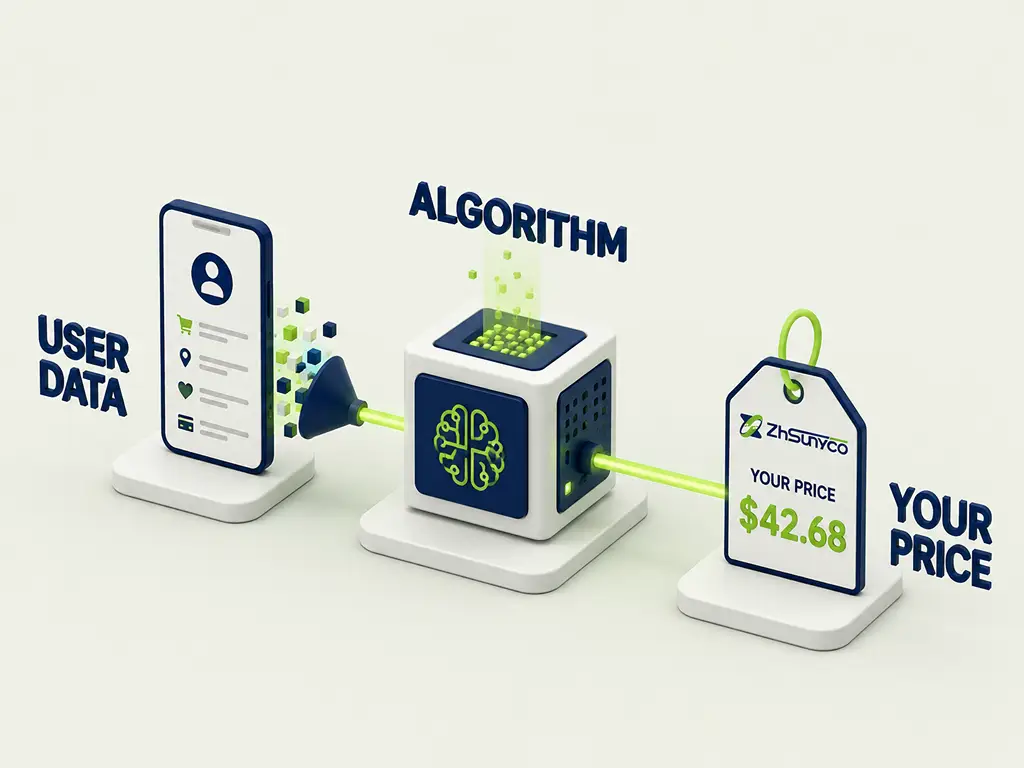
From these examples, three defining features emerge:
- The data source is personal, not market-based. Dynamic pricing asks “what’s happening in the market right now?” Surveillance pricing asks “who are you, and what can we extract from you?”
- The price is individualized, not uniform. Two shoppers see different numbers for the same product at the same time — and typically neither knows what the other is paying.
- The process is opaque. There’s no disclosure, no price tag that says “this number was calculated using your personal data.” The consumer cannot verify whether they’re paying a fair price.
Think of it like a restaurant menu. Dynamic pricing means the weekend brunch costs more than the weekday lunch — everyone sitting down on Saturday pays the same. Surveillance pricing is the waiter glancing at your watch, phone, and shoes, then handing you a menu with prices 20% higher than the one handed to the person at the next table.
How Does Surveillance Pricing Work?
The surveillance pricing pipeline runs in three stages, from data collection to the price you see. It happens in milliseconds, and you never see it happening.
The Data Collection Layer — What Companies Know About You
The first stage is data intake. Companies and their data-broker partners collect signals from multiple sources, building profiles far more detailed than most consumers realize:
- Browsing history and search behavior — every product page you’ve viewed, every search query you’ve typed
- Device information — whether you’re on an iPhone or Android, a new laptop or an old one, and even your battery level (ride-share apps have been documented quoting higher prices to users with low batteries, who are presumed less willing to wait)
- Location data — your home ZIP code, a strong proxy for income; where you shop; whether you’re currently near a competitor’s store
- Purchase history and loyalty card data — up to 52 weeks of your grocery receipts, catalogued and scored
- Demographic inferences — income brackets, family structure, and lifestyle categories derived from the data points above
- Behavioral signals — mouse movements, time spent hovering over an item, cart abandonment patterns
As Joseph Turow documented in The Aisles Have Eyes, brick-and-mortar stores deploy Bluetooth beacons that ping your smartphone as you move through aisles, tracking dwell time at specific displays. The retail surveillance infrastructure is physical, not just digital.
The Algorithm Layer — Predicting Your Willingness to Pay
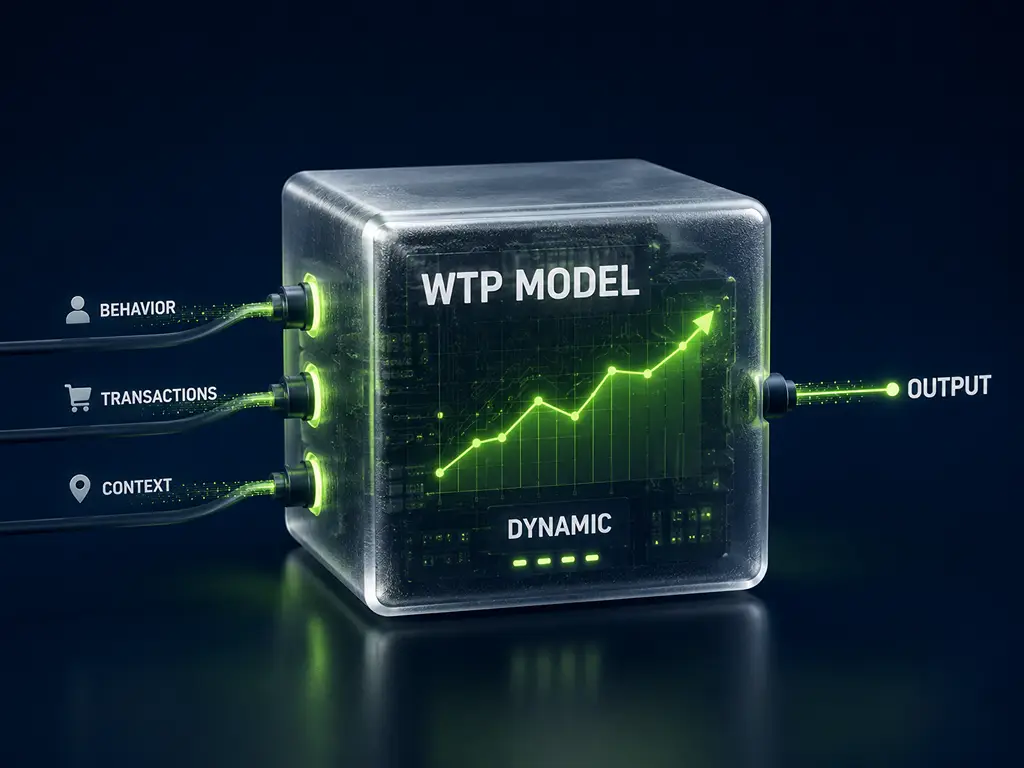
Once the data is collected, machine learning models go to work in three steps.
First, feature engineering transforms raw data into computable variables. Your ZIP code becomes a median-income estimate. Your device model becomes a spending-power signal. Your browsing patterns become a “price sensitivity score.”
Second, willingness-to-pay modeling estimates your individual price elasticity. The algorithm predicts: if we show this person $4.29, will they buy? What about $4.59? The model finds the ceiling for each product.
Third, real-time pricing decisions execute at millisecond speed. Amazon alone changes prices approximately 2.5 million times per day, adjusting based on user behavior signals, competitor pricing, and inventory levels — all processed simultaneously.
The FTC’s 6(b) investigation identified eight intermediary firms — including Mastercard, Revionics, Bloomreach, PROS, Accenture, and McKinsey — that provide retailers with the algorithmic infrastructure to run these pricing systems at scale.
The Price You See — Output and Execution
Online, the personalized price renders dynamically on the webpage. Different users loading the same product page see different numbers, generated in real time based on their profile.
In physical stores, the output mechanism increasingly relies on electronic shelf labels (ESLs) — small digital displays that replace paper price tags and can update prices centrally in seconds. Combined with store apps or loyalty-card identification at checkout, ESLs create the technical pathway for surveillance pricing to move from e-commerce into brick-and-mortar retail. This is where the technology becomes controversial, and it deserves a closer look.
Surveillance Pricing vs. Dynamic Pricing vs. Algorithmic Pricing — What’s the Difference?
These three terms appear constantly in news coverage and legislation, often used interchangeably. But they describe different things with different legal implications. Algorithmic pricing is the largest circle: any pricing system where a formula or model, rather than a human, sets the price. Inside that circle sit dynamic pricing and surveillance pricing — two subsets with fundamentally different data sources.
| Dimension | Surveillance Pricing | Dynamic Pricing | Algorithmic Pricing |
|---|---|---|---|
| Data source | Personal data — who you are | Market data — supply, demand, time | Any data + any formula |
| Pricing target | Individual — different prices per person | Uniform — same price for all in the same market condition | Depends entirely on algorithm design |
| Consumer visibility | Hidden — you can’t see what others pay | Visible — travelers understand surge pricing | Depends on disclosure policy |
| Typical use cases | E-commerce, retail with loyalty-card + ESL systems | Airlines, hotels, ride-sharing, event tickets | All automated pricing — from retail to B2B |
| Legal exposure (2026) | High — Maryland banned; NY, NJ, CA legislating | Medium — antitrust scrutiny on algorithmic collusion | Low — the tool itself is neutral |
| One-line summary | “Who you are determines your price” | “Market conditions determine the price” | “A machine calculated the price” |
The relationship matters because it explains why some legislation targets ESLs directly. Lawmakers are not worried about the display technology itself. They’re worried about the combination of ESLs (rapid price-update capability) plus consumer data infrastructure (personal profiling) creating a surveillance pricing pipeline inside physical stores.
Is Surveillance Pricing Legal? The 2026 Regulatory Landscape
The short answer: it depends where you are, and the map is changing fast.
At the federal level, there is no comprehensive ban. The FTC’s 6(b) study — launched in July 2024 with information demands sent to eight pricing-intermediary firms — published a preliminary staff research summary in January 2025 confirming that companies use consumer data to charge different prices for identical goods. However, the FTC under Chairman Andrew Ferguson has signaled a narrower, disclosure-focused approach rather than pursuing an outright federal prohibition. A bipartisan group of Senators (Warner, Hawley, Blumenthal, and Gallego) sent a letter in December 2025 urging the FTC to reopen the investigation and pursue enforcement.
The real action is at the state level. Over 70 bills have been introduced across more than two dozen states in 2026 alone. Here are the most consequential:
| Jurisdiction | Action | Status | Key Provision |
|---|---|---|---|
| Maryland | Protection from Predatory Pricing Act | ✅ Signed into law (April 2026, effective October 2026) | First state to ban surveillance pricing in grocery stores >15,000 sq ft and third-party delivery services |
| New York | Algorithmic Pricing Disclosure Act (GBL § 349-a) | ✅ Effective November 2025 | Requires clear disclosure when prices are algorithmically set using personal data; civil penalties up to $1,000 per violation |
| New Jersey | Fair Price Protection Act | 🟡 Passed both houses (June 2026), awaiting governor signature | Includes a one-year moratorium on new ESL installations in grocery stores |
| California | AB 446 (Surveillance Pricing Protection Act) | 🟡 Advancing through legislature | Would prohibit customized pricing based on personal data in grocery retail |
| Federal | Stop Price Gouging in Grocery Stores Act (H.R. 4966 / S. 3892) | 🟡 In committee | Would ban surveillance pricing AND electronic shelf labels in grocery stores >10,000 sq ft |
Notice something striking: ESLs — the digital price tags themselves — appear in multiple pieces of legislation, from New Jersey’s installation moratorium to the federal bill’s outright ban. The technology has become a legislative target, not because of what it does, but because of what lawmakers fear it enables.
Electronic Shelf Labels and Surveillance Pricing — Separating Technology from Abuse
Why Consumers Are Worried — And They’re Not Wrong
Consumer concern about ESLs didn’t come from nowhere. When Walmart announced plans to install electronic shelf labels in 2,300 stores, and Kroger expanded its own ESL deployment alongside its loyalty-card data infrastructure, consumer advocacy groups drew a direct line from digital price tags to surveillance pricing.
The United Food and Commercial Workers (UFCW) union launched a “Stop Electronic Shelf Labels” campaign, citing polling data showing 68% of consumers believe ESLs will increase grocery costs and 67% support banning the technology outright. New York Attorney General Letitia James held rallies framing ESLs as the physical instrument of surveillance pricing — and 66% of New York voters supported the state’s proposed ban.
The worry is rational. If a store can change prices instantly, and it also knows who you are through your loyalty card or store app, what stops it from showing you a different price than the person behind you in line? When the Stop Price Gouging in Grocery Stores Act proposes banning ESLs alongside its surveillance pricing prohibition, it treats the technology and the practice as a package deal — inseparable threats.
Why the Technology Itself Isn’t the Problem
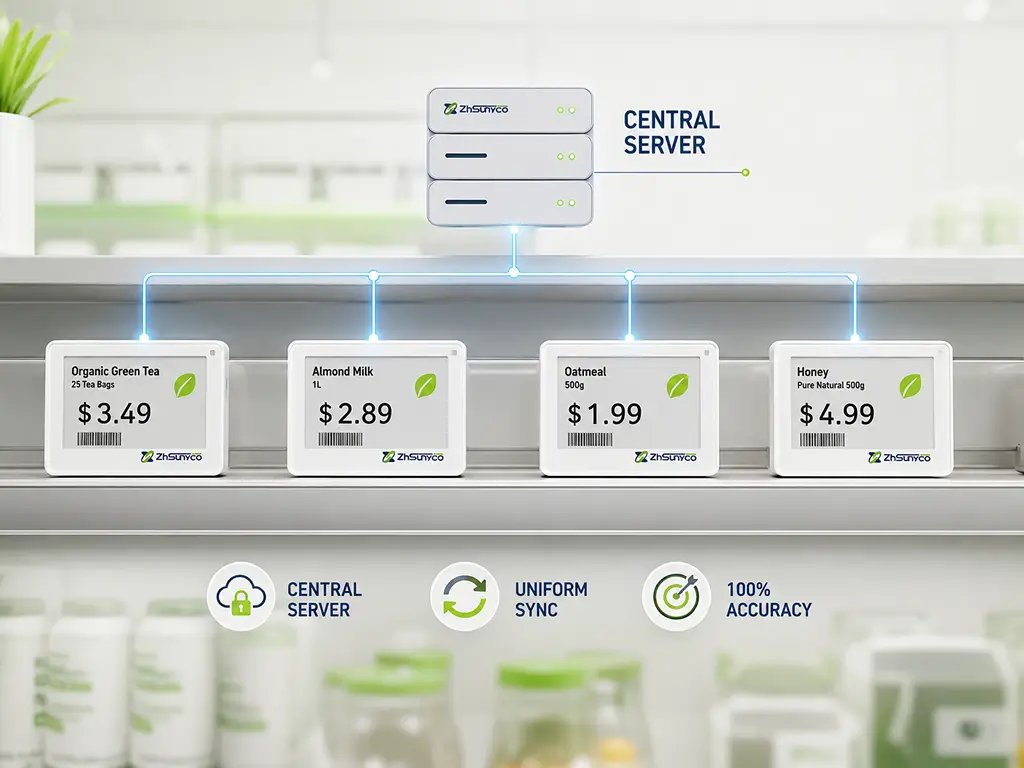
Here’s the distinction that gets lost in the legislative and media narrative: electronic shelf labels do not collect consumer data. They are display devices. They receive a price update signal from the retailer’s central management system and show it on a screen. An ESL in the dairy aisle doesn’t know who you are, doesn’t track your browsing history, and doesn’t calculate your willingness to pay.
The systems that do perform consumer surveillance — loyalty card databases, store WiFi tracking, Bluetooth beacons, mobile app location services, payment terminal analytics, and in-store cameras — are all independent of the ESL. They existed long before digital price tags arrived, and they would continue to function if every ESL were removed tomorrow.
What ESLs actually enable, when used as designed, is a fundamentally different set of outcomes:
- Uniform, real-time price updates — every tag in the store changes simultaneously to the same new price, eliminating the labor cost and error rate of manual paper-tag replacement across thousands of SKUs
- Online-to-offline price synchronization — the price you see on the website matches the price you see on the shelf. That’s transparency, not discrimination.
- Reduced pricing errors — manual paper-tag swaps produce mistakes; digital updates eliminate them, meaning consumers are more likely to be charged the correct price at checkout
The technology’s architecture matters. Well-designed ESL systems receive price data exclusively from the retailer’s own central management backend — the same price database that governs every channel. No consumer profile feeds into the display signal. The communication protocols that power ESLs (2.4GHz, BLE, WiFi, NFC, 433MHz) transmit display commands, not consumer data. The distinction is not subtle. It’s architectural.
Think of it as the difference between a highway and a speeding driver. A highway enables fast travel; it doesn’t decide whether someone obeys the speed limit. ESLs enable efficient price management; they don’t decide whether the retailer feeds consumer profiles into the pricing logic. The responsibility — and the regulatory target — should sit with the data governance decisions retailers make, not with the display hardware that shows the result.
For retailers evaluating pricing technology in today’s regulatory climate, the practical question isn’t “should I avoid digital price tags?” It’s “does my pricing system’s data architecture separate market-driven price logic from consumer profiling?” A transparent system architecture — where ESL displays show prices sourced from a unified retail management backend rather than from personal-data-driven algorithms — keeps the technology on the right side of the regulatory line. When evaluating suppliers, retailers should look for open SDK and API access that gives them full visibility into the pricing logic, rather than accepting black-box systems where the data flow is obscured. Some ESL manufacturers, such as Zhsunyco, have built their system architecture around this principle: price data originates exclusively from the retailer’s central management backend, and the communication protocols that drive the displays carry no consumer-profile information. In practice, this means a retailer using such a system can demonstrate to regulators and customers alike that their digital price tags serve operational efficiency — not personalized price discrimination.
The conversation about surveillance pricing is important, and the consumer anxiety driving it is real. But conflating the display technology with the data practice doesn’t protect shoppers. It just makes it harder for retailers to adopt tools that genuinely improve pricing accuracy, operational efficiency, and price transparency for everyone.
References
- Federal Trade Commission. “Surveillance Pricing 6(b) Study — Preliminary Staff Research Summary.” January 2025. ftc.gov
- Cornell Law School Legal Information Institute. “Surveillance Pricing.” law.cornell.edu
- American Bar Association, Antitrust Law Source. “When Pricing Gets Personal.” April 2026. americanbar.org
- Kelley Drye Ad Law Access. “Surveillance Pricing: Key Concepts.” April 2026. kelleydrye.com
- EPIC. “Kroger’s Surveillance Pricing Harms Consumers.” epic.org
- WRVO Public Media. “Electronic Shelf Labels Leave Concerns.” February 2026. wrvo.org
- UFCW. “Support Affordable Groceries.” ufcw.org
- New York Times. “Why ‘Surveillance Pricing’ Strikes a Nerve.” November 2025. nytimes.com

 English
  Russian
  Spanish
  German
  Arabic
  French
  Bulgarian
  Polish
  Romanian
  Turkish
  Portuguese