


What Is Retail Pricing? A Clear Guide to Strategies, Formulas, and Modern Technology
Retail pricing is the final price a consumer pays when buying a product from a store — but that definition only scratches the surface. Behind every price tag on every shelf sits a chain of decisions: what the product cost to make, what the distributor added along the way, what the retailer needs to cover their own expenses, and what the customer is actually willing to pay.
Take a bottle of water that costs a retailer $0.50 wholesale. Add a share of store overhead ($0.30) and a target profit ($0.20), and it lands on the shelf at $1.00. Every product on every shelf went through a version of this arithmetic — whether the retailer calculated it consciously or not.
Three terms tend to get tangled together, so let’s separate them:
- Retail price — the price the end consumer pays. This is the number on the shelf.
- Wholesale price — the price retailers pay to distributors or manufacturers. Typically 40–60% lower than retail, depending on the industry.
- MSRP (Manufacturer’s Suggested Retail Price) — a recommendation from the brand, not a mandate. In Europe and the UK, the equivalent term is RRP (Recommended Retail Price). Retailers can price above or below MSRP — though going too far in either direction has consequences for brand perception and margin.
The supply chain flows like this: Manufacturer → Wholesaler/Distributor → Retailer → Consumer. At each link, a markup is added. The retail price at the end of that chain isn’t arbitrary — it reflects the accumulated costs, competitive pressures, and strategic choices of every player before it.
Core Retail Pricing Strategies
Before you calculate a single price, decide how you’re going to price. The method you choose shapes everything — your margins, your customer base, and how you compete. Start with two questions: Is your product a price-sensitive commodity or a differentiated experience? And what are your competitors charging?

Cost-Plus and Markup Pricing
Almost every retailer starts here. The formula is simple:
Retail Price = Cost × (1 + Markup Percentage)
If a product costs you $10 and you apply a 50% markup, it goes on the shelf at $15. The best-known variation is keystone pricing — doubling the wholesale cost for a 100% markup, which yields a 50% profit margin. Keystone began in the department-store era and remains the default starting point for many independent retailers today.
The appeal is obvious: it’s simple, predictable, and guarantees you won’t sell below cost. The limitation is equally obvious: it ignores what competitors charge and what customers are willing to pay. A $25 candle keystoned to $50 makes sense in a spreadsheet — until the shop next door sells a comparable candle for $35.
Competitor-Based Pricing
This approach shifts the reference point from your own costs to the market around you. It comes in three flavors:
- Below competition (discount pricing): You deliberately price lower than rivals. Effective in price-sensitive markets, but markups can dip below 20% — volume has to make up the difference.
- At the going rate: You match the prevailing market price. Common in categories where products are hard to differentiate — gasoline, staple groceries, basic hardware.
- Above competition (premium pricing): You price higher and justify it with a superior experience, brand reputation, or product quality. Premium fashion and luxury goods routinely carry markups of 70–80% or more — but only when the brand story supports the price.
Competitor-based pricing keeps you grounded in reality, but it has a trap: your cost structure isn’t the same as your competitor’s. Copying their prices while carrying higher overhead is a slow bleed.
Value-Based and Psychological Pricing
The most sophisticated retailers don’t price based on cost or competitors — they price based on what the customer perceives the product is worth. The same bottle of water costs $1 at a convenience store, $3 at an airport, and $7 in a hotel minibar. The water didn’t change — the context and perceived value did.
Psychological pricing techniques build on this insight:
- Charm pricing: $9.99 consistently outperforms $10.00. Research from William Poundstone’s Priceless found that prices ending in .99 can lift sales by 8–24% depending on the category — the left-digit effect makes the brain round down.
- Anchor pricing: Showing the original price ($100) next to the sale price ($65) makes the discount feel concrete and compelling. But there’s a legal boundary: in the European Union, the “original” price must have been the actual selling price within the last 30 days — fabricated anchors are illegal.
- Bundle pricing: Three for $25 feels like a better deal than $8.50 each, even when the math barely differs. Bundles increase basket size while making the customer feel smart.
How to Calculate Your Retail Price
Strategy sets the direction. Formulas turn strategy into a number on a shelf. If you take one thing from this section, let it be this: markup and margin are not the same thing, and confusing them is the most expensive arithmetic mistake in retail.

The Two Formulas Every Retailer Needs
There are two ways to calculate a retail price, and they serve different purposes:
Markup-based pricing (for setting the tag):
Retail Price = Cost × (1 + Markup Percentage)
Example: A jacket costs you $30 wholesale. You want a 60% markup. $30 × 1.60 = $48 on the shelf.
Margin-based pricing (for hitting a profit target):
Retail Price = Cost ÷ (1 − Target Margin)
Example: Same $30 jacket. You need a 40% profit margin. $30 ÷ (1 − 0.40) = $30 ÷ 0.60 = $50 on the shelf.
Notice the gap: same product, same cost, but the two formulas give different answers — $48 vs. $50. That $2 difference is the gap between “I added 60% to my cost” and “I built in a 40% profit.” Neither is wrong, but they’re not interchangeable. If you use the markup formula thinking you’re getting a 60% profit, you’ve already made the mistake this section exists to prevent.
A word on what counts as “cost”: it’s not just the wholesale price. Factor in shipping, platform fees, payment processing (typically 2.5–3.5% per transaction), and a realistic allowance for returns. Skip these and you end up with profitable spreadsheets and empty bank accounts.
Markup vs. Margin: The Mistake That Costs Money
Here is the most important arithmetic lesson in this article. Read it twice.
A 50% markup does not equal 50% profit. Markup is the percentage added to cost. Margin is the percentage of the final selling price that is profit. They are calculated from different bases:
| Markup % | Margin % |
|---|---|
| 25% | 20% |
| 50% | 33.3% |
| 100% (keystone) | 50% |
| 200% | 66.7% |
The formula: Margin = Markup ÷ (1 + Markup). A 100% markup → 100% ÷ (1 + 1.00) = 50% margin.
Here’s why this matters outside the spreadsheet. A clothing boutique owner buys a dress for $30, applies keystone pricing (100% markup), and sells it for $60. She tells her accountant she’s making “100% profit.” At year-end, her P&L shows 50% gross margin — and she can’t figure out where the other half went. It was never there. She had been reporting markup as margin the whole time, and every business decision she made — hiring, inventory buying, rent negotiation — was based on a profit number twice the real figure.
Always make business decisions on margin, not markup. Markup is for setting price tags. Margin is for understanding whether your business is actually making money.
How Technology Is Changing Retail Pricing
A brilliant pricing strategy is worthless if it takes your team three days and a battalion of label guns to execute. This is the part of the pricing conversation most guides ignore — and it’s the part that separates retailers who plan pricing from those who actually execute it.
Electronic Shelf Labels: The Hardware Behind Modern Pricing
Think about what happens when a 50,000-SKU supermarket needs to update 500 prices in a week. In the paper-label world: two employees, eight hours each, walking the aisles with printed sheets and label guns — 16 labor-hours, plus the inevitable errors from manual placement. By the time they finish, another dozen prices may have already changed upstream.
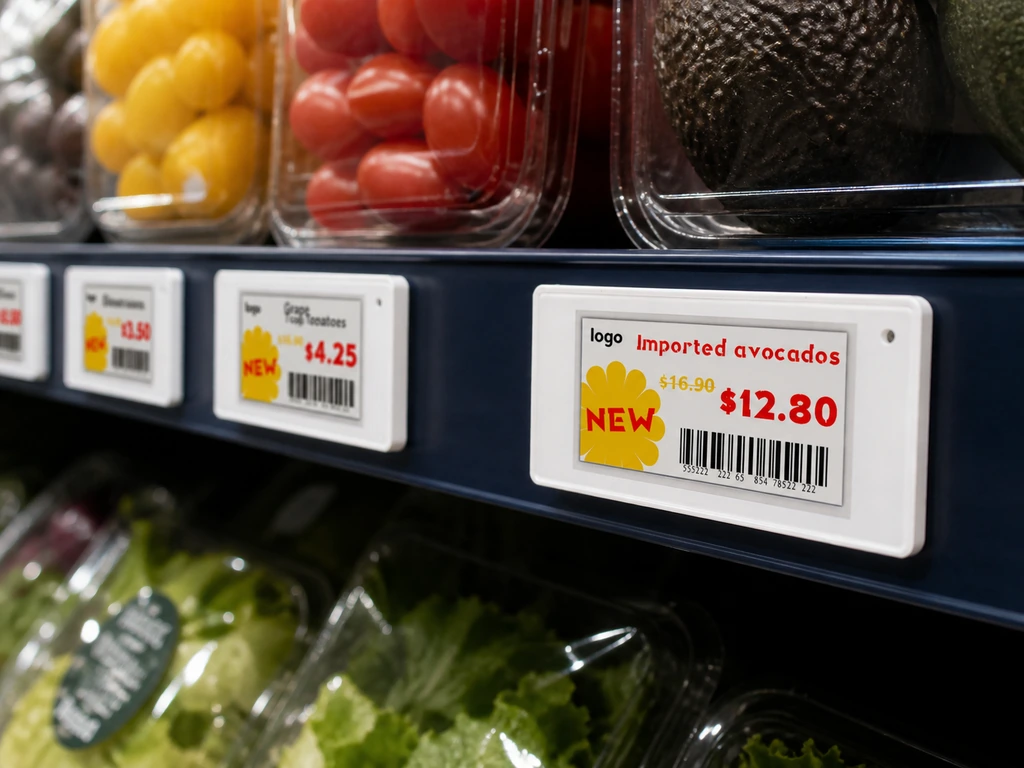
Electronic Shelf Labels (ESLs) remove this bottleneck. An ESL is a battery-powered e-ink display — the same screen technology as a Kindle — that replaces a paper price tag on the shelf edge. Connected wirelessly to a central management system, all 50,000 labels in a store can update simultaneously in minutes. Price changes, promotions, and markdowns happen at the speed of software, not the speed of walking.
The adoption numbers tell the story. The global ESL market was valued at approximately $2.1 billion in 2025 and is projected to reach $7.3–8.8 billion by 2033, growing at roughly 17% annually (Maia Research, 2025). Walmart has deployed ESLs across more than 2,300 stores. Woolworths in Australia has installed approximately 17 million labels across over 600 locations, making it one of the largest ESL deployments globally (ABC News Australia, 2026). Kroger, Whole Foods, and Amazon Fresh have all followed suit.
What do retailers get in return? Three concrete gains: (1) labor savings — stores consistently report 10+ hours per week freed from manual label changes, (2) price accuracy — what’s on the shelf matches what’s at the register and what’s online, and (3) sustainability — eliminating paper labels reduces waste and carbon footprint. For context, each 2.9-inch electronic tag can save approximately 0.0002 trees per year in paper consumption alone.
Different retail environments call for different wireless protocols. Medium-to-large supermarkets often use 2.4GHz systems with frequency-hopping spread spectrum (FHSS) for anti-interference and 13–15 meter range. Sub-GHz 433MHz solutions offer stronger wall penetration for multi-floor stores. Small retailers can use Bluetooth Low Energy (BLE) or NFC tags managed directly from a smartphone — no infrastructure needed. Large-format displays for warehousing or outdoor use run on WiFi with rechargeable batteries lasting five years or more. The technology landscape is broad because retail itself is broad — a convenience store and a hypermarket have fundamentally different needs.
For retailers evaluating ESL adoption, the key is matching the wireless protocol to the store environment — a 50,000-SKU hypermarket, a multi-floor department store, and a corner boutique each need different hardware. Providers like ZhSunyco® offer ESL hardware solutions across 2.4GHz, 433MHz, BLE, and NFC protocols, covering the full spectrum from enterprise-scale FHSS systems to smartphone-managed BLE tags for small retailers, with deployments documented in real-world retail case studies across supermarkets, warehouses, and specialty stores globally.
Dynamic Pricing: What It Really Means for Retailers
When people hear “dynamic pricing,” they picture Uber surge pricing — the 2.5× multiplier on a rainy Friday night. That association has created real anxiety about ESLs. US Senators have introduced legislation seeking to ban digital shelf labels in large grocery stores, and Australian consumer groups have pressed major supermarkets to rule out dynamic pricing entirely (Inside Retail, 2026).
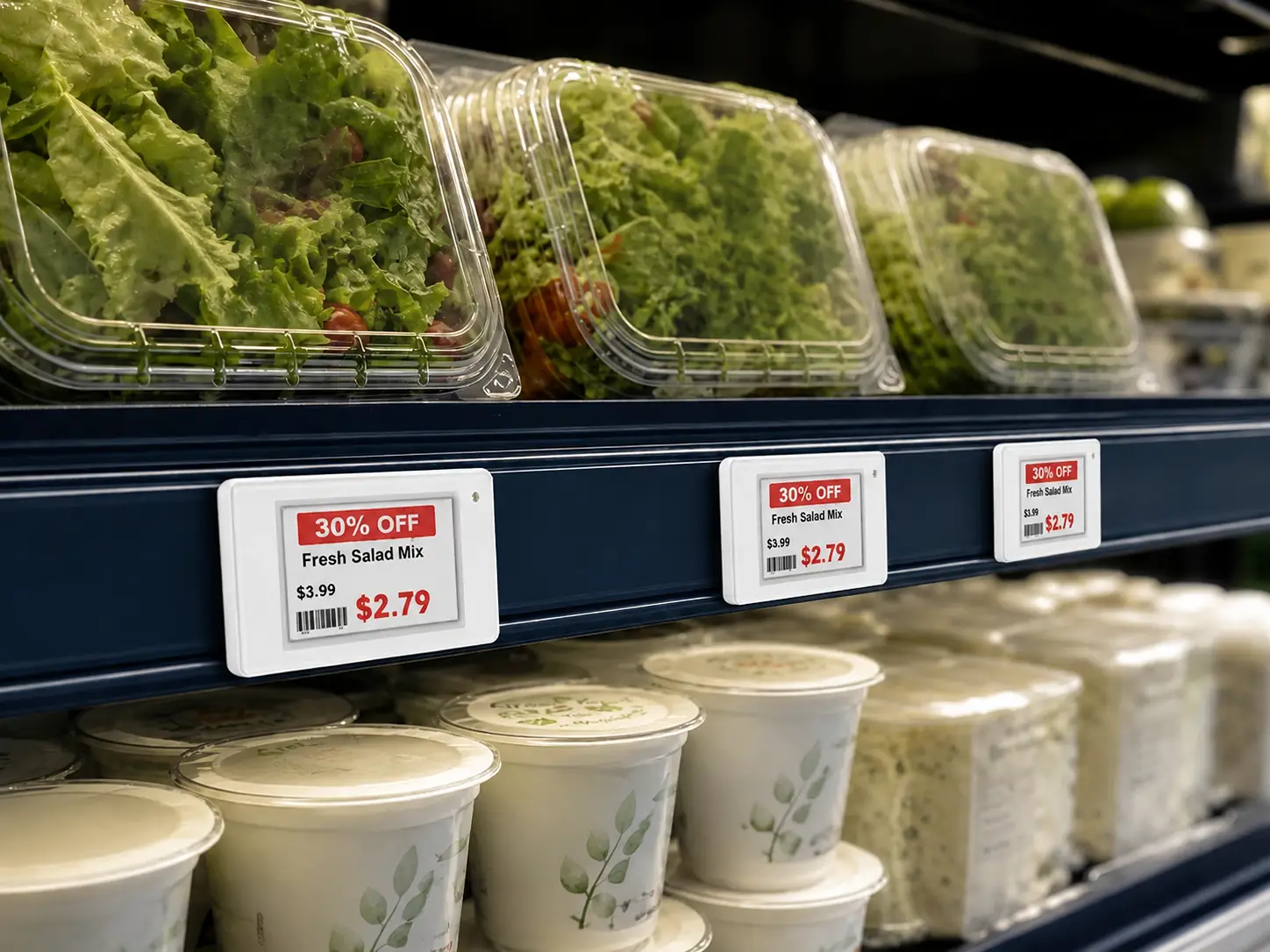
But the reality of retail dynamic pricing is almost the opposite of surge pricing. Most dynamic pricing in physical retail is downward — markdowns on perishable food approaching its sell-by date, end-of-season clearance, promotions tied to inventory levels. The UK surplus supermarket Company Shop uses ESLs precisely this way: prices drop automatically as products near expiration, reducing food waste while giving customers genuine bargains.
The most rigorous evidence comes from an academic study affiliated with Bocconi University, published on SSRN in May 2025. Researchers analyzed transaction data from a $3 billion US grocery chain that rolled out ESLs across more than 100 stores, validated against NielsenIQ scanner data from other retailers in the same states. Their finding: temporary price surges affected approximately 0.0042% of products — about 4 in every 100,000 — before ESL adoption, and the rate after adoption showed no statistically significant change (p-value = 0.90). The fear that ESLs enable widespread surge pricing is not supported by the data (Stamatopoulos, Sanders & Bray, SSRN, 2025).
That doesn’t mean the fear is irrational — the capability exists, and regulatory attention is appropriate. But for the retailer evaluating whether to adopt ESL technology, the operational evidence points in one direction: the real-world use case is efficiency, not exploitation.
Retail Pricing Best Practices
If you take nothing else from this guide, take these five habits. They’re the difference between pricing that drifts and pricing that performs.
| # | Best Practice | Why It Matters |
|---|---|---|
| 1 | Know your true cost — include shipping, fees, returns allowance, and labor, not just wholesale price | Underpricing from hidden costs is the #1 killer of small retailers. If your “cost” is incomplete, your “profit” is imaginary. |
| 2 | Match strategy to product role — your key value items (KVIs) need competitive pricing; your margin drivers can run higher | Customers price-check your KVIs. One pricing method for every SKU leaves money on the table. |
| 3 | Monitor competitors, don’t copy them | Your cost structure, value proposition, and customer base are different. Blindly matching prices means importing someone else’s margin structure. |
| 4 | Review prices quarterly, not annually | Supply chain costs move faster than annual cycles. In inflationary environments, monthly reviews are the minimum for margin protection. |
| 5 | Invest in pricing execution, not just strategy | A great strategy executed slowly is worse than a decent strategy executed instantly. The gap between “what we decided” and “what’s actually on the shelf” is where margin leaks. |
References
- Maia Research. “Global Electronic Shelf Label ESL System Industry Trends Analysis Report 2025, Forecast to 2033.” 2025. https://www.marketresearch.com/Maia-Research-v4212/Global-Electronic-Shelf-Label-ESL-43434350/
- ABC News Australia. “Digital price tags bring online-style ‘dynamic pricing’ to supermarkets.” March 2026. https://www.abc.net.au/news/science/2026-03-04/digital-price-tags-bring-dynamic-pricing-to-local-shops/106386330
- Inside Retail. “Coles, Woolworths refuse to rule out dynamic pricing.” March 2026. https://insideretail.com.au/business/strategy/coles-woolworths-refuse-to-rule-out-dynamic-pricing-202603
- Stamatopoulos, I., Sanders, R.E., & Bray, R. “Electronic Shelf Labels Have Not Led to Surge Pricing in US Grocery Retail, Despite Regulator Concerns.” SSRN, May 2025. https://papers.ssrn.com/sol3/papers.cfm?abstract_id=5271491
- Lumen Learning. “Retail Pricing Strategies.” https://courses.lumenlearning.com/wm-retailmanagement/chapter/retail-pricing-strategies/
- ZhSunyco®. “ESL Hardware Solutions.” https://www.zhsunyco.com/esl/
- ZhSunyco®. “Case Studies.” https://www.zhsunyco.com/case-studies/
- ZhSunyco®. Official Website. https://www.zhsunyco.com/

 English
  Russian
  Spanish
  German
  Arabic
  French
  Bulgarian
  Polish
  Romanian
  Turkish
  Portuguese