


What Is MAP Pricing in Retail? The Complete Guide to Minimum Advertised Price Strategy
What Is MAP Pricing in Retail?
MAP Defined — The Advertising Floor, Not the Selling Price
MAP stands for Minimum Advertised Price — and every word in that phrase matters. It is the lowest price a manufacturer or brand permits any retailer to publicly advertise for a product. The key word is advertised. MAP does not control what happens at the cash register. It controls what price you’re allowed to show in a store window, on a product page, in a Google Shopping listing, or inside a marketing email.

Here’s the distinction in practice: a brand sets a MAP of $49.99 for its flagship product. A retailer can sell that product for $39.99 at the checkout counter. What it cannot do is display “$39.99” on the shelf tag, on its website product page, or in a Facebook ad. This is why you’ve almost certainly encountered the phrase “Add to Cart to see price” while shopping online — it’s the most common workaround retailers use to sell below MAP without technically advertising a price below MAP.
MAP policies operate through Authorized Reseller Agreements — contracts between the brand and its retail partners. MAP isn’t a government-imposed price control. It’s a private, contractual obligation that retailers accept in exchange for the right to carry the brand’s products. Break it, and the brand can stop supplying you. That leverage is what makes MAP enforceable, even though no law requires retailers to follow it.
MAP vs. MSRP — Two Terms Every Retailer Must Keep Straight
If you’ve spent any time around retail pricing, you’ve encountered MSRP — the Manufacturer’s Suggested Retail Price. The two terms sound similar, but they serve fundamentally different purposes. Confusing them leads to expensive mistakes.
| Aspect | MAP (Minimum Advertised Price) | MSRP (Manufacturer’s Suggested Retail Price) |
|---|---|---|
| What it controls | The lowest price you can advertise | A recommended selling price |
| Is it enforceable? | Yes — through contracts and supply agreements | No — it’s a suggestion only |
| Can you sell below it? | Yes, just can’t advertise the lower price | Yes, freely — it’s not binding |
| Who sets it? | Brand, unilaterally | Brand, as a reference point |
| Legal status (US) | Generally legal under federal antitrust law if unilateral | Legal — it’s non-binding advice |
Think of it this way: MSRP tells you what the brand hopes you’ll charge. MAP tells you the cheapest number you’re allowed to say out loud. MSRP is sometimes called RRP (Recommended Retail Price) in the UK and Europe, or “sticker price” in everyday American consumer language. The terms differ by region, but the concept stays the same: a suggestion, not a rule.
MAP vs. iMAP — When the Store Moves Online
iMAP — Internet Minimum Advertised Price — is MAP’s digital-native sibling. It applies the same advertising-floor logic specifically to online channels: e-commerce product pages, Google Shopping and Bing Shopping ads, social media shopping posts, email marketing, and affiliate landing pages.
Why does the internet need its own MAP variant? Because online pricing operates under fundamentally different physics than physical retail. In a brick-and-mortar store, if a competitor quietly lowers a price, only the customers who walk through that door ever know. Online, a price change is detected by crawler bots within hours — sometimes minutes — and propagates across price comparison engines instantly. The same discount that would have been a local competitive advantage offline becomes a global race to the bottom online.
Modern MAP monitoring tools like Prisync, PriceMole, and MetricsCart have emerged specifically to handle this speed differential. Leading tools now scan prices up to six times per day, automatically capture timestamped screenshots as evidence, and generate real-time violation alerts — capabilities that would be science fiction in a manual-monitoring world.
Why Do Brands Enforce MAP Policies?
Brands don’t create MAP policies because they enjoy policing their retail partners. They do it because the alternative — unrestricted price advertising — predictably destroys the value they’ve spent years building. Four forces drive the decision.

Brand value protection. When a product gets advertised at ever-lower prices across different channels, consumers draw a simple conclusion: if it’s always on sale, it was never worth the full price. This is particularly existential for premium and luxury brands, where perceived value is the entire product. But it matters for mid-market brands too — consistent pricing signals reliability, and reliability builds trust.
A level playing field for all retailers. Without MAP, a large online discounter can advertise prices below what a small independent store pays at wholesale. The independent store becomes a free showroom — customers browse in person, then buy from the discounter. MAP prevents this dynamic by ensuring everyone plays by the same advertising rules, regardless of buying power.
Margin stability. McKinsey found that nearly 40% of consumers switch retailers specifically to get better deals (McKinsey & Company, 2024). When one retailer drops a price, the pressure on everyone else to match is immediate. Without MAP, this pricing chain reaction compresses margins across the entire channel until nobody makes money on the product. At that point, retailers stop stocking it, and the brand loses distribution.
Customer trust. A shopper who buys a product for $79.99 and then sees it advertised elsewhere for $59.99 doesn’t think “I should have shopped around.” They think the brand is inconsistent, or that the retailer who charged more is dishonest. Consistent advertised pricing across channels eliminates this experience — and the erosion of trust that comes with it.
Real-world results back this up: Rev-A-Shelf, an American home storage manufacturer, reduced daily MAP violations by 87% and saw average advertised prices increase by up to 47% within a year of implementing a structured MAP enforcement program (Rev-A-Shelf case study). Earthbath, a pet grooming products brand, filtered out 42% of violating sellers after introducing MAP, leading to a 93% drop in daily violations and a 30% increase in retail margins across its authorized channel.
How a MAP Policy Works — Creation, Enforcement, and Penalties
Creating a MAP Policy — The Brand’s Step-by-Step Playbook
A MAP policy is not a template you download and fill in. It’s a legal and commercial document that reflects specific decisions about your brand positioning, your channel strategy, and your tolerance for enforcement costs. Done properly, it follows six sequential steps.
Step 1: Determine your MAP price. This isn’t arbitrary. Set the MAP floor based on production costs, target brand positioning, competitor pricing analysis, and — critically — the margin your retail partners need to stay profitable selling your product. Set MAP too high and retailers won’t bother stocking you. Set it too low and you’ve given away the price protection you created the policy to provide.
Step 2: Work with a lawyer. MAP policies live in antitrust territory. In the United States, the policy must be demonstrably unilateral — meaning the brand created it independently, without consulting or negotiating with any retailer about what the price floor should be. An antitrust attorney will ensure your policy includes a Unilateral Policy Statement explicitly declaring this independence. This isn’t boilerplate — it’s the difference between a legal MAP program and illegal price-fixing.
Step 3: Define product scope and advertising restrictions. List every covered SKU explicitly. Specify which advertising channels fall under the policy — online product pages, print catalogs, TV and radio ads, social media promotions, email marketing. Ambiguity here creates loopholes that violators will exploit.
Step 4: Design the penalty ladder. A standard three-tier escalation works for most brands: first violation gets a written warning with a 48-hour correction window; second violation triggers a 30-day suspension of new-product allocations and co-op marketing funds; third violation results in termination of authorized retailer status and permanent supply cutoff. The key is consistency — every retailer faces the same consequences for the same violation, every time. Selective enforcement is not only ineffective, it can create legal exposure.
Step 5: Include promotional waiver terms. Black Friday exists. So do seasonal clearances. Your MAP policy should include a mechanism for temporary, clearly-dated promotional exceptions — communicated to all retailers simultaneously, with the same terms for everyone.
Step 6: Deploy monitoring and establish a review cadence. A MAP policy is a living document. Market conditions change, competitors enter and exit, production costs shift. Schedule an annual review — at minimum — and communicate any changes to all authorized retailers at once.
Enforcement in Action — How Brands Monitor, Warn, and Penalize Violators
Writing the policy is approximately 10% of the work. The remaining 90% is enforcement — and this is where most brands underestimate the commitment.
Monitoring is the foundation. Modern automated tools scan online prices up to six times daily across domestic and international marketplaces, capturing timestamped screenshots and seller details to build a legally defensible audit trail. Manual monitoring, by contrast, hits a hard ceiling: one full-time employee can realistically track about 200 to 300 SKUs across five to eight platforms. For brands with thousands of SKUs distributed across dozens of channels, manual monitoring isn’t a cost-saving measure — it’s selective blindness.
Evidence collection matters because screenshots without timestamps and seller identification have no enforcement value. A proper audit trail answers three questions: what price was displayed, when was it captured, and which seller displayed it. Without all three, a violation notice is a request, not a demand.
The penalty escalator works only when enforced consistently. The three-tier model — warning, suspension, termination — creates predictable consequences that retailers can factor into their own risk calculations. The goal isn’t to punish; it’s to make compliance the economically rational choice. When a retailer knows that a few dollars of discount-driven margin will cost them their authorized status and supply, the math does the enforcing for you.
The grey areas deserve special attention. Retailers have developed sophisticated workarounds: bundling a MAP-protected product with a “free” accessory to effectively lower the total price, charging inflated shipping fees to recoup a product discount, or hiding lower prices behind member-login walls. Your monitoring system needs to catch these too — not just the obvious violations.
The Legal Side of MAP Pricing — What Retailers and Brands Must Know
MAP is generally legal — under specific conditions. The “specific conditions” part is where the complexity lives, and the rules vary dramatically by jurisdiction.
| Region | MAP Legal Status | Key Condition or Precedent | Practical Implication |
|---|---|---|---|
| United States | Generally legal | 2007 Leegin Supreme Court ruling: vertical price restraints judged under “rule of reason,” not automatically illegal. Must be unilateral — no retailer consultation on price floors. | Brands can enforce MAP provided the policy is independently created and uniformly applied. Consulting retailers on pricing = illegal price-fixing. |
| European Union / UK | Largely restricted | MAP-style clauses treated similarly to Resale Price Maintenance (RPM) under EU competition law. France fined 10 appliance manufacturers €611 million in December 2024 for fixing both advertised AND final selling prices over a 13-year period. | EU-based brands should seek specialized legal counsel before implementing any MAP policy. The risk is real and the penalties are severe. |
| Canada | Conditional | MAP can be challenged as illegal “price influence” unless the brand can document that retailers retain full pricing freedom and the policy is unilaterally issued. | Document everything. Retailer pricing autonomy must be demonstrable. |
| Australia / New Zealand | Under active scrutiny | The ACCC pursued Hard Rock in April 2025 for allegedly threatening retailers over advertised prices — signaling that vertical price restraints are an enforcement priority. | Treat MAP as a high-risk activity in this region. |
| Asia (China, Japan, India) | Treated as vertical restraint | Brands typically rely on advisory price guides and marketplace takedown requests rather than formal MAP contracts. | The MAP playbook that works in the US does not automatically translate. |
The bottom line: MAP’s legality is not a binary yes or no. It depends on how the policy is created, how it’s enforced, and where the products are sold. The single most important discipline — across every jurisdiction — is that the brand must act unilaterally. The moment a manufacturer sits down with retailers to agree on a price floor, it has crossed from legal MAP enforcement into illegal horizontal price-fixing. That line is bright, and crossing it carries criminal exposure in multiple jurisdictions.
The Hidden Challenge — Why Manual Pricing Makes MAP Compliance Nearly Impossible
Most discussions of MAP pricing share a blind spot. They treat MAP as a policy problem with a software solution — draft the document, deploy the monitoring tool, enforce the penalties. But for any retailer operating physical stores, there is a deeper layer that software alone cannot reach: the price tags themselves are still pieces of paper.
The Speed Gap — When Your Price Tags Lag Days Behind Your Pricing Decisions
Consider a mid-size retail chain with 50 locations, each carrying an average of 2,000 price-labeled SKUs. In a typical week, 8% to 12% of those SKUs need a price change — promotions launching or ending, MAP updates from suppliers, competitive adjustments. That’s 8,000 to 12,000 price tags that need to be physically replaced, across 50 different buildings.
A single price-tag change — printing the new label, walking to the correct aisle, locating the correct shelf position, removing the old tag, placing the new one, verifying it’s straight and legible — takes an average of three to five minutes when done carefully. At four minutes per tag, those 10,000 weekly changes require 667 labor hours. That’s nearly 17 full-time employees doing nothing but changing price tags — and it still means most tags get updated once per week at best.
During the gap between when a MAP price changes and when the corresponding shelf label gets updated — which could be six days in a weekly-update cycle — every customer who sees that outdated label is witnessing a potential MAP violation. The price in the brand’s system says one thing. The price on the shelf says another. And the retailer may not even know.
Research from IHL Group shows that retail store price inconsistency — where the shelf price doesn’t match the system price — affects an average of 2% to 4% of SKUs during normal operations, climbing above 8% during peak promotional periods (IHL Group & Brain Corp, 2025). At those rates, a 50-store chain with 100,000 total price labels has 2,000 to 4,000 incorrect prices on its shelves at any given moment. Every one of those that falls below MAP on a protected product is a compliance failure waiting to be discovered.
The Accuracy Gap — One Mispriced Shelf Label Can Trigger a MAP Violation
Speed isn’t the only problem. Accuracy is arguably worse, because speed issues are visible and predictable — you know the tags are a week old. Accuracy failures are invisible. They happen one at a time, silently, in aisle 7, when an associate places a $39.99 tag on the hook meant for the $49.99 product one SKU over.
Manual shelf-label management has a documented error rate of 1% to 3%, covering misplaced tags, missed replacements after promotions end, and simple human mistakes during high-volume changeovers. In that same 100,000-label environment, 1% means 1,000 wrong prices. If even 10% of those errors involve MAP-protected products where the displayed price sits below the floor, that’s 100 MAP violations occurring right now — not because any retailer made a strategic decision to discount, but because someone was tired, distracted, or trying to finish a 200-tag changeover before their shift ended.
Promotional residue makes this worse. A weekend sale ends on Sunday. The system prices revert on Monday morning. But the shelf tags? Those get changed when someone has time — maybe Tuesday, maybe Thursday. Every hour those sale tags remain on the shelf after the promotion expires, the product is being advertised below MAP.
The Scale Problem — Multi-Store, Multi-Currency Complexity
So far we’ve described a single country, single currency scenario. Add international operations and the complexity multiplies.
A brand sells the same product in the United States (MAP = $49.99), the European Union (MAP = €44.99), and Japan (MAP = ¥5,500). A retailer operating across all three markets needs to manage three different MAP floors, in three currencies subject to exchange-rate fluctuations, across three regulatory regimes with different legal definitions of what MAP even means. A pricing decision made at headquarters on Tuesday needs to propagate to shelf labels in Dallas, Düsseldorf, and Osaka — ideally on the same day, with zero errors, in full compliance with three sets of laws.
The operational reality is that most multi-market retailers run separate pricing processes per country, with different teams, different systems, and different update cadences. The idea that all of these can stay perfectly synchronized without automation is not optimistic — it’s physically impossible.
From Policy to Practice — Building a Technology-Enabled MAP Compliance System
Here is the uncomfortable truth that most MAP content avoids: a MAP policy can be drafted, signed, and distributed in a single day. But making it real — ensuring every price on every shelf in every store matches what the policy requires — is not a document problem. It’s a physics problem. Information moves at the speed of light; paper price tags move at the speed of a person walking down an aisle with a label printer.

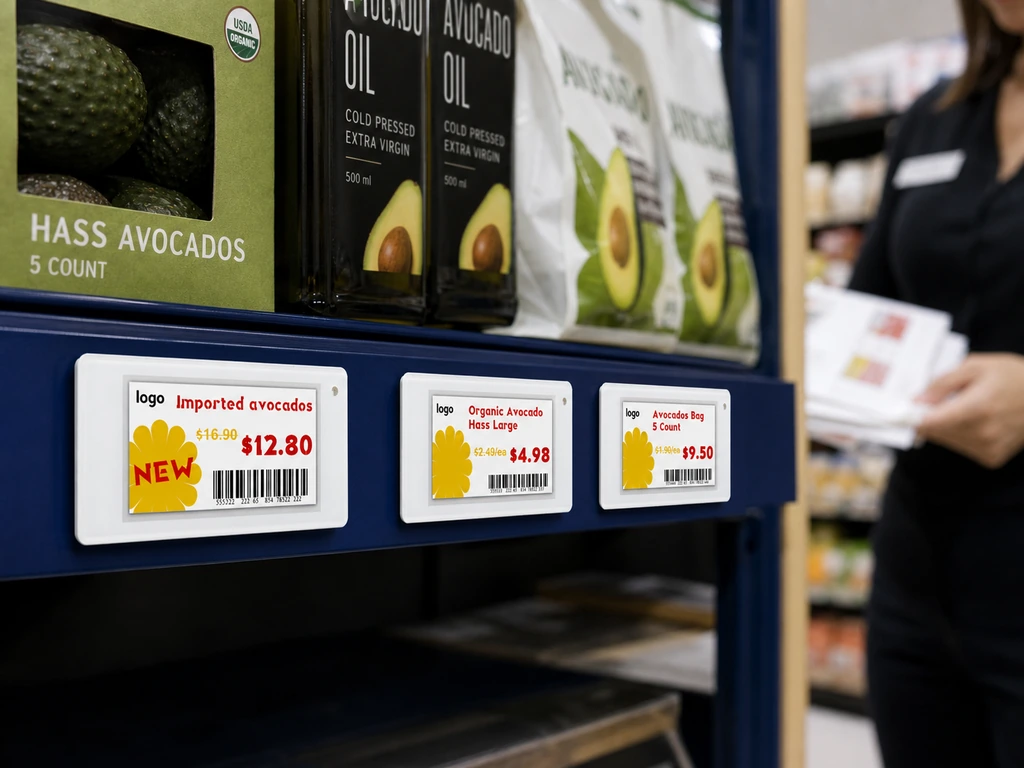
The solution has three layers. Layer one is monitoring — software tools that continuously scan online and marketplace prices, flagging violations in near real-time. This layer is well-served by the existing market. The tools work, and they’ve become table stakes for any brand serious about MAP. Layer two is management — a centralized pricing platform where a single price change propagates to every sales channel simultaneously. One update, one source of truth, one audit trail. Without this, your monitoring layer will find violations faster than your operations team can fix them. Layer three — and this is the layer the industry conversation has largely missed — is execution at the physical shelf. Electronic shelf labels (ESLs) replace paper tags with e-ink displays that update in seconds from a central system. A MAP price change that would have taken a week and 600 labor hours to implement across 50 stores now happens in under a minute, with every label updating simultaneously and every change automatically logged with a timestamp, SKU, old price, and new price — a built-in compliance audit trail that paper can never provide.
The insight isn’t that technology makes MAP compliance easier. It’s that at a certain scale, technology is the only thing that makes MAP compliance possible. You cannot manually update tens of thousands of price tags fast enough, accurately enough, and consistently enough to keep pace with a MAP policy that updates in real time. The bottleneck isn’t your policy. It’s your shelf.
For organizations ready to close the gap at the physical shelf, electronic shelf label solutions from manufacturers like zhsunyco — a top-three ESL producer globally, serving over 400 retailers across 180 countries — offer a practical path forward. You can explore their electronic shelf label solutions or talk to a specialist about what a store-wide deployment would look like for your operation.

 English
  Russian
  Spanish
  German
  Arabic
  French
  Bulgarian
  Polish
  Romanian
  Turkish
  Portuguese