


Walmart’s Digital Price Tags and the ‘Surge Pricing’ Panic: What the Data Actually Shows
The “Surge Pricing” Firestorm: What Walmart’s ESL Rollout Actually Triggered
By the end of 2026, every one of Walmart’s roughly 4,600 U.S. stores will have swapped their paper price tags for small, e-ink digital displays. More than 2,300 locations already have them. Kroger, Whole Foods, and other major chains are following suit. The electronic shelf label, a technology that has been quietly powering European retail for over a decade, has suddenly become the center of a political firestorm in America.
The fear, articulated most forcefully by the United Food and Commercial Workers (UFCW) union, goes something like this: if a store can change prices instantly with a few keystrokes, what stops it from raising the price of bottled water during a heatwave, or charging more for ice cream on a Saturday afternoon? Senators Elizabeth Warren, Bob Casey, and Ben Ray Luján have voiced similar concerns, with Luján introducing federal legislation that would ban digital shelf labels in grocery stores larger than 10,000 square feet. The term that has stuck is “surge pricing,” borrowed from Uber’s playbook, and it carries all the consumer hostility that association implies.
Walmart’s response has been unequivocal. “No,” said COO Kieran Shanahan in June 2026, when asked directly whether the company planned to implement surge pricing. “We have a principle of everyday low price. We’ve had that since the company was started. It’s not our approach.” The company has stated that its digital shelf label system locks prices during store hours, allowing only decreases or rare error corrections during the shopping day. The labels, Walmart insists, do not interact with shoppers or collect personal information.
So which is it: a labor-saving efficiency tool, or the infrastructure for a surveillance-pricing dystopia? The answer requires looking past the headlines and into how ESL technology is actually designed.
What Electronic Shelf Labels Are Actually Built For
The gap between what ESLs can technically do and what they were designed to do is the key to understanding this entire debate. It is also the distinction most coverage has missed.
The System Architecture: What ESLs Are Engineered to Do
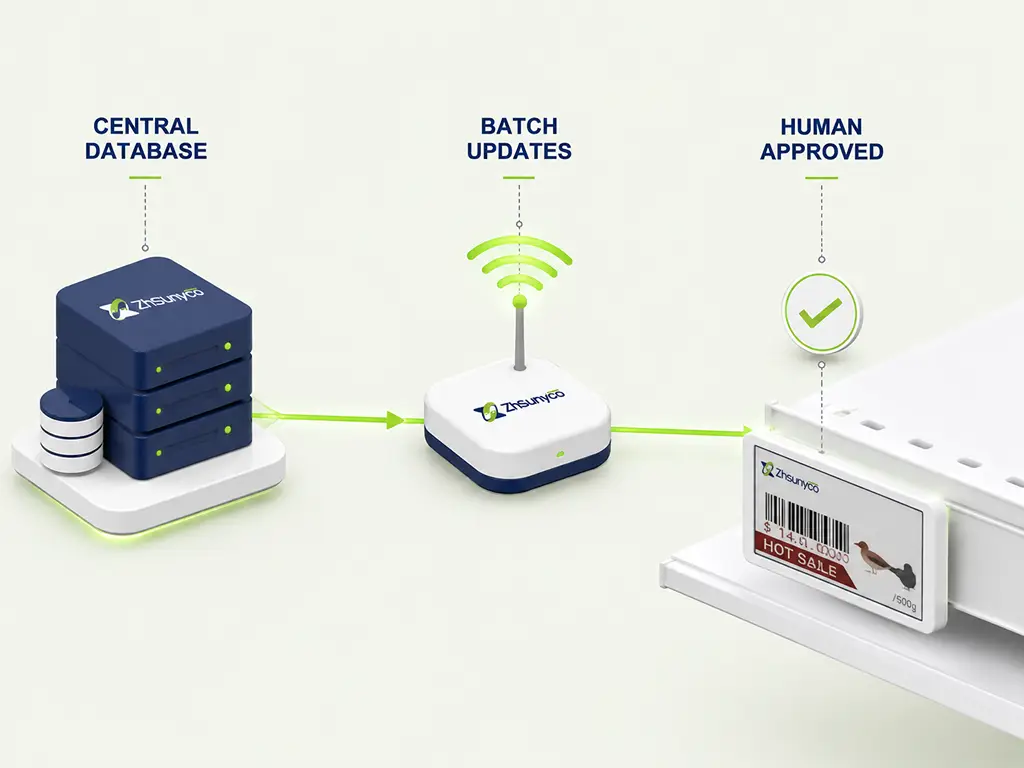
An ESL system is built around three components: the label itself (an e-ink display with a wireless module), a base station or access point that relays data, and management software that is the central price database. The workflow is straightforward: a pricing manager updates a price in the software → the change travels via local network or cloud to the base station → the base station broadcasts it to the relevant label via radio frequency (2.4GHz, 433MHz, BLE, or NFC, depending on the installation) → the label refreshes its display. That is the entire loop.
Two things about this architecture matter. First, it is a batch-driven, human-initiated process. Prices do not change autonomously. Someone in headquarters decides, approves, and pushes the update. Second, the e-ink display itself imposes a practical constraint: each label is rated for roughly 100,000 refresh cycles over its 5-to-10-year lifespan. Running thousands of daily price fluctuations per label would burn through that lifespan in months. The hardware’s physical design encodes an assumption of stability.
This is fundamentally different from the real-time, algorithmic bidding infrastructure that powers Uber’s surge pricing or Amazon’s dynamic repricing. Those systems are built for continuous, automated, individualized price variation. An ESL system is built for centralized, auditable, batch-synchronized price management. The capability for frequent updates exists, but it exists in the same way a smartphone’s capability to record audio exists. The presence of a microphone does not make every phone a surveillance device. Design intent matters.
Design Philosophy: Efficiency First, Pricing Second
If you browse the product documentation and ROI calculators of the world’s major ESL manufacturers — Pricer, VusionGroup (formerly SES-imagotag), SoluM, Hanshow, Zkong — you will notice a striking consistency. Not one of them markets “dynamic pricing capability” as a selling point. Every single ROI calculator leads with the same metric: labor hours saved.
This is not marketing coyness. It reflects the actual problem ESLs were invented to solve. In a typical mid-size supermarket, 2,000 to 3,000 prices change every week. Promotions, seasonal adjustments, supplier cost pass-throughs, clearance markdowns — all of it. With paper tags, each change requires a staff member to physically walk the aisle, locate the product, remove the old tag, and insert the new one. The process can take two days from decision to shelf. ESLs collapse that to minutes.
Some manufacturers take this philosophy a step further in their software design. Zhsunyco, a China-based ESL manufacturer serving over 180 countries, builds its management software around price synchronization and template management. The system is engineered for operational consistency, not consumer-profile-driven pricing. Its architecture does not include the kind of real-time, individualized pricing logic that “surveillance pricing” would require. That is not an accidental omission; it reflects a deliberate design choice about what an ESL system ought to be.
The Evidence: What the Data Says About ESLs and Pricing
Fear often outruns fact. When researchers actually looked at what happened in stores that adopted ESLs, the results told a story that bears little resemblance to the “surge pricing” narrative.
The Academic Verdict: No Surge Pricing Detected
In 2025, a joint research team from Northwestern University’s Kellogg School of Management, UT Austin, and UC San Diego published the most comprehensive study to date on ESLs and pricing behavior. They analyzed nearly 400 million transactions across 114 grocery stores over five years. That is a dataset large enough to detect even subtle pricing pattern shifts.
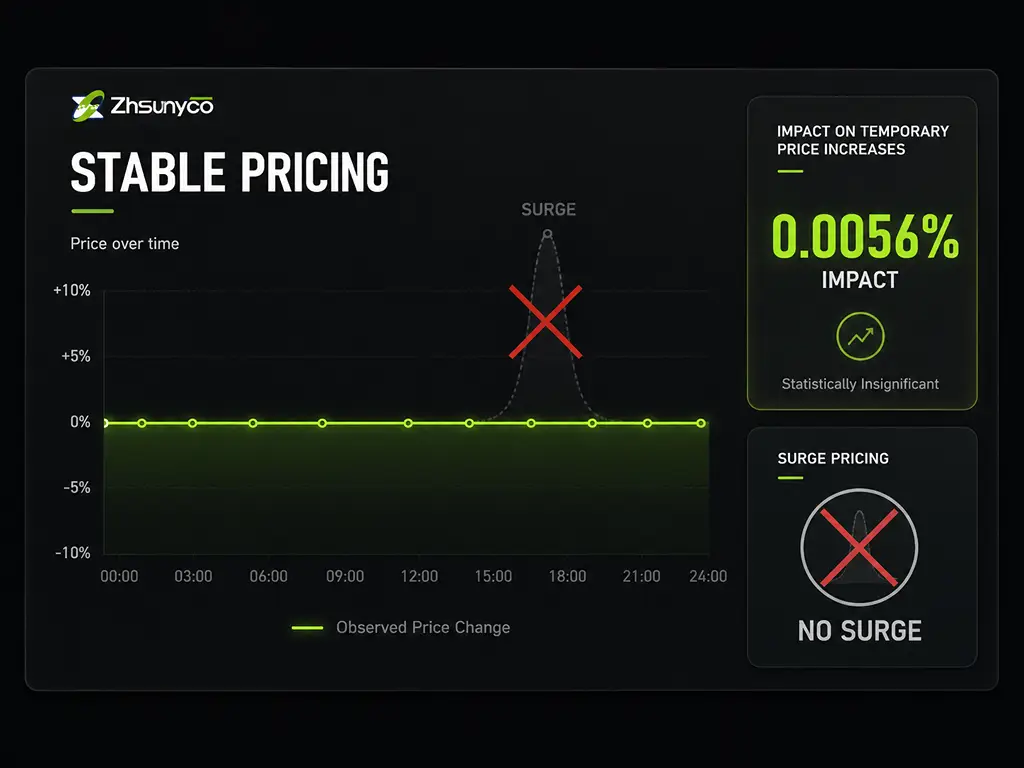
Their finding was unambiguous: surge pricing was virtually nonexistent both before and after ESL adoption. Temporary price increases affected only 0.005% of products per day before ESLs were installed. After installation, that figure rose by 0.0006 percentage points. The change is so small it is statistically indistinguishable from zero. If anything, the researchers observed a slight increase in the frequency of discounts after ESL deployment.
The economic logic behind this finding is straightforward, even if it rarely makes it into news coverage. A grocery store’s profit comes from long-term customer loyalty and basket size: the total value of everything a shopper puts in their cart, week after week. A few extra cents captured through a temporary price spike on one item means nothing if it drives that customer to a competitor for their next full shopping trip. Grocery retail is a relationship business measured in years, not a transaction business measured in clicks. Uber’s surge pricing model works precisely because most rides are one-off transactions with low switching costs. Grocery shopping is the opposite.
| Fear | Reality in the Data |
|---|---|
| ESLs enable frequent price surges | Temporary price increases: 0.005% → 0.0056% of products/day (statistically insignificant) |
| Discounts will disappear with automation | Discount frequency slightly increased after ESL adoption |
| Stores will charge different customers different prices | Researchers found zero evidence of personalized pricing |
The ROI That Retailers Actually Measure
If ESLs aren’t delivering surge-pricing revenue, what are retailers spending millions on? The answer is far more mundane, and far more meaningful.
East of England Co-op, a regional UK chain, deployed 500,000 ESLs across 125 stores using Pricer’s platform. In the first year, the rollout saved the company £1 million. That saving is equivalent to roughly 70% of the labor time previously consumed by manual price-tag maintenance. Printing costs fell by half. New stores now open paper-free, with zero in-store label printing infrastructure.
On the pricing accuracy front, the numbers are similarly unglamorous but important. Manual price-tag systems in grocery typically operate at around 95% accuracy, meaning one in every 20 products on the shelf shows a price that does not match what the register will charge. ESL systems push that figure above 99.9%. For a retailer, that gap represents thousands of avoided customer disputes, fewer service-desk queues, and lower compliance risk. For a shopper, it means the price on the shelf is the price you actually pay.
There is also the omnichannel dimension. When a supermarket runs a promotion, the new price needs to be live on the shelf, at the POS terminal, and on the e-commerce site simultaneously. With paper tags, “simultaneously” was a fiction. The e-commerce site updated in seconds; shelf tags took days. ESLs close that gap, making “one price, everywhere, instantly” an operational reality rather than an aspiration. This is dynamic synchronization, not dynamic discrimination.
The Real Story: ESL Is About Retail Efficiency, Not Price Manipulation
Strip away the “surge pricing” label, and ESL reveals itself for what it actually is: an infrastructure upgrade for physical retail. Think of the shift from paper ledgers to ERP systems, or from manual inventory counts to RFID tracking. The relevant KPI is not “how much did prices go up?” It is: how many more customers did staff serve today? How much faster did the promotion go live? How many pricing disputes were avoided?
Labor Transformation: From Tag-Changers to Customer-Facing Staff
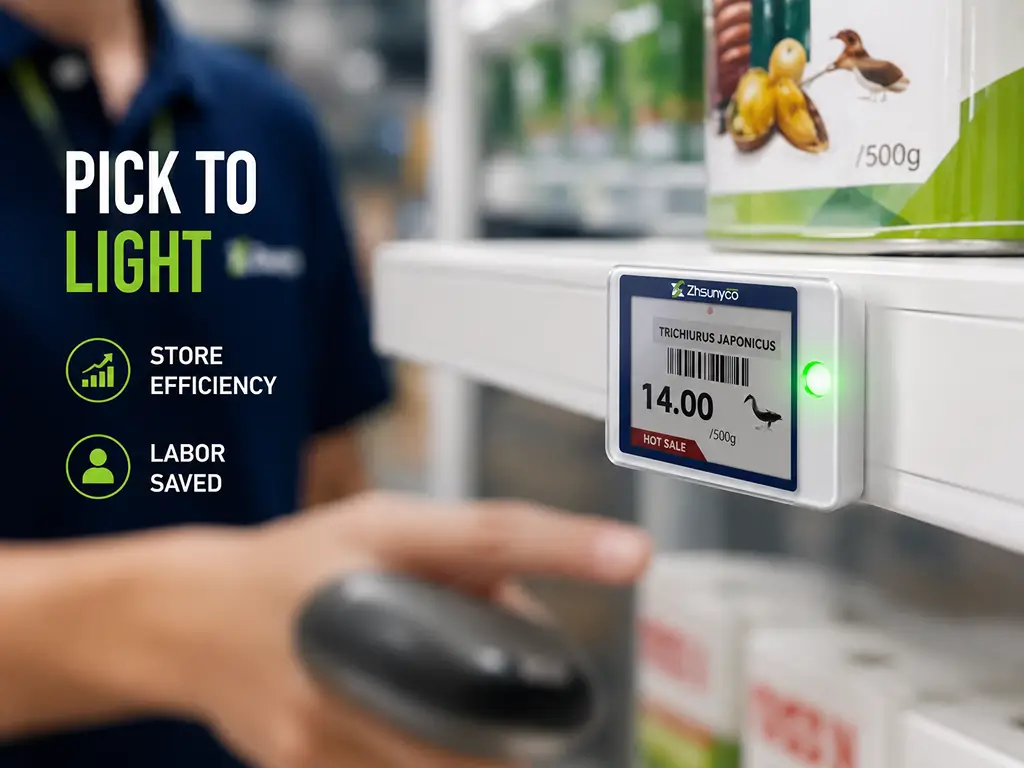
The most immediate impact of ESL deployment is on the people who work in stores. Amanda Bailey, an electronics department team lead at Walmart, told CNBC that digital shelf labels cut her pricing-related duties by roughly 75%, freeing her to help customers on the sales floor. That pattern repeats across every department in every store that adopts the technology.
Walmart’s broader strategy makes the labor arithmetic clear: the company aims to grow sales 4% annually without increasing headcount. ESLs are one of the efficiency levers that make that possible. They don’t eliminate jobs; they shift hours from repetitive manual tasks (printing, sorting, hanging, and verifying paper tags) to higher-value work: assisting customers, fulfilling online orders, and maintaining store standards. The labels’ “Pick to Light” feature, a flashing LED that guides associates to the exact shelf location of an online order, is a capability that paper tags could never provide. It is a net-new productivity tool, not a replacement for one.
Omnichannel Reality: One Price, Everywhere, Instantly
Modern retail is no longer a single-channel business. A customer might check a price on their phone in the morning, see it in-store in the afternoon, and order it for delivery in the evening. When those three touchpoints show three different prices, trust erodes.
ESLs solve this by making the shelf itself part of the digital infrastructure. The management software integrates with the retailer’s POS, ERP, and e-commerce systems, creating a single source of truth for pricing data. When a price changes in that central database, every surface — shelf label, checkout terminal, website, mobile app — updates together. This is not dynamic pricing in the Uber sense. It is dynamic accuracy: the simple, powerful idea that a price should be the same everywhere a customer encounters it.
The Quiet Win: Sustainability at Scale
There is an environmental dimension that gets lost in the pricing debate. A retailer the size of Walmart consumes millions of paper labels annually. Each one printed, shipped, inserted into a plastic sleeve, and eventually discarded. E-ink labels, by contrast, draw power only during the fraction of a second it takes to refresh the display. Their batteries last five to ten years. Multiply that across thousands of stores and the reduction in paper waste, printer toner, and plastic sleeve disposal becomes material. ESL manufacturers have reported that a single large retail chain adopting their system can eliminate hundreds of tons of carbon emissions annually through paper and printing reduction alone. It is a secondary benefit, but not a trivial one.
Where This Goes From Here: Trust, Regulation, and the Future of Retail Pricing
The legislative response to ESLs is already taking shape, and in a telling direction. Maryland’s Protection from Predatory Pricing Act, which takes effect in October 2026, bans dynamic pricing on groceries while explicitly allowing the continued use of electronic shelf labels. Connecticut and New York have passed similar legislation. The lawmakers closest to this issue appear to be learning the distinction between a technology and its potential misuse. They are regulating the behavior (price gouging) rather than the tool (digital labels).
Public sentiment, meanwhile, is slowly shifting. CivicScience polling in 2026 found that 14% of U.S. adults say they are more likely to shop at a store with digital price tags, up from 9% in 2024. The share who say they are less likely held steady at 36%. Half of all consumers remain neutral. Trust takes time to catch up to experience. Fear moves faster.
The ESL industry now stands at a crossroads, one that will be familiar to anyone who has watched a new technology navigate its first public controversy. The hardware is neutral. Like any infrastructure, it can be steered toward transparency or opacity, toward efficiency or exploitation. The question is not what the technology can do, but what the industry chooses to build and what retailers choose to deploy.
Professor Marshall Fisher of the Wharton School, one of the foremost authorities on retail operations, has spent decades studying what separates successful retail technology from the kind that collects dust. His framework is deceptively simple: the best retail technologies are those that “make the right thing easier to do.” ESLs, at their best, make price accuracy easier. They make promotion execution easier. They make omnichannel consistency easier. They do not, by design, make surge pricing easier, because surge pricing was never the right thing to do in grocery retail.
As the industry matures, the manufacturers that will earn lasting trust are those whose system architectures reflect this philosophy from the ground up, building for operational integrity rather than pricing gamesmanship. Zhsunyco, for example, designs its ESL management software around price synchronization and template management, without the consumer-profile-driven dynamic pricing logic that critics fear. For retailers evaluating ESL partners, that architectural distinction — what a system is designed to do, and just as importantly, what it is designed not to do — is worth understanding. More information is available at Zhsunyco.
References
- ModernRetail. “It’s not our approach: Walmart COO says digital shelf labels aren’t for surge pricing.” June 2026. modernretail.co
- Northwestern University, Kellogg School of Management. “Surge Pricing in Aisle Five?” 2025. insight.kellogg.northwestern.edu
- CNBC. “Walmart digital price labels are coming to every store shelf in U.S. by end of 2026.” March 2026. cnbc.com
- Pricer. “How East of England Co-op Scales Efficiency and Saves £1M Annually with Pricer ESLs.” 2024. pricer.com
- PYMNTS. “Lawmakers Worry Electronic Shelf Labels Will Facilitate Dynamic Pricing.” 2025. pymnts.com
- USA Today. “Are Walmart digital price tags for surge pricing? What to know in DC.” May 2026. usatoday.com
- Progressive Grocer. “UFCW Ramps Up Attack on Electronic Shelf Tags.” 2026. progressivegrocer.com
- TheStreet. “Walmart Bets on Digital Pricing — But Most Shoppers Aren’t Sold.” 2026. thestreet.com
- Zhsunyco. Official Website. zhsunyco.com
- Zhsunyco. Contact Us. zhsunyco.com/contact-us

 English
  Russian
  Spanish
  German
  Arabic
  French
  Bulgarian
  Polish
  Romanian
  Turkish
  Portuguese