


Walmart's DSL Rollout and What It Signals for the Global ESL Industry
Walmart's DSL Rollout — The Scale of the Bet
By the end of 2026, every Walmart store shelf in America will carry a digital price tag. It is not a pilot. It is not a test in a handful of locations. It is a chain-wide deployment across approximately 5,200 stores, with roughly 2,300 locations already live as of early 2026. The total price tag for this transformation: an estimated one billion dollars.
To grasp the operational scale, consider what a single Walmart Supercenter handles: over 120,000 SKUs, each with a paper price tag that needs to be printed, sorted, and manually swapped whenever a price changes — and prices change thousands of times per week across rollbacks, markdowns, and promotions. The labor math alone makes the case. One electronics department team leader in Ohio reported that digital shelf labels cut her pricing duties by roughly 75%, freeing her to spend more time helping customers on the floor rather than walking aisles with a stack of paper tags.
A quick note on terminology before we go deeper. In the American market, the industry has largely settled on the term DSL (Digital Shelf Labels) — that is the language Walmart uses, and it is the term increasingly adopted by US retail trade press. Globally, however, the technology is still most widely known as ESL (Electronic Shelf Labels), the term dominant across European and Asian markets. This article uses both interchangeably, reflecting the reality that the same technology answers to two names depending on which side of the Atlantic you are standing on.
Walmart frames this initiative as a workforce-efficiency play, not a pricing-strategy shift. The company’s Chief Operating Officer has been unequivocal: “It’s not our approach,” referring to fears that DSLs would enable surge pricing. Price updates are human-approved and typically pushed during non-shopping hours. Still, the scale of the commitment — $1B, every store, every shelf — raises a question that goes beyond one retailer: if the world’s largest brick-and-mortar chain is betting its shelf edge on this technology, what does that mean for everyone else?
Under the Hood — How Walmart's Digital Shelf Labels Actually Work
Before asking what the Walmart deployment means for the industry, it is worth understanding what is actually being deployed. Most news coverage stops at “e-ink labels that update prices wirelessly,” which is accurate but incomplete. Walmart’s DSL system is a three-layer architecture: a display layer built on electronic paper, a communication backbone running on a dedicated wireless protocol, and a software layer that ties everything into the retailer’s existing IT infrastructure. Each layer solves a distinct engineering problem.
The Display Layer — E-Paper and the Smart Rail Revolution
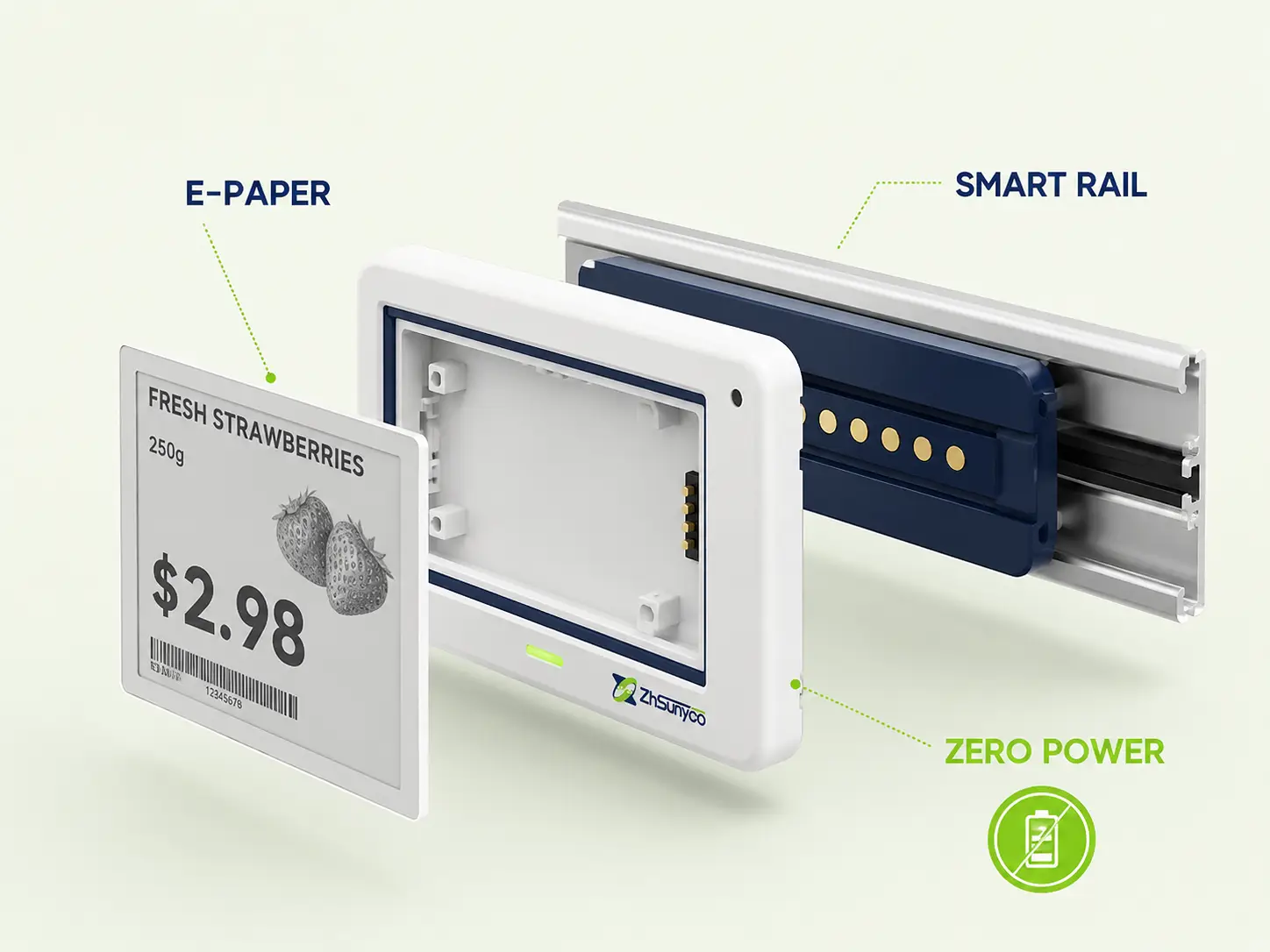
The labels themselves use electrophoretic display technology — the same electronic paper found in a Kindle, cut into shelf-sized rectangles. The physics are well understood: charged pigment particles suspended in a microcapsule layer move toward or away from the viewing surface when voltage is applied, then stay locked in place with zero power consumption. A static price display draws no current. Electricity is only consumed during the fraction of a second when the image changes.
This matters enormously at Walmart’s scale. If each of the millions of labels drew even a trickle of standby current, the battery replacement burden alone would make the economics untenable. Early-generation ESLs — the kind deployed in European supermarkets a decade ago — relied on coin-cell batteries rated for five to ten years. Real-world experience painted a less flattering picture. Walmart employees on Reddit have reported tags needing battery replacements within three months of installation, with entire stores flashing red error indicators simultaneously. The lesson the industry absorbed from these early deployments: battery management at scale is a hidden operational cost that vendor spec sheets tend to understate.
The architectural answer to this problem, at least in Walmart’s current-generation deployment, is the smart rail — a powered track mounted along the front edge of shelving that delivers both electricity and data to each label. Labels clip into the rail rather than running on standalone batteries, drawing power and connectivity from the same physical interface. It is a deceptively simple idea: instead of putting a battery in every tag and hoping they last, run a single power bus along the shelf and let the tags sip from it. VusionGroup, the French technology provider behind Walmart’s rollout, co-developed the underlying ultra-low-power Bluetooth protocol with Qualcomm and the Bluetooth Special Interest Group.
The Communication Backbone — How 120,000 Labels Stay in Sync
A single Walmart Supercenter can carry over 120,000 SKUs. If every shelf position gets a digital label, the system needs to manage a six-figure device fleet inside one building — each requiring reliable, verifiable communication.
The architecture uses ceiling-mounted communication access points that relay signals to the smart rails, which in turn distribute data to individual labels. Crucially, the wireless protocol operates on a dedicated, isolated radio frequency band — it does not share spectrum with the store’s guest Wi-Fi, employee handhelds, or any other system. This physical isolation eliminates the interference risks that would otherwise plague a dense deployment.
The protocol is bidirectional: labels do not just receive price updates — they send back status confirmations. When a batch of price changes is pushed (typically overnight, outside shopping hours), the central system can verify that every targeted label received and applied the correct update. System uptime is rated above 99.9%. For a retailer where a price discrepancy between shelf and register is both a customer-experience failure and a regulatory liability in some jurisdictions, that confirmation loop is not a nice-to-have — it is the difference between a tool you trust and a tool you double-check manually.
The Software Layer — Cloud CMS, POS Integration, and the Associate App
Hardware displays prices. The communication layer delivers the right price to the right label. But the question of what to display, when to change it, and who controls it belongs to the software stack.
At the top sits a cloud-based content management system (CMS) — Vusion’s Cloud platform — that serves as the single pane of glass for pricing across all stores. When a pricing manager adjusts a SKU in the central database, the CMS schedules the update, the access points push it through the rails, the labels refresh, and — critically — the point-of-sale system syncs simultaneously. The shelf and the register always agree, because they are reading from the same source of truth.
API-level integration with existing POS and ERP systems makes this possible. The DSL network is not a standalone gadget bolted onto the store; it is a peripheral on the retailer’s core operational stack. That integration model — open APIs, standard protocols, cloud or on-premise deployment options — is one of the key variables that separates enterprise-grade ESL systems from commodity hardware.
Then there is the feature that frontline associates actually like. Each label contains a small LED that can be triggered remotely through a mobile app. An associate looking for a specific product to restock taps the item on their handheld, and the corresponding shelf label flashes. Walmart calls this Stock-to-Light. The same mechanism — Pick-to-Light — guides online order pickers to exact shelf positions. It is a simple feature, but it is the one that converts skeptics on the store floor: the LED turns an abstract price tag into a physical wayfinding beacon.
Beyond One Retailer — What Walmart's Move Signals for the Global ESL Industry
If Walmart were a mid-sized regional chain testing DSL in 50 stores, the industry would barely register the news. But 5,200 stores, $1 billion, and the brand name that defines American retail change the calculus. Walmart’s deployment is not just a procurement decision — it is a market signal. It tells every retail executive who has been watching ESL from the sidelines that the technology has passed its largest real-world stress test.
Market Acceleration — The $1B Endorsement Effect
The global electronic shelf label market was already expanding before Walmart placed its bet. Industry analysts pegged the 2026 market at $2.5 to $3.6 billion, with projections reaching approximately $7.4 billion by 2035 — a compound annual growth rate between 12.7% and 17%, depending on the scope of the estimate. North America accounts for roughly 31% of global ESL revenue, and that share is growing faster than any other region — a trajectory that Walmart’s deployment will only steepen.
Other retailers are already moving. Kroger has expanded its EDGE Shelf system to over 500 stores. Whole Foods, which began experimenting with ESLs in 2016, has approximately 150 locations equipped. Schnucks, a regional chain in the Midwest, is rolling out DSL to all 115 of its stores. On the global stage, Aldi has deployed over 25 million electronic shelf labels across more than 7,500 locations worldwide.
The psychological mechanism at work here is straightforward. Before Walmart’s announcement, a mid-size grocery chain evaluating DSL faced a risk calculus weighted toward inaction: “If this technology isn’t fully proven, we could waste millions on a system that underdelivers.” After Walmart’s commitment, the asymmetry flips: “If every Walmart shelf in America is digital by next year, the risk of falling behind may be greater than the risk of adopting.” That reversal — from “why should we?” to “why haven’t we?” — is what marks the crossing from early-adopter phase to mainstream market.
The Supply Chain Reality — Where the Hardware Comes From
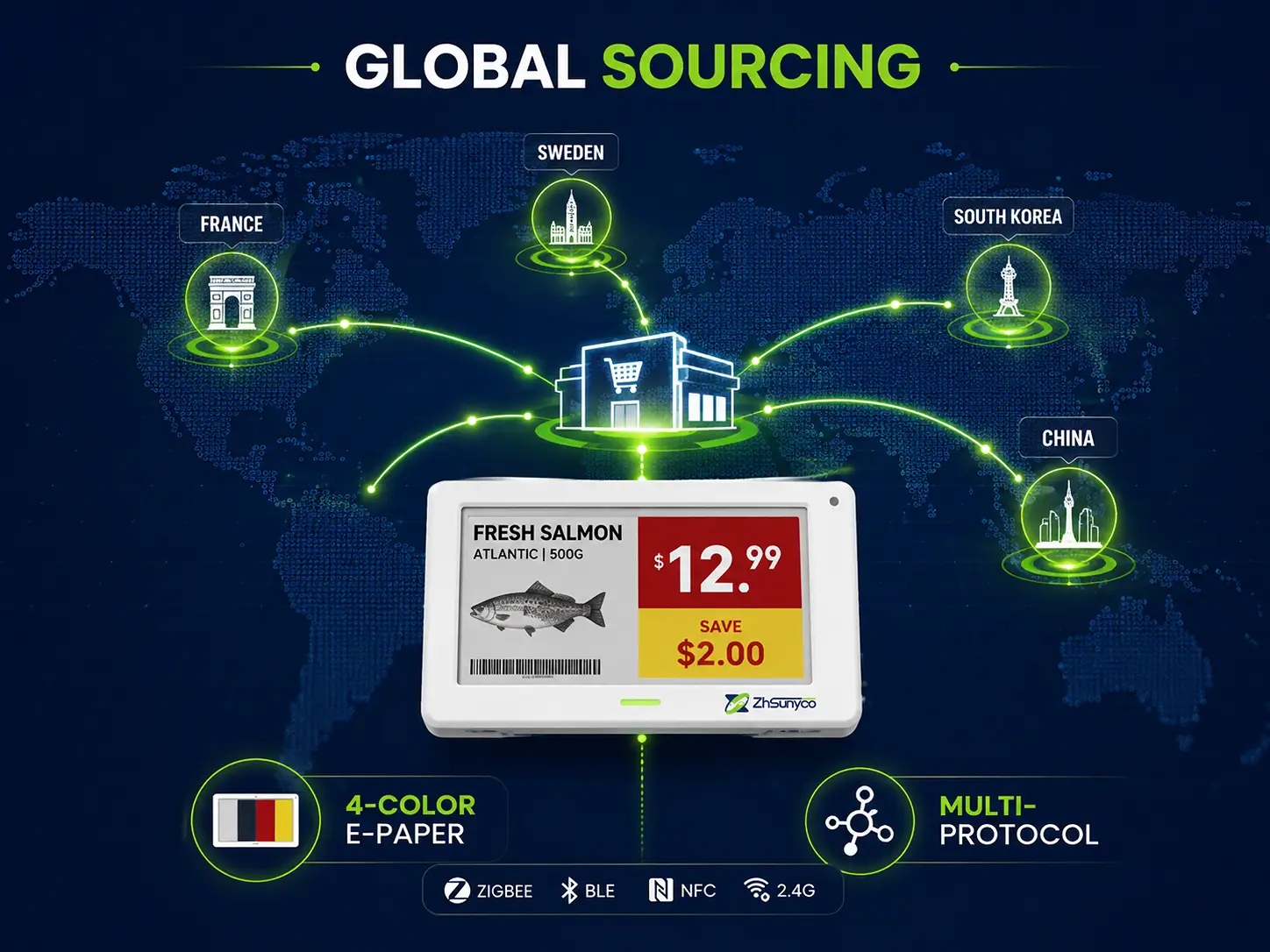
One dimension of this story that general news coverage consistently misses is the manufacturing geography behind the labels. The global ESL supply chain is concentrated in a handful of companies: VusionGroup in France (Walmart’s primary partner), Pricer in Sweden, Solum in South Korea, and a cluster of highly capable manufacturers in China — notably Hanshow Technology plus a deep bench of specialized producers.
The competitive dynamic has shifted over the past five years. A decade ago, “made in China” in the ESL context implied cost-driven commodity hardware. That characterization no longer holds. Today’s leading Chinese ESL manufacturers compete on technical depth: full protocol coverage across 2.4GHz, 433MHz, BLE, NFC, and Wi-Fi to match different retail environments; four-color electronic paper displays — black, white, red, and yellow on a single tag, a 2024 innovation that enables richer on-shelf communication; and open-architecture base stations with MQTT protocol support for seamless integration into existing POS and IoT infrastructure. Some offer a one-time software licensing model with lifetime free updates and optional on-premise deployment — a TCO profile that contrasts sharply with the recurring SaaS fees common among Western vendors.
For example, Zhsunyco — a top-three Chinese ESL manufacturer with 12 years of R&D experience and a 720-million-unit annual production capacity — exemplifies this shift from component supplier to full-stack solution provider. Its product line spans all five major wireless protocols, and its 2024 four-color ESL release reflects the kind of in-house innovation cycle that was once the exclusive domain of European vendors. The takeaway for a retailer evaluating suppliers is not “buy Chinese” or “buy European” — it is that the supplier landscape has diversified to the point where protocol coverage, software licensing model, and customization depth are now the real differentiators, not geography.
The 2025 US tariffs on imported displays, microprocessors, batteries, and communication modules add another layer of complexity. Every ESL system sold into the American market — regardless of whose brand is on the box — contains components that cross multiple tariff boundaries. This is reshaping sourcing strategies and, in some cases, accelerating plans for regional assembly outside China. It is not a showstopper for the technology’s adoption curve, but it is a cost variable that procurement teams can no longer ignore.
The Psychology of Adoption — Why “Walmart Did It” Matters
There is a well-documented pattern in enterprise technology adoption: a long period of niche usage by innovators and early adopters, followed by a sharp inflection point when a market leader commits at scale, followed by a rush of mainstream adoption. It happened with cloud computing in the early 2010s — before Netflix migrated its entire infrastructure to AWS, enterprise CIOs argued that “the public cloud isn’t secure enough.” Afterward, the conversation shifted to “how fast can we migrate?”
ESL technology appears to be at a similar inflection point. Before Walmart, the technology’s stronghold was Europe — particularly Germany and France, where labor costs and pricing regulation created a natural pull. Asia — China, Japan, South Korea — followed, driven by retail modernization and strong local manufacturing. North America, despite being the world’s largest retail market, was relatively slow to adopt at scale. Walmart’s commitment changes that overnight. The region is now the growth leader.
For the supply side, the implication is sharp and near-term: a wave of mid-size American retailers — chains with 50 to 500 locations — will begin formal ESL evaluations over the next 12 to 24 months. The trigger is not a vendor’s cold outreach. It is a Saturday trip to the local Walmart Supercenter, where every shelf carries a digital label. The competitor in their market is not a slide deck from a sales rep. It is the store their customers already shop at.
Three Technology Shifts Walmart's Deployment Is Accelerating
Deploying at Walmart’s scale does more than validate current technology — it exposes its limits and creates demand for the next generation. Three shifts in particular are being accelerated by the pressure of a 5,200-store, multi-million-label fleet.
Batteryless ESL — Solving the Maintenance Trap
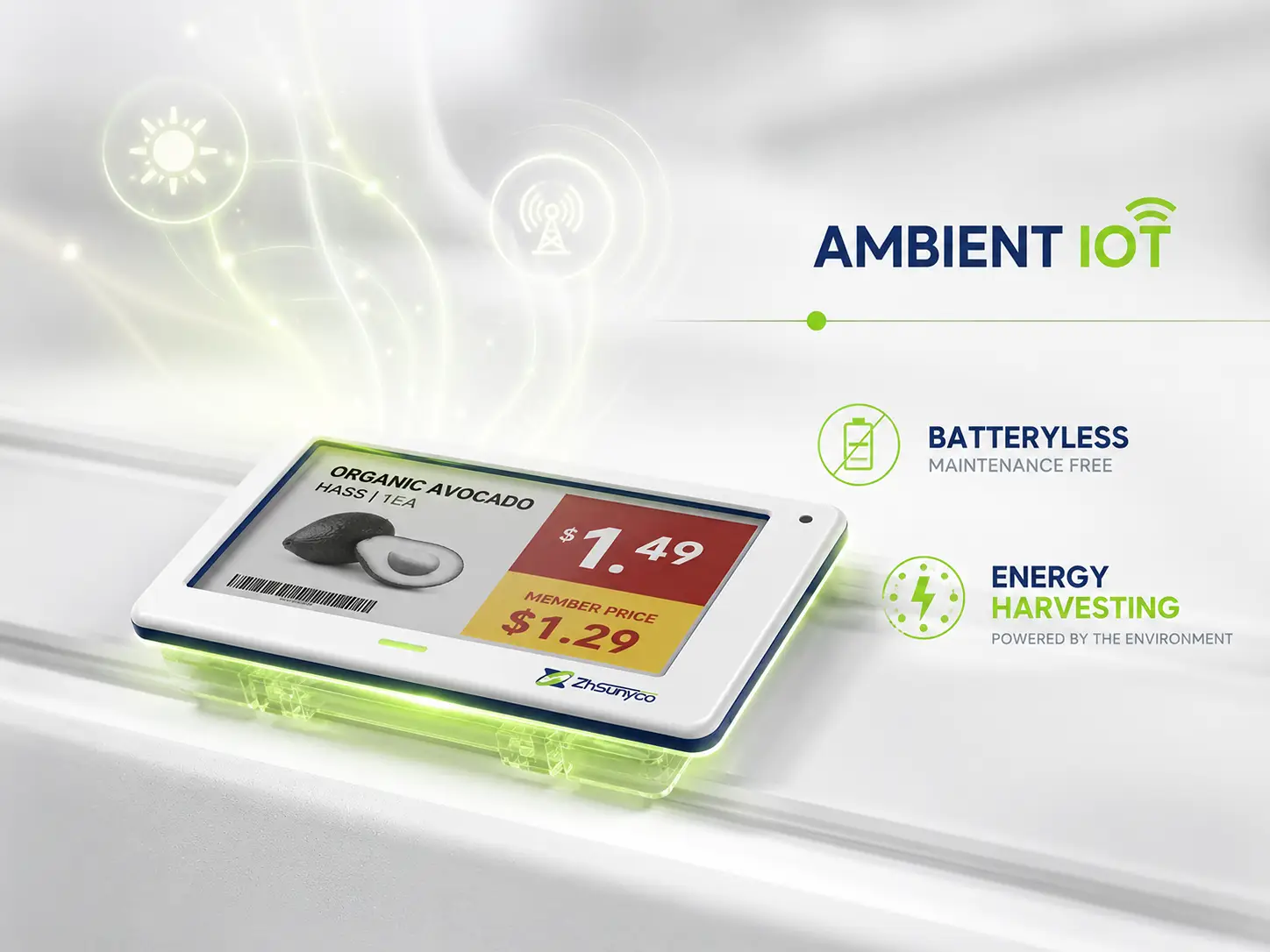
Battery management at scale is the problem that first-generation ESL deployments revealed and that the smart rail partially solves. But rails add cost and installation complexity — they are feasible for a Walmart with dedicated store-remodel budgets, less so for a 20-store regional grocer.
The next step is ambient IoT: electronic shelf labels that harvest energy from their environment — ambient light, radio frequency waves from existing wireless infrastructure — and operate indefinitely without any battery at all. Think of a solar-powered calculator, but one that can also draw trickle power from the Wi-Fi and Bluetooth signals already saturating a retail environment.
The technology is moving from lab to early commercialization. Within three to five years, batteryless labels are expected to become the default architecture for new large-scale deployments, eliminating both the battery-replacement labor burden and the e-waste stream of millions of spent coin cells. For the mid-market retailers who will begin evaluating ESL in the wake of Walmart’s rollout, batteryless options will likely be commercially available by the time they are ready to sign a purchase order — which changes the TCO equation considerably.
AI-Powered Pricing Intelligence
No aspect of the DSL story has attracted more public attention — and more misunderstanding — than the question of dynamic pricing. The fear, widely circulated in consumer media and amplified by union campaigns, is that digital labels will enable airlines-style surge pricing in grocery aisles: the price of milk rising at 5 PM on a weekday because demand is high.
The reality, as borne out by both Walmart’s stated policy and independent research, is more nuanced. A UC San Diego study found no evidence that electronic shelf labels cause price increases in stores that deploy them. Walmart has been explicit that its everyday-low-price strategy is unchanged and that price decisions remain human-led. The labels are a communication tool, not a decision-making system.
The practical AI applications emerging in the ESL space are more operational than sensational. The real use cases look like this: a machine learning model flags that a batch of organic yogurt in a specific store will expire in 48 hours and suggests a 30% markdown to clear inventory before write-off; a store manager reviews and approves the recommendation; the DSL system pushes the updated price to the relevant shelf labels overnight. Or: an AI engine analyzes three months of sales velocity data and recommends a permanent price adjustment on a slow-moving SKU, which the category manager evaluates alongside supplier cost data before acting. These are margin-protection and waste-reduction tools, not consumer-surveillance mechanisms. The distinction matters because it will shape both regulatory response and public acceptance of the technology.
Walmart has filed two machine-learning pricing patents — one for automated markdowns, one for AI-driven demand-behavior pricing suggestions — but the company frames both as decision-support tools for human managers, not as autonomous pricing engines. Whether that distinction holds over the long term is likely to be determined as much by legislation as by technology. Senator Ben Ray Luján’s proposed Stop Price Gouging in Grocery Stores Act, which would ban DSLs in grocery stores over 10,000 square feet, represents one pole of the regulatory debate. The National Retail Federation represents the other, arguing that existing antitrust and price-gouging laws already provide sufficient guardrails.
Full-Graphic Displays — From Price Tag to In-Store Media
The original electronic shelf label displayed exactly one thing: a price, in black and white, on a segmented screen. Today’s full-graphic e-paper displays can render product images, barcodes, QR codes, nutritional panels, allergen warnings, promotional graphics, and brand messaging — all on a tag the size of a business card.
Four-color electronic paper — adding red and yellow to the traditional black and white — entered commercial production in 2024 and is already being deployed at scale. The next logical step is NFC integration: a shopper taps their smartphone on a shelf label and sees detailed product information, membership pricing, recipe suggestions, or a promotional video. At the higher end of the display spectrum, shelf-edge LCD strips — stretch-bar form factors with 2K resolution, dual-sided visibility, and 50,000-hour lifespans — are turning the shelf edge into a dynamic media surface.
When millions of shelf labels become programmable, network-connected displays, the retail media network — the advertising platform that retailers like Walmart and Kroger are building as high-margin revenue streams — gains a physical in-store surface. The shelf edge becomes an impression. For consumer brands that already buy digital ads on Walmart.com, the ability to extend that spend to the physical shelf — with guaranteed placement, at the exact moment of purchase consideration — represents an entirely new advertising channel. This convergence of ESL hardware and retail media is still in its early stages, but the infrastructure being laid today makes it inevitable.
From Pilot to Infrastructure — What's Next for Digital Shelf Labels
Walmart’s full chain-wide deployment is expected to be complete by the end of 2026. That milestone will mark the close of the “pilot era” for digital shelf labels in North America. What comes after falls into three time horizons.
In the short term — the next 12 to 24 months — the most visible effect will be a cascade of adoption decisions among mid-size American grocery and specialty retail chains. These retailers have been watching Walmart’s rollout from the sidelines. Once the system is live in every Walmart store in their region, the internal conversation shifts from “should we look into this?” to “which vendor and when?” The procurement window that opens during this period will define the competitive landscape for ESL vendors for the next half-decade.
In the medium term — three to five years — batteryless ambient IoT labels will reach commercial maturity and begin displacing first-generation battery and rail-powered systems. This will bring the total cost of ownership down sharply, opening the market to retail formats that could not justify the investment at earlier price points: convenience stores, independent pharmacies, specialty boutiques, quick-service restaurants. The addressable market expands by an order of magnitude when the per-label infrastructure cost drops below a certain threshold — and batteryless technology is the lever most likely to get it there.
In the long term, the DSL network will cease to be a standalone system and become part of the store’s core operating infrastructure. Shelf labels, inventory sensors, POS terminals, fulfillment systems, and retail media platforms will operate as an integrated stack, with AI orchestration sitting on top. The shelf label’s job will expand from “display the price” to “be the physical anchor point where inventory data, pricing logic, picking instructions, and consumer engagement converge.” That is not a prediction about a distant future — the architectural pieces are already being assembled. Walmart’s $1 billion bet is the accelerant.
References
- Walmart Corporate. “How the Shelf Got Smarter and Our Jobs Got Easier.” 2026. corporate.walmart.com
- CNBC. “Walmart digital price labels are coming to every store shelf in U.S. by end of 2026.” 2026. cnbc.com
- ModernRetail. “‘It’s not our approach’: Walmart COO says digital shelf labels aren’t for surge pricing.” 2026. modernretail.co
- GM Insights. “Electronic Shelf Label Market Size, Share & Trends Report, 2035.” 2026. gminsights.com
- invidis. “Walmart Gears Up for Chain-Wide DSL Roll-Out.” 2026. invidis.com
- IoT Business News. “Why Retailers are Rushing to Adopt Ambient IoT for Batteryless Electronic Shelf Labels.” 2026. iotbusinessnews.com
- NRF. “Electronic Shelf Labels: Separating Fact from Fiction.” Citing UC San Diego research. 2025. nrf.com
- VusionGroup. “How Digital Price Tags Boost Pricing Accuracy & Satisfaction.” 2026. vusion.com

 English
  Russian
  Spanish
  German
  Arabic
  French
  Bulgarian
  Polish
  Romanian
  Turkish
  Portuguese