


Retail Pricing Software: From AI-Powered Decisions to Shelf-Edge Execution
What Is Retail Pricing Software — and Why It’s No Longer Optional
Retail pricing software is the technology layer that connects data, decisions, and execution across every price tag in a retail operation. It is not a fancier spreadsheet. It is not “auto-repricing” in the narrow sense of matching Amazon prices. It is an infrastructure category: a system that ingests competitive data, demand signals, and cost structures, determines what price each product should carry, and increasingly pushes that price to every sales channel in real time.
The distinction matters because the retail pricing landscape has shifted fundamentally in the last three years. Three forces have driven this change. First, e-commerce price transparency means customers compare prices in seconds, not days. Second, inflation volatility means cost structures change faster than quarterly review cycles can absorb. Third, omnichannel operations mean a single product now carries its price across a website, third-party marketplaces, and physical shelves at the same time — and a mismatch on any one of those surfaces erodes trust instantly.
Yet the industry is startlingly far behind. A 2026 benchmark by 7Learnings and The Retail Hive found that 64% of retail executives still price by gut feel, and 84% of retail organizations operate without any predictive capability in pricing (7Learnings/Retail Hive, 2026). In other words, the majority of retailers are making their highest-stakes commercial decisions the same way they did twenty years ago — with intuition, spreadsheets, and hope.
This is not a story about “nice to have” technology. It is a story about structural competitive disadvantage that grows worse every quarter.
The Hidden Costs of Sticking with Manual Pricing
The cost of manual pricing is easy to underestimate because it leaks in three separate dimensions — none of which show up as a single alarming line item on a P&L. But together, they represent a persistent drain on revenue, margin, and organizational capacity.
Before examining the evidence, here is the core argument: manual pricing does not just make you slower — it causes structural losses in revenue capture, profit margin, and team productivity that compound over time. The table below maps each dimension.
| Loss Dimension | How It Plays Out | What the Data Says | Why Spreadsheets Cannot Fix It |
|---|---|---|---|
| Revenue Leakage | Competitor drops a price on Tuesday; your response goes live Friday. A demand surge hits on Saturday; your prices stay flat until the next weekly review. | 38% of retail executives rank “missed revenue opportunities” as their top pricing loss (7Learnings/Retail Hive, 2026). | Excel cannot monitor competitor prices in real time, let alone across thousands of SKUs. |
| Margin Erosion | A promotion ends on Sunday but prices stay discounted until Wednesday because no one manually rolls them back. A high-demand store charges the same price as a low-demand store, leaving margin on the table at one and losing sales at the other. | A 1% pricing error across a large SKU base translates to an estimated 8% operating profit loss (McKinsey & Company). Promotional price rollback failures alone represent significant margin leakage, especially on high-velocity items with deep discount depths. | Thousands of price points × multiple channels × promotion windows = complexity no spreadsheet model can track. |
| Organizational Drag | Category managers spend 8–12 hours per promotional cycle manually updating prices across systems. A 500-SKU promotion takes 3–5 days just to execute. Rules accumulate over years — one grocery chain reported 30+ pricing rules that became impossible to manage or explain. | 52% of retailers still manually track competitor prices by checking individual websites (IPRoyal Survey). 64% price by gut feel; 84% lack predictive capability (7Learnings/Retail Hive, 2026). | Rule-based spreadsheets turn brittle — each new rule interacts with existing ones in ways no human can trace. |
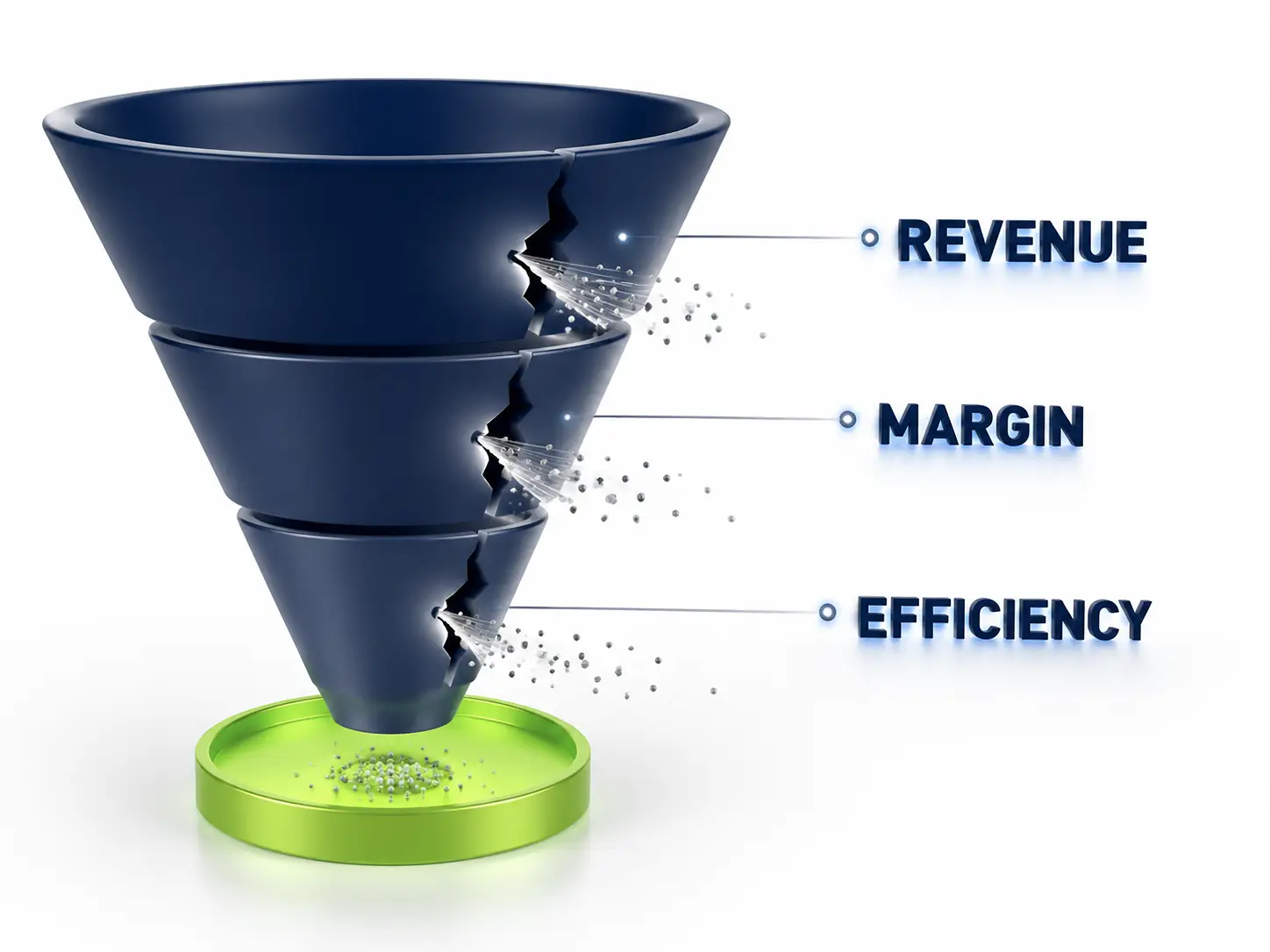
The pattern is consistent: manual pricing is not a cost-saving choice. It is a slow, quiet bleed. And here is what makes it particularly dangerous — because it is quiet, there is no crisis moment that forces a decision. The business just gradually falls behind competitors who automated two years earlier.
What Modern Retail Pricing Software Actually Does
If you are evaluating pricing software for the first time, the vendor landscape can look like a blur of similar-sounding claims: “AI-powered,” “real-time optimization,” “omnichannel execution.” But beneath the marketing language, good retail pricing software is built on three distinct capability layers. Think of them as a stack: if any layer is missing, the system cannot deliver on its promise.
So before diving into the details, use this as your evaluation lens: a complete pricing platform must cover the decision layer (what price should this be?), the perception layer (what is happening in the market?), and the execution layer (how does this price reach every selling touchpoint?). Missing one means you have a partial tool, not a pricing system.
AI-Powered Price Optimization — From Gut Feel to Data-Driven Decisions
This is the decision layer — the part that replaces intuition with computation.
The core mechanism is demand elasticity modeling. Modern pricing AI ingests four categories of variables: historical sales at different price points, competitor pricing, inventory position, and seasonal or promotional context. From these, it calculates the price that maximizes a target metric — gross profit, revenue, sell-through rate, or a weighted combination. The output is not a single “optimal price” but a range with projected outcomes at each point, constrained by business rules you define: margin floors, MAP/MSRP boundaries, and competitive positioning guidelines.
The most important recent development in this space is not the math — elasticity models have existed for decades. It is explainability. Earlier generations of pricing AI were “black box” systems: they produced a number, and the pricing manager had to either trust it or override it on instinct. The current generation — sometimes called Glass Box AI — makes every recommendation traceable. It shows which inputs drove the recommendation, how much weight each had, and what the projected outcome would be if you adjusted any variable. This matters enormously for adoption, because the #3 barrier to pricing software adoption, after organizational buy-in and legacy technology, is “confidence in AI outputs” (7Learnings/Retail Hive, 2026).
A useful way to think about the maturity spectrum: pricing AI exists on a continuum, roughly analogous to autonomous driving levels.
Level 1 is rule-based guardrails — the system enforces your minimum margin and MAP compliance but does not recommend prices. Level 3 is AI-assisted — the system recommends, a human approves or overrides. Level 5 is fully autonomous dynamic pricing — the system adjusts prices in real time within human-defined boundaries, and humans monitor by exception. Most retailers today operate between Level 0 (pure manual) and Level 1. The goal is not to jump to Level 5 overnight — it is to move one level at a time, building organizational trust at each stage.
Competitor Price Intelligence — Know When to React (and When Not To)
This is the perception layer. And the biggest mistake first-time buyers make is assuming they need to track every competitor’s price on every SKU.
The actual value of competitor intelligence lies in sensitivity filtering — understanding which competitor price changes actually affect your demand, and which ones are noise. If a competitor 500 miles away drops a price on a product your customers never cross-shop, matching that price accomplishes nothing except giving away margin. The concept, formalized by some vendors as a Competitor Sensitivity Index, identifies the subset of competitors and products where price changes correlate with your sales velocity. Everything else is monitored but not acted upon.
The technical backbone here is product matching accuracy. Matching SKUs across retailers is harder than it sounds — different product descriptions, different units of measure, different packaging configurations. The best systems claim 99%+ matching accuracy, and the gap between 95% and 99% is the gap between “mostly useful” and “reliable enough to automate decisions on.” For categories like grocery, where a fresh produce item at one retailer needs to be matched to an equivalent at another, the matching problem is especially complex and calls for vertical-specific tuning.
Here is the practical rule: the goal of competitor intelligence is not to react to every price change. It is to identify the 15–20% of competitive moves that actually threaten your demand, and respond to those with precision — while ignoring the other 80% and preserving your margin.
Omnichannel Price Synchronization — One Price, Everywhere, in Real Time
This is where the decision layer meets the execution layer — and where most pricing software implementations reveal their biggest blind spot.
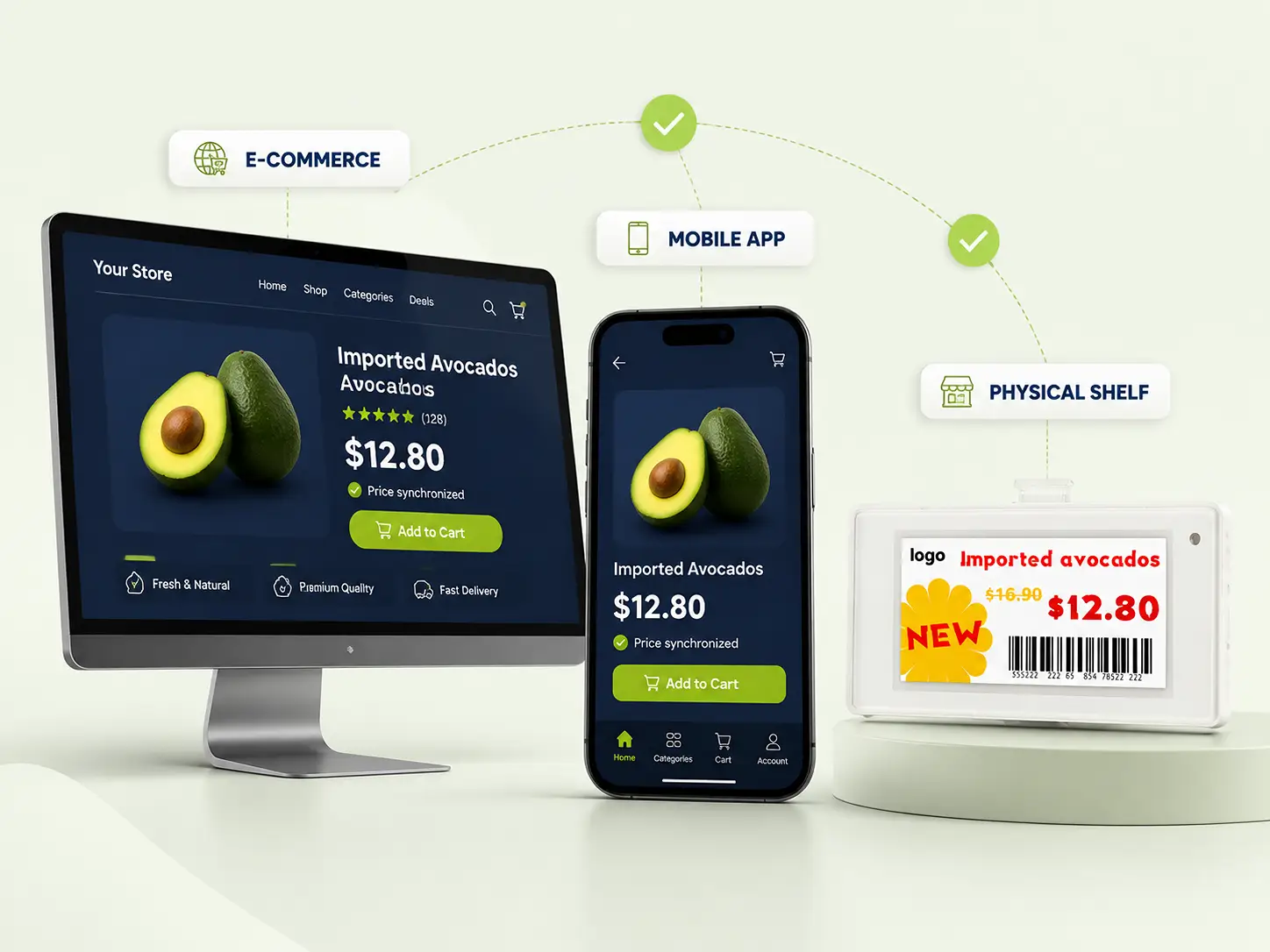
Omnichannel synchronization means a single price change propagates to your e-commerce site, your marketplace listings, and your physical store shelves simultaneously. The failure mode is familiar to anyone who has shopped across channels: the online price says $29.99, but the in-store shelf tag says $34.99. The customer scans the barcode, sees the discrepancy, and trust evaporates. In regulated markets, price label inaccuracies can carry compliance penalties beyond the lost sale.
The technical requirement is straightforward but demanding: a unified price master database that serves as the single source of truth, connected via API to every sales channel. When the pricing engine recalculates a price, it writes to the master. Every channel reads from the master. The weak link is almost always the physical store — because updating a price in a database is instant, but updating a paper price tag on a shelf takes a human being with a printer, a stack of labels, and time. We will return to this physical execution gap in detail — it is the least-discussed and most consequential bottleneck in retail pricing, and it deserves its own section.
How to Choose the Right Pricing Software for Your Retail Business
At this point, you understand the capability landscape. The next question is: which tool fits your operation? The answer is not “the one with the most features” or “the one that ranked highest on a comparison site.” It is the one that matches your scale, integrates with your existing systems, and delivers value that exceeds its total cost.
But before comparing any vendors, do three things first. Count your SKUs and sales channels — a 500-SKU single-channel retailer has fundamentally different needs from a 50,000-SKU omnichannel operation. Assess your pricing team’s size and technical capability — a team of two category managers needs different software from a team of fifteen with a dedicated data analyst. And decide whether you need assisted decision-making (the AI recommends, you approve) or automated execution (the AI acts within guardrails). These three answers will filter out 80% of the market before you read a single feature list.
Scale and Vertical Fit — One Size Does Not Fit All
Retail pricing software spans a vast range. At the small end, tools like Priceva and PriceForge serve e-commerce sellers and small retailers at $99–$599 per month, with basic competitor tracking and rule-based repricing. At the mid-market, platforms like Quicklizard serve regional chains and DTC brands at roughly $1,000+ per month, with full AI optimization, omnichannel execution, and Glass Box AI. At the enterprise tier, solutions like Competera and ClearDemand are custom-priced and built for national or global retailers with dedicated pricing teams.
Scale is not just about budget — it is about team capacity. ClearDemand explicitly designs its platform for pricing teams of 3–20 people, with exception-based workflows that let a small team manage what would otherwise take an army of analysts. On the other end, enterprise platforms assume you have in-house data science resources and build for configurability over simplicity.
Vertical fit matters just as much. Grocery and convenience retailers need fresh-item product matching, private-label gap protection, and deep promotion optimization — areas where generalist platforms fall short. Fashion and apparel retailers need lifecycle pricing that handles seasonal markdowns, new-arrival pricing, and end-of-season clearance. General merchandise retailers with massive SKU counts need breadth over depth. The most expensive mistake in this category is buying an enterprise platform built for grocery when you run a 50-store apparel chain — or vice versa.
Integration — Your Pricing Software Does Not Live in a Vacuum
A pricing engine that cannot talk to your existing systems is an expensive reporting dashboard, not an operational tool.
At minimum, your pricing software needs to integrate with four systems: your POS (for actual sales data — what sold at what price), your ERP (for cost data and inventory levels), your e-commerce platform (for online price execution), and your PIM (for product attributes that drive pricing logic). Each integration point is a potential source of delay and cost. The quality of a vendor’s API — its documentation, its maturity, its support for real-time versus batch data transfer — matters more than the number of connectors listed on their website.
A real-world pattern to watch for: the software is live within weeks, but the POS integration drags on for months because the POS system is a legacy on-premise installation with no modern API. The software is technically deployed but functionally useless. Before signing, ask the vendor to describe their last three integrations with your specific POS and ERP systems — and ask for the timeline, not the marketing summary.
Total Cost of Ownership — Beyond the License Fee
The subscription price is the visible cost. The invisible costs are often larger.
Implementation and integration typically run 50–150% of the first-year license fee, depending on the complexity of your tech stack. Data preparation — cleaning product master data, normalizing SKU identifiers, mapping channel structures — can add 2–4 weeks before implementation even begins, and it is almost always more work than anticipated. Training and change management are ongoing costs: if your category managers do not trust the system’s recommendations, adoption stalls and ROI never materializes.
A realistic TCO expectation for the first year: budget 1.5–2.5× the subscription fee. From year two onward, the implementation amortizes and ROI begins to compound — which is why most vendors report the strongest profit impact in years two and three, not year one.
From Price Decision to Shelf Edge — Closing the Execution Loop
Here is the argument that almost no one in the pricing software industry makes, and it is the single most important thing to understand if you are investing in pricing technology: the value of a pricing strategy is not determined by how precise the AI’s recommendation is. It is determined by whether that price actually appears in front of the customer — on the right shelf, at the right time, in the right channel. The best price in the world is worthless if it lives only in a dashboard while the customer stares at an outdated tag.
The Execution Gap — Why the Best Price Means Nothing If It Never Reaches the Shelf
Picture a typical week at a mid-sized retail chain. On Monday morning, the pricing software recalculates 500 SKUs — a 3–8% adjustment across several categories based on competitor moves and demand shifts. By Monday evening, the e-commerce site reflects the new prices. By Tuesday, the marketplace listings are updated. But the physical stores — 80 locations, each with thousands of shelf tags — are still showing last week’s prices.
The store manager receives a price change report. A team member prints new labels, walks the floor, locates each SKU, and replaces the tag. This takes days. By Friday, 85% of tags are updated. The remaining 15% — roughly 75 products across the chain — still show the old price. A customer scans a $29.99 item that rings up at $27.99 at the register. Some customers do not notice. Some do, and they feel cheated. Some post about it.
This is not a hypothetical edge case. It is the operational reality for any retailer still using paper shelf tags with a pricing software backend. And the problem compounds during promotions, when price change frequency surges 3–5× and the volume of tag replacements overwhelms store staff. In certain European markets, regulations require that the price displayed on the shelf must match the price charged at the POS — discrepancies carry fines. The execution gap is not just a margin problem; in some jurisdictions, it is a compliance risk.
Electronic Shelf Labels — The Hardware That Completes Your Pricing System
If pricing software is the brain that decides what a price should be, electronic shelf labels (ESLs) are the nervous system that transmits that decision to the physical world.
ESLs are small e-ink displays — similar to a Kindle screen — that replace paper price tags on store shelves. They connect wirelessly to a base station linked to the pricing software. When the pricing engine updates a price in the master database, the change propagates through the base station to the corresponding ESL in under a minute. The price the customer sees on the shelf is, by definition, the price in the system. No lag, no manual replacement, no discrepancy between online and offline.
The technology is not experimental. ESLs have been deployed in over 41,500 stores across more than 180 countries. Multiple wireless protocols — 2.4GHz for large-format stores that need fast batch updates, BLE and NFC for smaller deployments, 433MHz for long-range industrial environments — allow the solution to scale from a single boutique to a national supermarket chain covering hundreds of thousands of SKUs. The e-ink displays draw power only when the image changes, giving them a battery life of 5–7 years under normal retail operation. This is a mature, proven technology category.
The practical implication for anyone evaluating pricing software is this: if you operate physical stores, your pricing system is incomplete without an electronic execution layer. The software tells you what price to set. ESLs ensure that price actually reaches the customer. Together, they close the loop that manual processes leave open — and that open loop is where margin leaks, customer trust erodes, and competitive advantage dissipates.
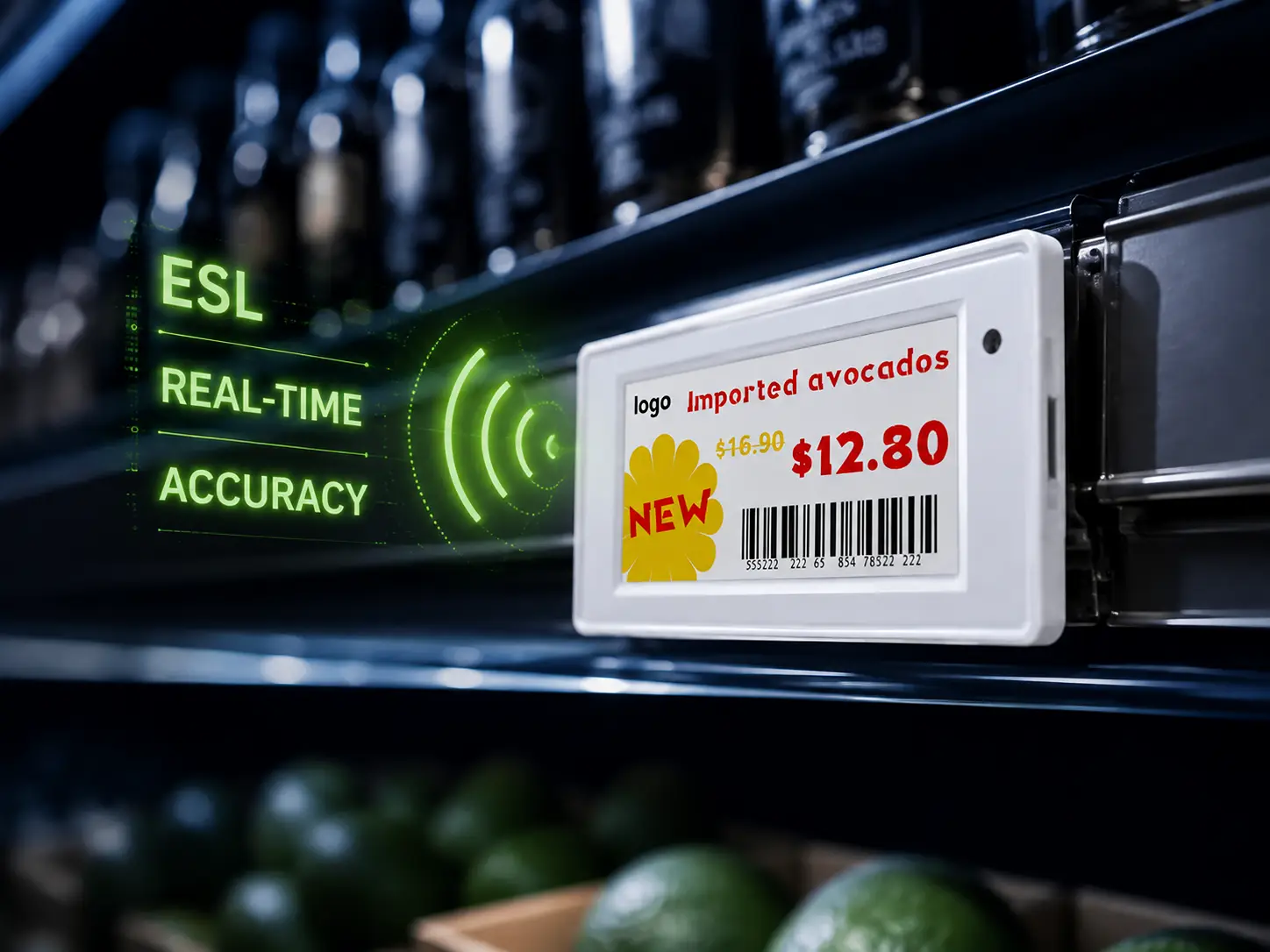
Among the manufacturers serving this global market, ZhSunyco® has deployed its multi-protocol ESL solutions across a wide range of retail formats: supermarkets in Cyprus, pharmacy chains in Greece, building materials stores in the Netherlands, sports nutrition retailers in Slovakia. The company ranks among the top three Chinese ESL manufacturers, backed by 12 years of R&D, 142 utility model patents, and the full protocol range — 2.4GHz, 433MHz, BLE, NFC, and WiFi — so retailers can match the wireless infrastructure to their store size and update frequency. On the manufacturing side, CE, ISO 9001, and RoHS certifications combine with an 8-step quality control process that includes 8X+ electron microscope inspection at the PCB level, meeting the baseline that enterprise retail deployments demand. For retailers who have already invested in pricing intelligence at the software layer, the logical next step is making sure that intelligence reaches the shelf edge — and that is precisely the layer ESL technology provides.
Verify and Iterate — Closing the Feedback Loop
The full pricing cycle has four stages: decide → execute → measure → refine. Most retailers stop after stage two.
The missing stage — verification — is what separates good pricing operations from great ones. After a price change executes across all channels, the system should capture three things: Did the price actually update on every endpoint? What happened to sales velocity at the new price point? How did the margin outcome compare to the AI’s prediction? This feedback data trains the next iteration of the pricing model, making it sharper each cycle.
Retailers who close this feedback loop gain a compounding advantage. Every cycle produces better data, which produces better recommendations, which produce better outcomes, which build organizational trust, which increases adoption, which produces more data. Competitors who stop at stage two — decide and execute — are essentially running the same pricing playbook every quarter while the market evolves around them.
Implementation Realities — Timeline, Team, and ROI Expectations
If you have read this far, you have a realistic understanding of what pricing software can and cannot do. The final question is: what does it actually take to implement, and what should you expect in return?
On timeline: a pilot deployment in a single category typically delivers initial price recommendations within 30–60 days. That is the first milestone — the system is generating usable output. But meaningful margin improvement — the kind that shows up on a quarterly earnings call — takes 6–9 months. This is not a shortcoming of the software; it reflects organizational reality. Category managers need time to trust the recommendations. Merchandising teams need time to align their workflows. The data pipeline needs time to stabilize. Anyone promising “transform your pricing in 30 days” is selling a dashboard, not a pricing system.
On ROI: the industry data converges on a consistent range. Revenue uplift of 3–7% is commonly reported. Gross margin improvement of 1.5–4 percentage points in the first year is the benchmark from practitioners (R4.ai). The most important variable is not the software — it is the organization’s willingness to adopt it. A pricing tool where category managers override 80% of recommendations is an expensive Excel replacement. A pricing tool where recommendations are accepted 70%+ of the time, with overrides tracked and analyzed for patterns, is a profit engine.
On team: the software does not eliminate the need for human judgment. It elevates it. Instead of spending 12 hours a week updating spreadsheets, your pricing team spends that time analyzing exceptions, testing scenarios, and refining strategy. The software handles the computation; the humans handle the context — competitive dynamics the data cannot see, supplier negotiations in progress, brand positioning considerations. The retailers who get the most out of pricing software are not the ones who automate everything. They are the ones who automate the repetitive and elevate the strategic.
Your pricing system is only as complete as its weakest link. If you have invested in intelligence at the decision layer, make sure that intelligence reaches every shelf, every channel, every customer — because a price that exists only in a database is a price that does not exist at all.
References
- 7Learnings / The Retail Hive. “The 2026 Retail Pricing Benchmark.” 2026. https://7learnings.com/blog/retail-hive-pricing-benchmark/
- McKinsey & Company. “The Power of Pricing.” https://www.mckinsey.com/capabilities/growth-marketing-and-sales/how-we-help-clients/pricing
- IPRoyal Survey. “Inflation as Top Driver of Retail Pricing Decisions Amid Margin Pressure.” 2025.
- R4.ai. “Retail Pricing Tool: Why Most Implementations Create More Problems Than They Solve.” 2025. https://r4.ai/retail-pricing-tool/
- IDC MarketScape. “Worldwide Retail Price Optimization Solutions 2025–2026 Vendor Assessment.” 2025. https://www.idc.com/getdoc.jsp?containerId=US52989825
- Quicklizard. “Augmented vs AI Pricing: Why Transparency Wins.” 2025. https://quicklizard.com/blog/black-box-vs-transparency-in-pricing-artificial-vs-augmented-intelligence/
- ZhSunyco®. Official Website. https://www.zhsunyco.com/
- ZhSunyco®. Case Studies. https://www.zhsunyco.com/case-studies/
- ZhSunyco®. Corporate Profile. https://www.zhsunyco.com/corporate-profile/
- ZhSunyco®. Contact. https://www.zhsunyco.com/contact-us/

 English
  Russian
  Spanish
  German
  Arabic
  French
  Bulgarian
  Polish
  Romanian
  Turkish
  Portuguese