


Pricing Tags for Retail: A Store-Size Guide to Paper, Digital, and Smart Selection
What Retail Pricing Tags Are (And Why They Matter More Than You Think)
A retail pricing tag is the last centimeter between a product and a purchase decision. It sits at the shelf edge — the exact physical point where a shopper decides whether to pick up an item or walk past it. Get it wrong, and you lose the sale. Get it consistently wrong across hundreds of SKUs, and you lose something bigger: customer trust.
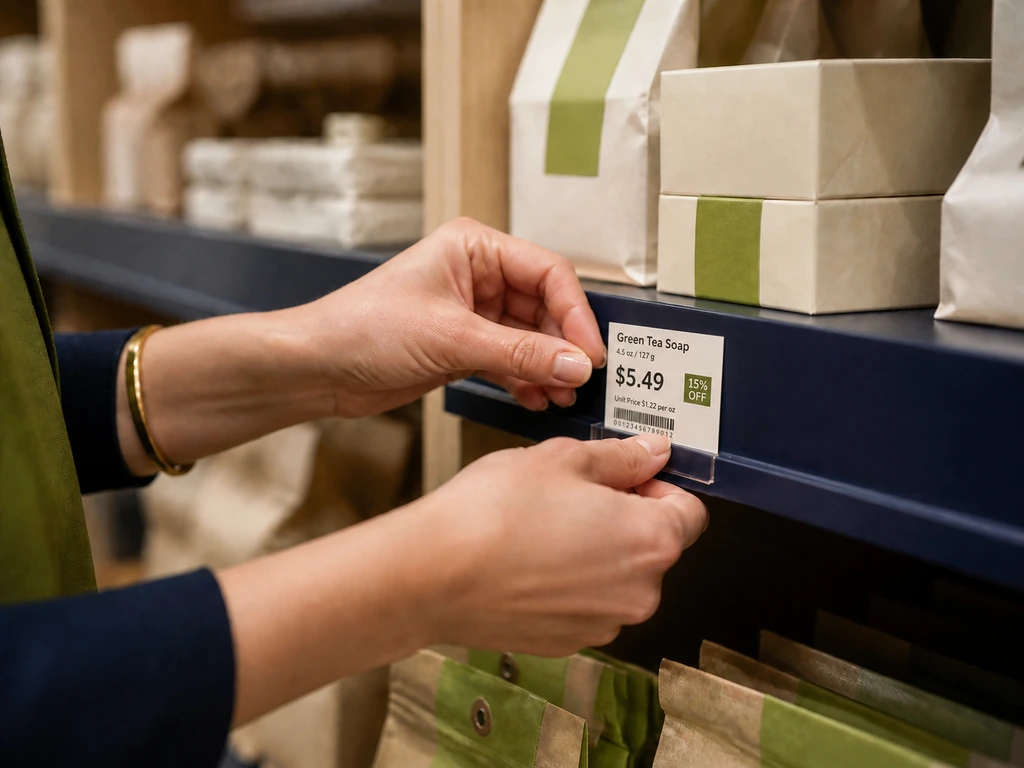
Pricing tags come in three broad categories. Traditional paper tags — the familiar printed labels attached with string, adhesive, or plastic fasteners — remain the default for millions of small shops worldwide. Electronic shelf labels (ESLs) replace paper with e-paper or LCD displays that update prices wirelessly from a central system. And special-purpose tags — hold tags, markdown cards, shelf talkers, promotional danglers — serve temporary or situational needs that neither paper nor electronic tags fully cover.
That is why choosing the right pricing tag is not an administrative detail. It is an operational decision with direct consequences for labor cost, pricing accuracy, and the customer experience at the only place that counts: the shelf edge.
Paper Tags vs. Electronic Shelf Labels: The Real Operational Differences
Before comparing features, let us frame the question correctly. Choosing between paper and electronic tags is not a technology decision. It is the answer to three operational questions: How often do you change prices? How much labor does each change consume? And what does a pricing mistake cost you? Keep those questions in mind — we will return to them.
Speed, Accuracy, and Labor: The Daily Operational Toll
For a store using paper tags, a single price change follows a remarkably labor-intensive chain: print the new tag → trim it → walk to the correct aisle → locate the specific shelf position → remove the old tag → attach the new one → verify the new price matches the system → discard the old tag. Each step costs 3–5 minutes per SKU. Multiply that by your SKU count and your annual price-change frequency, and the labor burden becomes clear.
An independent pharmacy in New South Wales, Australia, reported that staff arrived early every Wednesday to manually change hundreds of paper tags. The ritual consumed 10 hours per week (ABC News, 2026). After switching to ESLs, the pharmacist told reporters he “threw out the label printer.” Prices now update twice daily in seconds.
ESLs achieve this through centralized digital control. A price change entered in the management software sends the update to every tag on the sales floor within seconds. The same pharmacy went from one weekly update cycle to two daily cycles, improving pricing responsiveness without adding a minute of labor.
On accuracy, the gap is similarly stark. Manual paper-tag systems in grocery retail average that 2.4% error rate cited by the FTC. ESL systems, synced directly to the point-of-sale database, can reduce shelf-price mismatches to below 0.5% (IW Technologies, 2024). For a retailer facing regulatory price-verification inspections or operating in jurisdictions with consumer protection penalties, that difference translates directly to compliance risk reduction.
Information Display and the Customer Experience Gap
A paper tag can carry roughly three to five fields: product name, price, barcode, and perhaps a unit price or size. That is the physical limit of a 2-inch printed rectangle.
An ESL on the same shelf edge can display all of the above plus a QR code linking to nutritional information or sourcing details, a promotional flash for items on special, real-time stock status, multi-language switching, and membership-tier pricing. The tag transforms from a passive price announcement into an active selling tool.
Consumer behavior data supports the importance of this shift: 90% of shoppers cite price transparency as a primary factor in purchase decisions. When the shelf tag answers every question a customer might ask — “Is this on sale? Is it in stock? Where was it sourced?” — it reduces the friction that causes shoppers to pull out their phones to compare prices elsewhere.
Where Paper Tags Still Win (And Probably Always Will)
Paper tags are not obsolete. They remain the right answer in several scenarios:
- Temporary and seasonal displays. A Christmas pop-up or weekend farmers’ market stall does not need a wireless infrastructure. Paper tags are sufficient and require zero system dependency.
- Stable-price environments. A community hardware store that adjusts prices twice a year has no economic case for ESLs.
- Ultra-low SKU density. A boutique with 80 handcrafted items does not need digital labels.
- No power, no network. Outdoor markets, field events, and locations without reliable electricity or internet are ESL-incompatible.
The economic threshold for considering ESLs, as a rule of thumb, is roughly 500 SKUs with six or more price-change cycles per year. Below that, paper tags remain the financially rational choice.
How Electronic Shelf Label Systems Actually Work
An ESL system has three layers. Understanding them removes the “black box” intimidation factor.
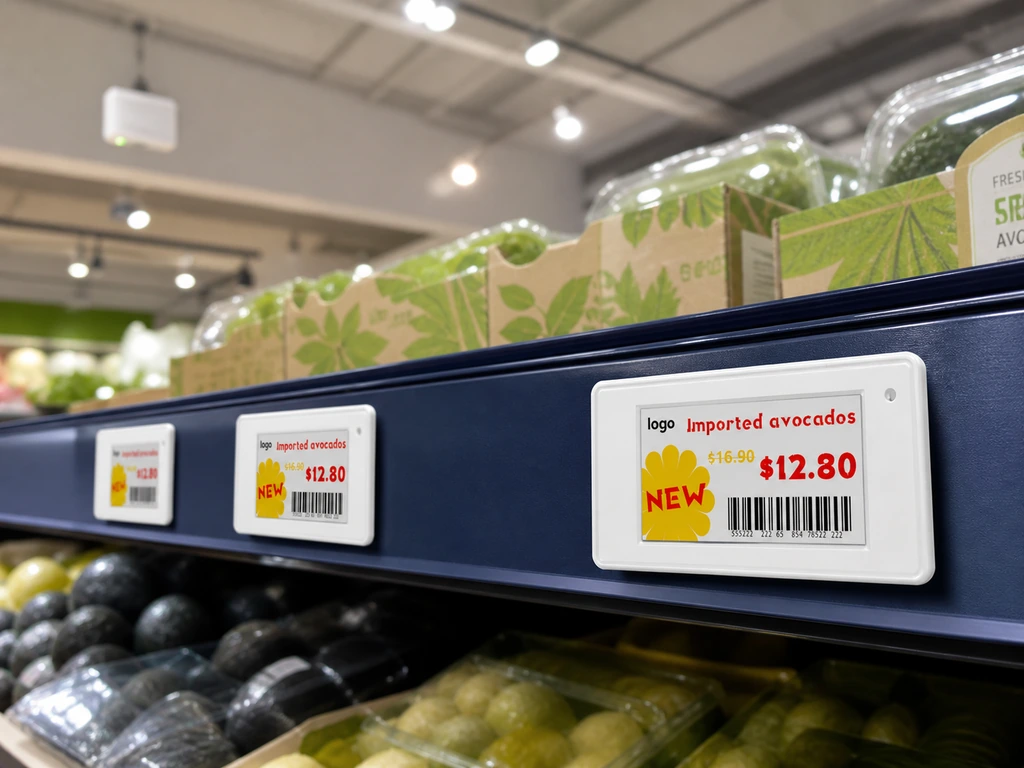
Layer one — the management software. This is a cloud-based or locally installed application where an operator sets prices. It looks and behaves like a dashboard: select a product, type a new price, click save. For multi-store chains, one dashboard controls every location.
Layer two — the communication infrastructure. Base stations or gateways installed in the store ceiling or on walls broadcast price-update signals wirelessly. Common protocols include 2.4GHz proprietary radio (good range, penetrates walls well), Bluetooth Low Energy (low power consumption, ideal for single-store deployments), WiFi (best for massive footprints), and NFC (enables shopper phone-tap interactions). A single gateway typically covers 500–1,000 tags within a 30-meter indoor radius.
Layer three — the tags themselves. Most modern ESLs use E Ink electronic paper, the same bistable display technology found in e-readers like Kindle. Bistable means the screen draws power only when changing the image. Once a price is displayed, it stays there indefinitely with zero energy consumption (E Ink Holdings). This is what enables the 3–10 year battery life that ESL manufacturers advertise. Unlike LCD displays, which require constant power to hold an image, E Ink tags are fundamentally low-maintenance devices.
Think of it this way: the system is a network of tiny Kindle screens attached to your shelves, receiving one-way updates from a router in the ceiling. Except instead of books, they display prices, and instead of manual page-turns, they refresh automatically.
What Pricing Tags Really Cost — Beyond the Sticker Price
The most expensive mistake in pricing-tag procurement is comparing the wrong numbers. A pack of 50 paper tags costs $6.99 at retail (Staples). An ESL system for a small store starts at $15,000. At a glance, paper wins. But that comparison ignores the three costs that actually matter: labor, errors, and missed opportunities.

The Hidden Costs of Paper Price Tags
Run a simple TCO calculation for a 500-SKU store changing prices every two weeks. The arithmetic:
- Materials: 500 tags × 26 change cycles × $0.14/tag ≈ $1,820 per year
- Labor: 500 SKUs × 26 cycles × 3 minutes ÷ 60 × $15/hour wage = $9,750 per year
- Error cost: 13,000 change events × 2.4% error rate × $3 average resolution cost per dispute ≈ $936 per year
- Opportunity cost: If competitors adjust prices weekly and you adjust biweekly because of the labor burden, the margin left on the table is real. This hurts most in categories like fresh produce or consumer electronics, where market prices shift quickly.
That 500-SKU store is spending over $12,500 per year on its paper-tag system. Most of it is invisible because it hides inside payroll, not the stationery budget.
ESL Upfront Investment Broken Down
An ESL system is capital expenditure, not consumables. The investment breaks into four buckets:
| Component | Small Store (500–2,000 labels) | Mid-Size (2,000–10,000 labels) |
|---|---|---|
| Hardware (labels) | $8–25 per label | Same unit cost; volume discounts |
| Infrastructure (gateways) | 1–3 gateways at $200–500 each | 3–10+ gateways |
| Software | Cloud ~$1,200–$3,600/year | Enterprise tier pricing |
| Deployment & integration | $2,000–$5,000 | $5,000–$15,000+ |
Total system cost for a small store typically lands between $15,000 and $40,000 for roughly 2,000 labels. A supermarket with 10,000+ labels can expect $80,000–$200,000 (ZKONG, 2026).
The Realistic ROI Timeline
The industry consensus, validated across grocery, pharmacy, and general retail deployments, places ESL payback at 12–24 months (IW Technologies, 2024; IGA, 2025). The primary driver is labor. The same $9,750 annual labor cost from the paper-tag TCO above flips to near-zero under ESLs. Secondary savings come from error reduction, faster markdown execution on perishables, and the ability to run more frequent promotions without additional labor.
Two caveats. First, ROI shortens dramatically with price-change frequency. A store that changes prices weekly recovers its investment roughly twice as fast as one that changes monthly. Second, budget for ongoing maintenance. Annual software subscriptions and battery replacements (every 3–10 years depending on tag model) typically run 5–8% of the initial hardware investment per year. These are not dealbreakers, but they belong in the spreadsheet from day one.
Choosing the Right Tag Type for Your Store Size
Strip away brand preferences, industry trends, and vendor pitches, and the decision reduces to two variables: how many SKUs you carry and how often your prices change. Everything else is secondary.
For Small Shops: Under 500 SKUs
If you run an independent bookstore, a boutique clothing shop, or a neighborhood convenience store with stable pricing, well-designed paper tags are almost certainly your best answer. The financial case for ESLs simply does not close at this scale.
That does not mean your paper tags should look amateurish. Use a consistent template with your logo, a clear price (minimum 24pt font for readability), a scannable barcode, and a color-coding system: white for regular price, yellow for sale, red for clearance. A professionally designed paper tag signals competence to customers and reduces scanning errors at checkout.
The threshold for considering an upgrade: you are approaching 500 SKUs and you change prices more than six times per year and you sell both online and in-store, creating a synchronization burden. At that point, entry-level BLE or NFC ESL systems — costing as little as $5–8 per label — become worth evaluating. Start with a pilot: pick the 50–100 SKUs you reprice most frequently, install ESLs on just that section, and measure the labor savings for three months before deciding whether to expand.
For Mid-Size Retailers: 500 to 3,000 SKUs
This is the decision zone where the math gets real. Big enough that ESL ROI is plausible, small enough that a wrong vendor choice hurts disproportionately.
Follow a four-step evaluation:
- Define your primary need. Is it labor reduction? Online-to-offline price synchronization? Faster promotional execution? Your answer determines which ESL features matter and which are distractions.
- Choose your communication protocol. BLE works well for single-story, open-plan stores up to about 300m² and is the simplest to install. 2.4GHz proprietary radio offers better wall penetration and range for multi-room or multi-floor layouts. WiFi suits very large footprints but consumes more tag battery. Match the protocol to your physical space, not to the spec sheet.
- Select display specifications. Do you need black-and-white only, or black-white-red for highlighting sale items? Do your customers expect QR codes for product information? Is your shelving deep enough that you need a larger screen (2.9 inches or above) for readability from the aisle?
- Evaluate vendors on integration, not just price. The critical question: does this system connect to your existing POS or ERP? If the vendor cannot name your POS platform and describe the integration path without hesitation, move on.
For Large Chains: 3,000+ SKUs and Multi-Store Operations
At this scale, the question is no longer whether to adopt ESLs. Walmart has already deployed digital shelf labels across 2,300 U.S. stores with plans to go chainwide within the year (Retail Dive, 2026). Woolworths in Australia has installed over 17 million tags across 600+ locations. The question is how to deploy at scale without creating an operational dependency nightmare.
Three considerations matter more than per-tag price:
- System architecture. Cloud-based central management with store-level permission hierarchies is essential. Your head office pricing team needs to push a promotion to 50 stores simultaneously. Each store manager needs the ability to override prices locally for clearance items. Both must work without creating conflicts.
- Vendor lock-in risk. Proprietary 2.4GHz protocols can lock you into one manufacturer’s ecosystem. Confirm that the vendor provides an open API, supports standard communication interfaces, and has a track record of integration with third-party systems. If you cannot switch vendors without replacing every tag and gateway, you are not buying a system. You are entering a marriage.
- Deployment velocity. Do not attempt a big-bang rollout. Pick two flagship stores, run a 3–6 month pilot, collect real data on labor savings and error reduction, and let the CFO’s own numbers sell the expansion to the board. Walmart’s 2,300-store deployment started with a single pilot in Grapevine, Texas.
What Your Customers Think About Digital Price Tags
If you deploy ESLs, prepare for a conversation you did not expect to have: your customers will ask whether you are about to start charging them Uber-style surge prices.
This is not irrational. When Kroger and Walmart began expanding ESL deployments, news headlines and social media erupted with “dynamic pricing” alarm. Consumer advocacy groups raised concerns. Several U.S. states — including Tennessee, New York, and Illinois — saw bills introduced to restrict electronic shelf labels in grocery stores (Retail Dive, 2026).
The fear is understandable, but the facts are reassuring. Walmart publicly confirmed its digital labels operate on a closed system with no capability for demand-based pricing. Prices are locked during store hours and updated only during overnight reset cycles. Kroger and Woolworths have made similar commitments. The technology enables dynamic pricing; responsible retailers are choosing not to use it that way.
Three practical steps to get ahead of customer concerns:
- Place a small notice card near your first ESL-equipped shelves. Something as simple as “These digital tags help our team serve you faster. Prices do not change during store hours.” It costs pennies and neutralizes the narrative before it starts.
- Train staff with a one-sentence response. When a customer asks, every employee should be able to say: “The tags are connected to our price database so the price you see is always accurate — no more mismatches at the register.”
- Make your price guarantee visible. If you have a price-match or accuracy policy, post it prominently near the entrance. ESLs paired with a visible guarantee build trust; ESLs without explanation breed suspicion.
Your customers are not opposed to new technology. They are opposed to feeling like the rules changed without their consent. A 3-by-5-inch sign and a trained team turn a potential PR vulnerability into a customer-service upgrade.
Finding the Right Pricing Tag Supplier
Whether you are buying paper tags in bulk or evaluating a six-figure ESL deployment, a structured evaluation process protects you from vendor lock-in and hidden costs. Use these five dimensions as your checklist:
| Evaluation Dimension | What to Ask | Red Flag |
|---|---|---|
| Product range | Do they offer the tag sizes, colors, and communication protocols you need — now and as you expand? | Only 1–2 sizes; no clear upgrade path |
| Certifications | FCC/CE for wireless compliance? ISO 9001 for quality management? RoHS/REACH for material safety? | Missing wireless compliance certs in your market |
| Integration capability | Open API? Documented integration with your POS/ERP? SDK availability and language support? | Proprietary closed protocol; no API docs |
| Service and support | Deployment assistance? Defined SLA for response times? Training materials? Multi-language support? | No SLA commitment; no local support |
| Customer validation | Case studies in your retail vertical and store-size segment? References you can contact directly? | Zero case studies in your industry or scale |
The global ESL manufacturing base is concentrated in two regions of China: Guangdong Province (Shenzhen, Guangzhou, Zhuhai) for electronics integration and innovation, and Zhejiang Province (Hangzhou, Ningbo) for cost-efficient high-volume production. When sourcing directly from manufacturers, verify certifications independently. Do not rely on a supplier’s self-declaration. Request a sample kit, test it in your actual store environment for at least two weeks, and, for larger deployments, visit the factory or an existing customer site before signing.
For context on what a comprehensive supplier looks like: SUNY (ZhSunyco), ranked among China’s top three ESL manufacturers, covers the full protocol stack — 2.4GHz, 433MHz, BLE, NFC, and WiFi — across tag sizes from 1.54 to 7.5 inches, with published case studies spanning pharmacies in Greece (90% efficiency gain), smart mini-marts in Cyprus, and building materials retail in the Netherlands. The company has deployed to over 400 retailers across 180 countries and provides an open API for system integrators. Use this as a benchmark when evaluating your options — not as the only answer, but as a reference point for what a full-stack supplier offers (ZhSunyco; Case Studies).
Before committing to any supplier, insist on three things: a paid sample order tested in your real store environment, a written SLA specifying system uptime guarantees and response times, and direct contact with at least one existing customer in a similar retail segment.
Whether you are running a single boutique or planning a chain-wide digital transformation, the right pricing tag strategy starts with an honest assessment of your SKU count and price-change frequency. For retailers ready to explore ESL options, manufacturers like ZhSunyco offer consultations tailored to your store format — from pilot programs to global rollouts.

 English
  Russian
  Spanish
  German
  Arabic
  French
  Bulgarian
  Polish
  Romanian
  Turkish
  Portuguese