


When retail decision-makers search for PIM tools in market, the results are typically uniform: lists of software vendors ranked by user reviews or analyst quadrants. These lists serve a purpose, but they represent an incomplete picture of what product information management requires in 2025.
The retail, manufacturers, and distributors’ buying of product information management software to complete part of a process is an operational strategy that is larger in scope. A Product Information Management (PIM) system is a lot more than a stop along the operational path to the marketing database of an organization. It is the operational and functional backbone of the retail system in focus, central to effective product data management. It needs to bridge the gap between the digitalized concept of a product and its real-life attributes, on-shelf in the store, and in the relevant warehouse.
Organizations need to stop assuming PIM is one software purchase if they truly want the ideal omnichannel equilibrium or balance. To achieve a single source of truth, an ecosystem of three should be built. The Software Layer (The container), the Methodology Layer (The rules), and the Physical Layer (The execution).
What follows is an outline of this ecosystem. It is precisely this framework that closes the gap that defines the PIM tools in the market.
| Ecosystem Layer | Core Components | Primary Function |
| Layer 1: Software | SaaS Platforms, Open Source PIM, MDM | Storing, enriching, and distributing product content and data. |
| Layer 2: Methodology | Taxonomy Maps, Data Dictionaries, Governance Models | Defining data structure, data quality rules, and attribute standards. |
| Layer 3: Hardware | Electronic Shelf Labels (ESL), Scanners, Kiosks | Capturing physical data and displaying digital assets in brick-and-mortar environments. |
Layer 1: Best PIM Software for Data Management
The software layer is the most important part. Still, there is no absolute “best” tool; it all depends on the organizational complexity and the necessary technical architecture to sustain the downstream endpoints, such as electronic shelf labels (ESLs) or mobile applications. Finding the right PIM is critical.
Top 7 PIM Tools in Market (2025 Comparison)
Before diving into the specific categories, the table below provides a snapshot of the seven most prominent software players currently shaping the industry. This list spans from agile open-source platforms to massive enterprise MDM systems, helping you align the right PIM with your business scale.
| PIM Software | Target Scale | Key Strengths | Potential Challenges | Best Use Case |
| Informatica | Enterprise | The Master Data Management (MDM) leader. Exceptional data governance capabilities supporting multi-domain data (Customer, Product, Supplier). | High TCO, long implementation cycles, legacy interface, and heavy reliance on technical IT teams. | Global 500 companies with millions of SKUs requiring strict compliance across dozens of countries. |
| Stibo Systems | Enterprise | Highly scalable Golden Record management via the STEP platform. Extremely stable architecture for complex supply chains. | Rigid and massive system. Altering the Data Model often requires expensive external consultancy. | Hierarchy support may not be deep enough for complex multinational conglomerates compared to Stibo. |
| Akeneo | Mid-Enterprise | Fashion and lifestyle brands are prioritizing Omnichannel experiences and agility. | Advanced features (like sophisticated workflows) are locked behind the Enterprise edition. Requires dev knowledge for custom builds. | Large-scale retailers need absolute data consistency across complex global hierarchies. |
| Salsify | Mid-Enterprise | The Digital Shelf expert. Combines PIM, Syndication, and DAM. Strongest direct connections to retailers like Amazon and Walmart. | Pricing can be high. Leans more towards “marketing syndication” than backend data governance; ERP integrations can be lighter. | Brand manufacturers that rely heavily on third-party e-commerce marketplaces. |
| Pimcore | Mid-Enterprise | A true All-in-One platform (PIM/MDM/DAM/CMS/Commerce). Open Source and license-free (Community Edition). | Steep learning curve. Not “out-of-the-box”; requires a dedicated internal development team to maintain and customize. | B2B manufacturers and distributors need to digitize quickly and escape Excel chaos. |
| Sales Layer | SMB-Mid | B2B focused with a highly Intuitive Interface. rapid implementation measured in weeks, not months. Excellent customer support. | Tech-driven companies or agencies need highly customized data models and frontend experiences. | DTC brands or small e-commerce teams with limited budgets prioritize Ease of Use. |
| Plytix | SMB | Designed for small teams. Unlimited Users, built-in simple DAM and analytics, and transparent public pricing. | Lacks deep enterprise automation and complex governance engines. | DTC brands or small e-commerce teams with limited budgets prioritizing Ease of Use. |
Didn’t find the right fit? Check out these two PIM software rankings: Gartner Peer Insights and G2 PIM Category.
Enterprise Solutions for Complex Global Retailers
At the very top of the pyramid are the most complex and massive-scale solutions designed for multi-domain international trade data governance. Here, the main competitors are Informatica and Stibo Systems.
These platforms are often classified as Master Data Management (MDM) Systems, as opposed to simplistic PIMs. They thrive in settings where a company operates in dozens of countries and handles millions of SKUs, acting as a centralized platform for highly controlled “Golden Record” management. They provide highly detailed permission settings coupled with prolific workflow engines that make it impossible for users to make unauthorized alterations to the data.
However, for those retailers seeking agility, these tools pose a problem.
- Implementation Cost: Total Cost of Ownership (TCO) is often well above 6 figures on a yearly basis, not including the cost of implementation service.
- Rigidity: Altering the data model to allow for new products or sales channels is often a highly complex, developer-required undertaking.
- Connectivity: Although powerful, their API setups tend to be legacy-heavy. Getting these systems connected to ERP systems or something more modern and lightweight, like IoT ESLs, often requires the construction of middleware, which incurs latency and maintenance overhead.
Mid-Market Tools with Open API Architecture
This segment represents the most dynamic area of the PIM tools in the market. Key players include Akeneo, Salsify, and Pimcore.
These platforms value ‘Composability’ and ‘Connectivity’ the most. They are built with the understanding that the journey of product data does not stop at Amazon and Shopify. It also includes TikTok Shop, digital ecommerce platforms, social commerce, and physical stores.
This category is often the most strategically appropriate for retailers with a physical store. Akeneo, for example, operates: API First. This means every data attribute — price, technical spec, stock status — is at the data level so that it is accessible through modern REST or GraphQL API.
This architecture is important for hardware integration. If a price is changed in the PIM platform, an API-first system can push that data to an ESL gateway in a matter of seconds. Unlike legacy enterprise systems that have to rely on nightly batch processing (causing price discrepancies between checkout and shelf), these systems are built with dynamic pricing in mind.
User-Friendly Tools for Agile SMB Teams
Speed and ease of use are essential for smaller brands or direct-to-consumer (DTC) manufacturers. PlytixPIM and Sales Layer rule this industry.
These companies are trying to do “PIM for everyone.” Most include Digital Asset Management (DAM) services and offer “plug-and-play” connections to most e-commerce sites. The implementation is measured in weeks instead of months, allowing for faster time to market. Yes, they don’t have advanced data governance machinery like Stibo or Informatica, but they do deal with spreadsheet chaos and reduce manual work. These are the highest ROI solutions for brands with ~5000 SKUs that sell predominantly online, offering an intuitive interface that improves product management and team collaboration.
Layer 2: Essential Methodology Tools for Governance
Software is where the data resides, but it doesn’t automatically structure or clean that data. Without restriction, a PIM solution becomes a “digital junk drawer.” The intellectual tools–the governance docs and frameworks–that wrap around the software constitute the second layer of the ecosystem, vital for product teams to maintain order.
The Taxonomy Map: Organizing the Structure
The very first thing to do prior to uploading a single SKU into the software is to build a Taxonomy Map. This is usually in the form of a visual diagram or structured spreadsheet that illustrates the hierarchy of the product catalogs.

A PIM does not understand the difference between “Apparel” and “Electronics.” The Taxonomy Map organizes items into product hierarchies and logical families (Men > Footwear > Running Shoes). This tool guarantees that items inherit the appropriate data fields. For example, the Running Shoe category must inherit data fields for Size and Material, while the Television category inherits technical specifications like those found on spec sheets (Screen Resolution and Voltage). Users without this map will experience an unorganized interface filled with irrelevant fields in the product details.
The Data Dictionary: Defining Standards
Every Data Dictionary outlines the primary guidelines governing an individual document attribute within PIM. If the Taxonomy Map is the outline skeleton, then the Data Dictionary is the soul. Each content management member of the team relies on it to address the following key questions:
- Format: Is “Color” a free-text field (where users can type “Midnight Blue”) or a dropdown menu (select “Blue”)?
- Limits: What is the highest total character count in a product title?
- Units: Is “Weight” in KG or pounds?
- Requirement: Is this field a must-have for publishing or is it optional?
Layer 3: Physical Hardware for Operations and Display
The Physical layer, or the third layer, is the most overlooked in standard information management software reviews. However, it is where the consumers and the supply chain derive the value of PIM. This includes the hardware that captures data for the PIM and the hardware that displays data from the PIM.
Electronic Shelf Labels (ESL) and Store Displays
Within a unified commerce strategy, the Electronic Shelf Label (ESL) is not simply a digital sticker, it is a dynamic surface of the PIM system. It is the Last Mile of product information.
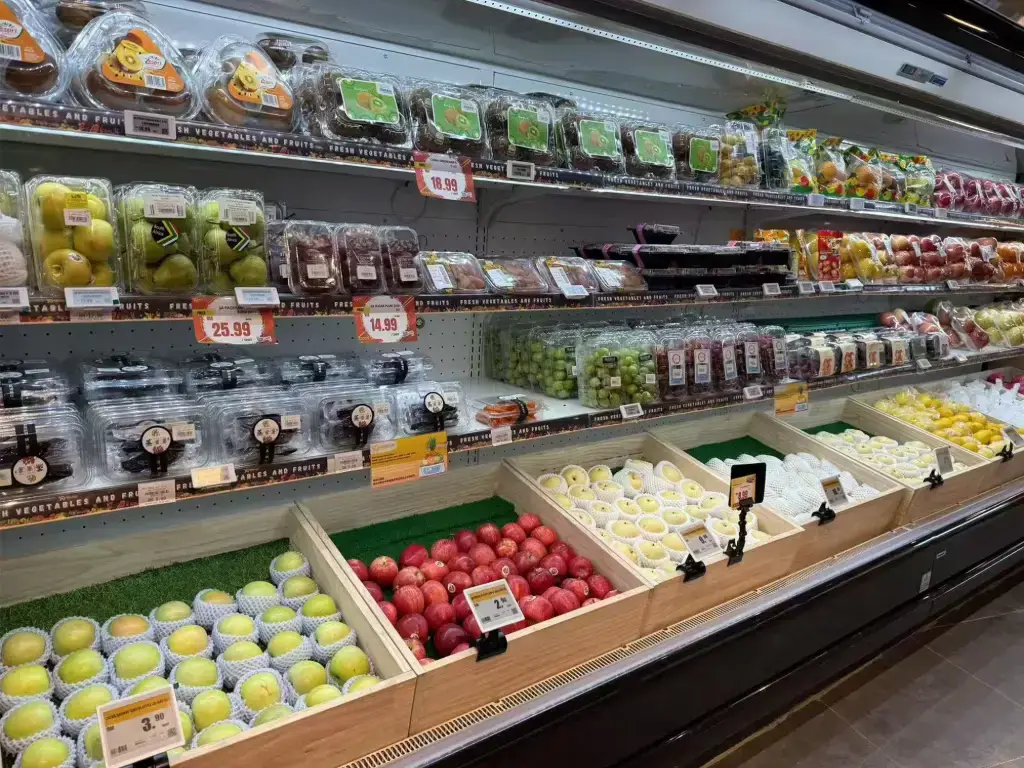
Retailers frequently deal with an issue they call “Gap of Inconsistency”. Let’s take as an example the launching of a promotion in the PIM, which updates the webstore immediately. In physical stores, however, employees must manually print and change thousands of paper tags, which creates a lag. This results in a situation in which the physical store pricing of an item (shelf price) is higher than the online price (digital price). This situation creates friction with customer experience and a loss of potential sales.
When the PIM software (Layer 1) is integrated with the ESL management system via API:
- The marketing team updates a product attribute (e.g., “Organic Certification” or “Gluten-Free”) in the PIM.
- The PIM triggers an update to the store server in real time.
- The ESL e-ink display refreshes automatically to show the new certification icon.
This turns shelf edges into marketing opportunities. Moreover, Interactive Kiosks are the “Endless Aisle” of physical stores. The kiosks integrate with the PIM database to overcome the constraints of physical store space. A customer scans the barcode, and the kiosk, via the PIM, retrieves and displays the various attributes, sizes, and other modifications of items held in the central warehouse, that aren’t available on the local shelf. The kiosks transform from passive displays into active demand generators to ensure that a store “stock-out” does not lead to a lost sale.
Using product data, digital signage unlocks the ability to create tailored and contextual experiences like Lift and Learn, a technology where a customer scans a product to unlock videos and comparison tables in the PIM’s digital asset library. More importantly, these displays can be strategically programmed with digital shelf analytics and PIM rules to become “siloed” (unresponsive to other marketing displays to prevent redundant messaging); remove adverts for items that fall below a particular stock level, and become stale by not reacting to other marketing displays. This guarantees siloed consistency in the marketing execution and eliminates unnecessary spend in marketing activities for items that can’t be purchased.
Data Capture Devices for Warehouse Accuracy
There is no point in displaying data if it is not accurate. Consequently, we now look at the operational edge of the physical layer: Laser Scanners and PDA Handhelds.
The PIM system concerning logistical data such as dimensions (height, width, depth), weight and packaging hierarchy (inner pack vs master case) is the system of record. This is crucial to determining the cost of shipping and planning space in the warehouse.

The PIM system is validated by the hardware tools deployed in the warehouse to ensure data accuracy.
- Inbound Logistics: When the shipment is received, warehouse personnel use their scanners to validate the physical GTIN (Global Trade Item Number) against the record in the PIM.
- Data Quality Control: When a barcode is scanned, and the system registers a ‘Product Not Found’ message, it clues in on a weak spot in the PIM data ingestion ecosystem.
- Dimensional Weight: Modern dimensioning scales record the dimensions of a box, and that data is subsequently sent to the PIM.
When there is damage, the shipping calculator at the e-commerce checkout will provide inaccurate costs due to the PIM containing erroneous weight data. If there is unverified barcode data in the PIM, the checkout scanner in a store is unable to ring up an item. Always ensure the systems are properly integrated to maintain accurate product data in the digital records captured.
Why Omnichannel Success Requires All Three Layers
When analyzing the PIM tools in the market, without this three-layer structure, the investments will be very fragmented. For example, a company may buy a leading premium license for software (Layer 1) but then neglects to put enforcement for data standardization (Layer 2) leading to data that cannot be properly rendered on devices used in the stores (Layer 3). That is why it is important to see the complete data flow in its entirety.
- Ingest & Verify: Data enters the PIM Software from suppliers. The Warehouse Hardware verifies the physical characteristics (weight/barcode) while digitally attributing it.
- Govern & Standardize: Under the Methodology Layer, it is dictated that product description should be concise enough to fit on ESLs while the images are required to be high resolution for Kiosks.
- Enrich & Contextualize: Emotional descriptions and additional media are provided by the marketing team to enhance the product experience.
- Distribute & Display: The PIM systems simultaneously push data that is clean and enriched to the Webstore and the ESL Gateway.
ROI is achieved only when this flow is unbroken. The efficiency gains come not just from faster marketing (Software), but from the elimination of manual price tagging (Hardware) and the reduction of shipping errors (Methodology/Capture).
Checklist: Selecting PIM Tools for Retail Growth
As you evaluate vendors, use the following matrix so that the chosen solution services the entire ecosystem, beyond only the marketing department.
| Dimension | Key Considerations for PIM Selection |
| Target Company Scale | Is the tool built for Large enterprises governance (Informatica) or Mid-market agility (Akeneo/Salsify)? |
| Integration & Ecosystem | Does the vendor have a pre-built connector or a documented API for IoT/ESL providers? How easy is it to connect to WMS (Warehouse Management Systems)? |
| Tech Stack Architecture | Is it API-first / Headless? Can it support “Get” requests from thousands of store devices simultaneously without crashing? |
| Functional Breadth | Does it include DAM (Digital Asset Management)? Images are required for Kiosks and POS tablets. |
| Commercial Capabilities | Does it support multi-currency and multi-language management for international physical stores? |
| Scalability & Performance | Can the system handle high-frequency updates (e.g., dynamic pricing changes every hour)? |
| Primary Use Case | Is the tool focused only on “Marketing Copy” or does it handle “Technical/Logistical Data” equally well? |
Conclusion: Building Your Complete PIM Tech Stack
In the year 2025, the PIM tools marketplace is no longer about storing product descriptions. It is about the technical systems that unify the digital with the physical.
The best product information management merchants are the ones who choose open architecture systems that interface with physical devices, spend effort on creating the taxonomy maps that dictate the quality of their data, and consider their shelf-edge technology—scanners and electronic labels—primary within their PIM strategy.
In such organizations, the value of advanced data goes beyond managing the information to controlling the entire Retail ecosystem—a true product experience management strategy—making sure that the product promise of the online offer is fulfilled at the shelf edge.
At Zhsunyco, we are the physical backbone of this ecosystem. Our ESL solutions are engineered to integrate seamlessly with your PIM capabilities, turning static data into dynamic shelf-edge updates instantly. Powered by robust open APIs and efficient MQTT protocols, we guarantee that a price change in your software is reflected on the shelf in real-time. We even offer high-definition LCD displays to amplify your visual storytelling. Don’t let your strategy fail at the last mile—let us connect your software to the store floor.

 English
  Russian
  Spanish
  German
  Arabic
  French
  Bulgarian
  Polish
  Romanian
  Turkish