


If you run a retail store and have typed “electronic shelf labels cost” into Google, you are probably not looking for a single number. You are looking for a number you can take to your CFO. That number does not live on a pricing page. It lives in a spreadsheet that accounts for hardware, software, installation, and the costs you stop paying once the paper tags come down. This guide walks through every layer of that spreadsheet.
01 — What Makes Up the Cost of Electronic Shelf Labels?
An ESL system is not a product you buy off a shelf. It is four cost layers stacked together, and each one behaves differently over time. Understanding the structure before you look at per-unit prices is the difference between an accurate budget and an awkward conversation six months after deployment.
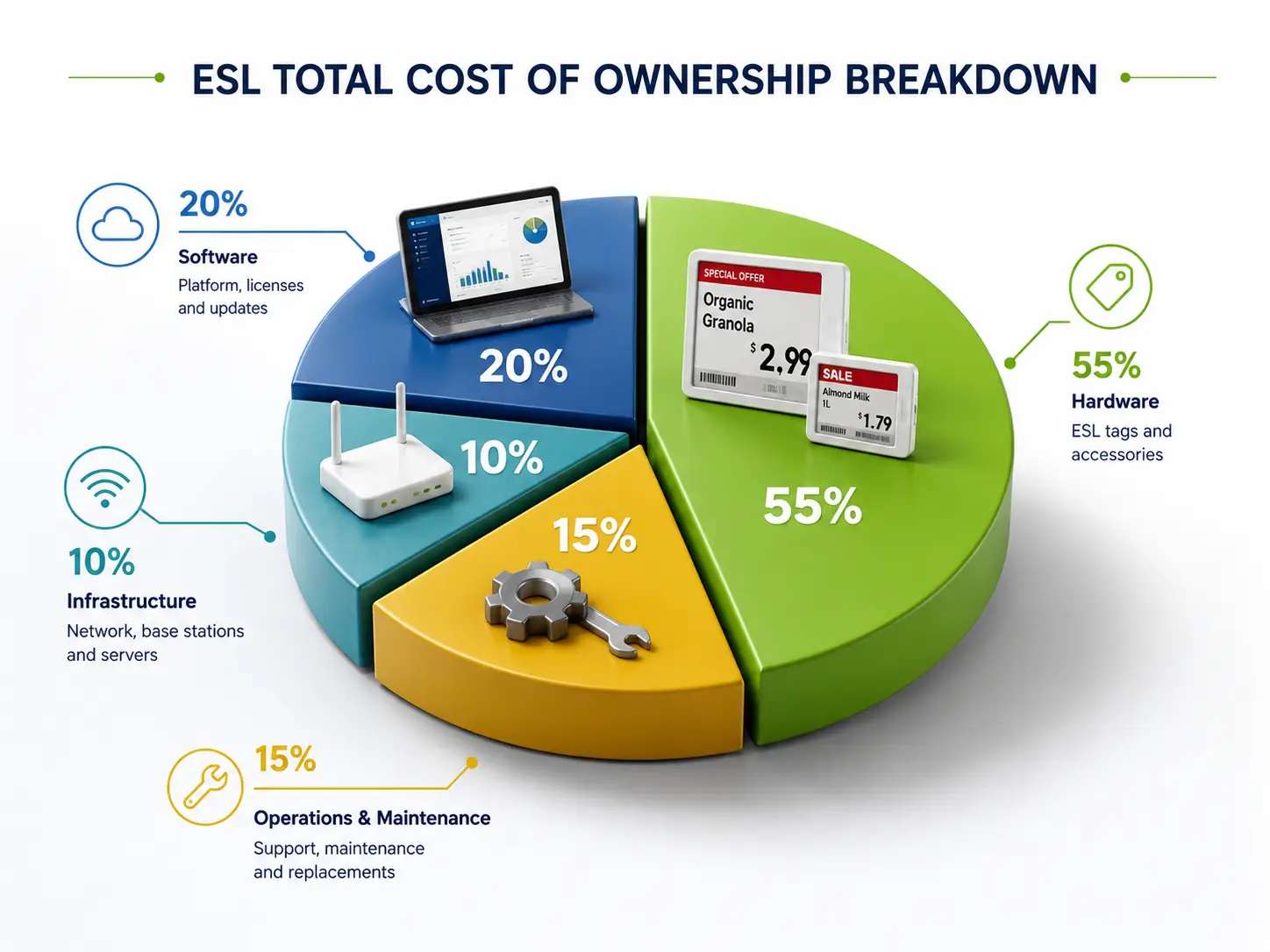
The total system cost splits into roughly four buckets: hardware procurement (the one-time big ticket, around 55% of total), software and integration (20%, split between one-time and recurring), infrastructure deployment (10%), and ongoing operations and maintenance (15%). These percentages shift by store size and vendor model, but the structure holds across nearly every deployment.
The Hardware Side — Labels, Screens, and Infrastructure
Hardware is the most visible cost. It is the number that shows up first on every quote. It has three sub-layers.
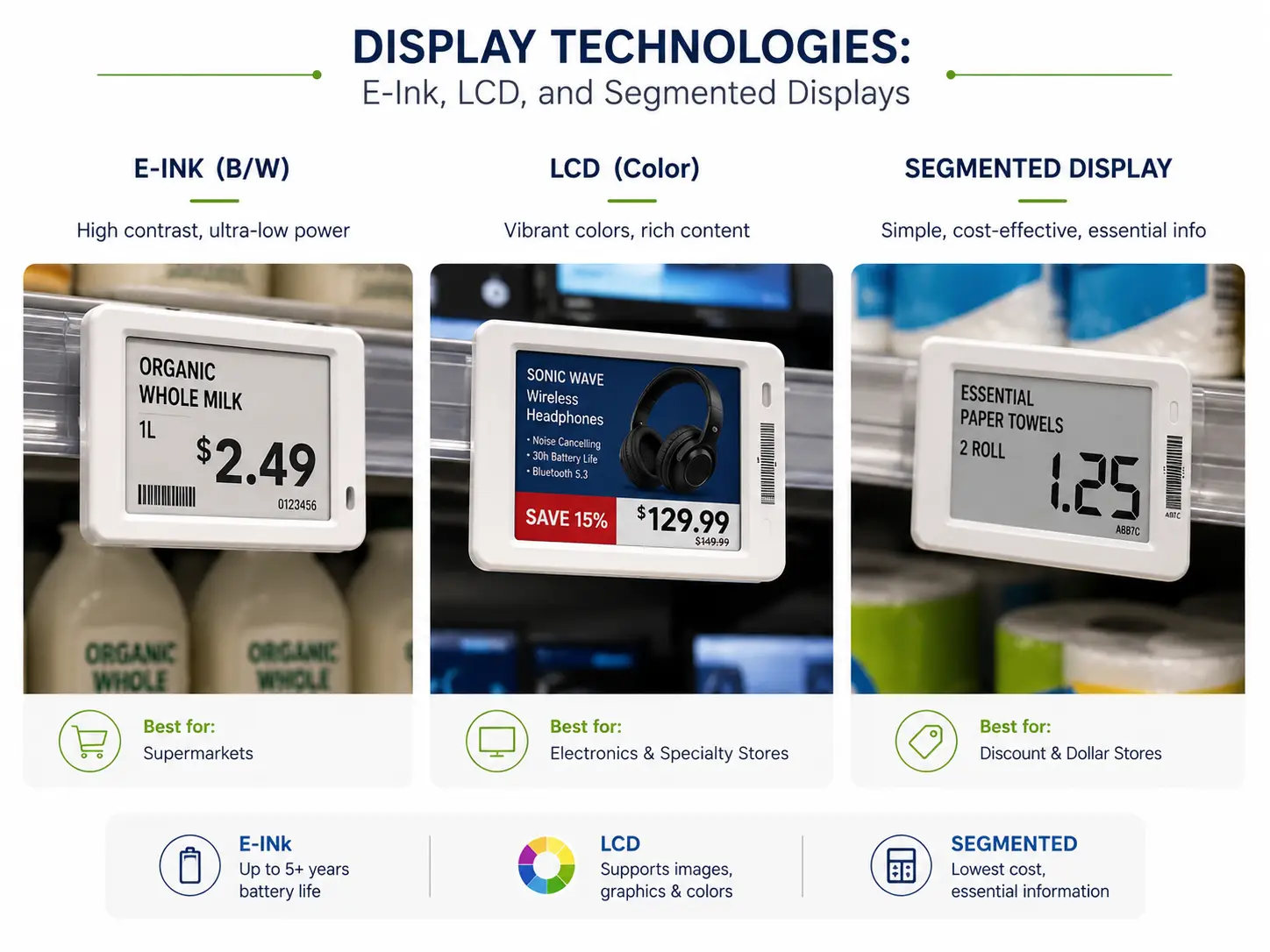
Labels. The tag itself. Electronic ink (e-ink) labels are the workhorse of grocery and pharmacy: a standard 2.13-inch e-ink tag runs $8 to $12 per unit, while larger 7.5-inch versions climb to $15 to $25. Freezer-rated models use a different battery chemistry to survive sub-zero temperatures and cost $12 to $20. At the premium end, full-color LCD labels — the kind you see in electronics stores and luxury retail — run $20 to $40 or more per unit. Segmented-display labels, which only show numbers, come in at $5 to $10 and suit discount formats where price is the only variable that changes.
Gateways. One gateway (also called a base station or access point) typically covers a 10-to-15-meter radius and manages up to roughly 2,000 labels. A 1,000-square-meter grocery store needs 8 to 15 gateways, each priced between $200 and $600 depending on the protocol: 2.4GHz, 433MHz, BLE, or Wi-Fi. Gateways are not a rounding error. In a mid-size supermarket they add $3,000 to $7,000 to the hardware bill.
Mounting accessories. Rails, clips, hooks, and stands. Usually 5–10% of the total hardware spend. Easy to overlook, impossible to deploy without.
For a 10,000-SKU mid-size supermarket, the hardware math is straightforward: 10,000 labels at an average of $10 each equals $100,000. Add 10 to 12 gateways at $400 each — another $4,000 to $4,800 — plus accessories. Total hardware: roughly $110,000 to $120,000. That is the number most quotes open with. It is also only part of the story.
The Software and Service Side — Licenses, Integration, and Support
If hardware is the car, software is the insurance, fuel, and maintenance. The cost that keeps running long after the sticker price is forgotten. Three sub-layers matter here.
Management software. Most vendors charge a SaaS subscription of $150 to $400 per store per month for their ESL management platform. Over five years, that is $9,000 to $24,000 per store. Some manufacturers offer a one-time perpetual license instead, typically $3,000 to $8,000, with free updates for life. The difference between these two models over five years can exceed $15,000 per store. That is enough to buy 1,500 more standard e-ink labels.
System integration. Connecting the ESL system to your existing POS, ERP, or e-commerce platform is a one-time cost that ranges from $2,000 to over $15,000, depending on how modern your backend is. Open-protocol systems using MQTT or REST APIs tend toward the lower end. Closed, proprietary ecosystems require vendor-specific middleware that pushes costs higher.
Ongoing support. Technical support contracts run $100 to $300 per store per month. Battery replacement cycles depend on the environment: e-ink labels in ambient conditions last 5 to 7 years on one battery; freezer labels need replacement closer to year 3. A store with 10,000 labels should budget for a rolling replacement program starting around year 5.
The quick math: a SaaS software model costs about $18,000 over five years at $300 per month. A one-time license at $5,000 with free updates saves $13,000. That covers the gateway and installation costs entirely. Asking “SaaS or perpetual?” before you sign is not a detail. It is one of the most expensive questions you will ever ask an ESL vendor.
02 — ESL Hardware Costs by Label Type and Store Size
Different retail formats need different display technology, and the per-unit price spread is wide enough to swing a six-figure deployment budget by 30% or more. This table maps the three main technology routes to cost, lifespan, and best-fit use cases.
| Label Technology | Typical Sizes | Price per Unit | Battery Life | Best For | Typical Supplier |
|---|---|---|---|---|---|
| E-Ink (E-Paper) | 2.13″–7.5″+ | $8–$25 | 5–7 years (ambient), ~3 years (freezer) | Supermarkets, pharmacies, general merchandise | E Ink-based manufacturers |
| LCD (Full Color) | 2K resolution, various | $20–$40+ | 50,000 hours (~5.7 years continuous) | Electronics, luxury retail, appliance stores | BOE/LG/Samsung panel-based manufacturers |
| Segmented Display | Fixed sizes | $5–$10 | 5–7 years | Discount stores, bulk retail (price-only display) | Budget-focused manufacturers |
The right choice depends on what your customers need to see on the shelf edge. A supermarket needs e-ink: readable under harsh fluorescent light, battery lasts half a decade, and the per-unit cost is manageable at scale. An electronics retailer showing spec sheets and promotional videos needs LCD. A discount grocer who only changes numbers on a white tag needs segmented displays. Matching technology to use case is the single biggest lever you have on hardware cost.
03 — Software, Integration, and Ongoing Operational Costs
If you have read this far, you already know that software is not an afterthought. It is the cost layer where most first-time ESL buyers get surprised. This section goes deeper into the two dimensions that separate a predictable budget from a creeping one: the pricing model you choose and the hidden costs you did not know to ask about.
SaaS Subscription vs. One-Time License — What the 5-Year Math Shows
The SaaS model is the industry default. It sounds reasonable at $150 to $400 per store per month — until you multiply by 60 months. Over five years, a single store pays $9,000 to $24,000 in software fees alone. A 50-store chain? $450,000 to $1.2 million. That is not software cost. That is a second hardware deployment, paid in installments.
The alternative, offered by a subset of manufacturers, is a perpetual license: pay once ($3,000 to $8,000), own the software, receive updates for life. The five-year saving per store is $6,000 to $16,000. Across a chain of 20 stores, that is $120,000 to $320,000 back in the budget. Enough to fund an entire expansion phase.
There is a second dimension inside the software decision: open versus closed protocols. A system built on MQTT or standard REST APIs can be integrated with your existing POS and ERP by your in-house IT team or a third-party integrator, typically for $2,000 to $5,000. A closed, proprietary system requires the vendor’s own integration services, which start at $5,000 and can exceed $15,000 for legacy backend environments. The protocol choice is a cost choice. Most buyers do not know to ask about it until the integration quote lands.
Hidden Costs That First-Time ESL Buyers Miss
Four costs routinely escape the initial budget conversation. Any one of them can turn a tidy ROI projection into an awkward boardroom update.
- Network infrastructure upgrades. ESL gateways need reliable network connectivity. If your store’s Wi-Fi coverage has dead zones — and most do — you will need additional access points or Ethernet runs. Budget $2,000 to $8,000 for a mid-size store. A reputable vendor should conduct a free site survey before quoting. If yours will not, that is a signal.
- Integration debugging. The POS-to-ESL connection rarely works on day one. Plan for 20 to 40 hours of integration and testing time, whether handled by your IT team or billed by the vendor. At $100 to $200 per hour, that is $2,000 to $8,000 in labor that sits outside the hardware quote.
- Staff training. Switching from paper to digital sounds simple. In practice, store staff need 10 to 20 hours of training each to operate the ESL management dashboard, handle label pairing, and troubleshoot common issues. For a store with 15 staff members, that is 150 to 300 hours of paid time before the system goes live.
- Battery replacement budgeting. E-ink label batteries last 5 to 7 years in ambient conditions but closer to 3 years in freezer and chilled sections. A store with 2,000 freezer labels will face a $10,000 to $24,000 replacement bill around year 3. That cost needs to live in the financial model from day one, not arrive as a surprise.
04 — ESL vs. Paper Labels — The 7-Year Total Cost Picture
All the numbers so far answer “what does ESL cost?” The more important question — the one your CFO will ask — is “is it cheaper than what we are doing now?” Over a seven-year horizon, the answer is yes, by a margin that makes the upfront investment hard to argue against.
7-Year Cost Comparison — Where ESL Becomes Cheaper Than Paper
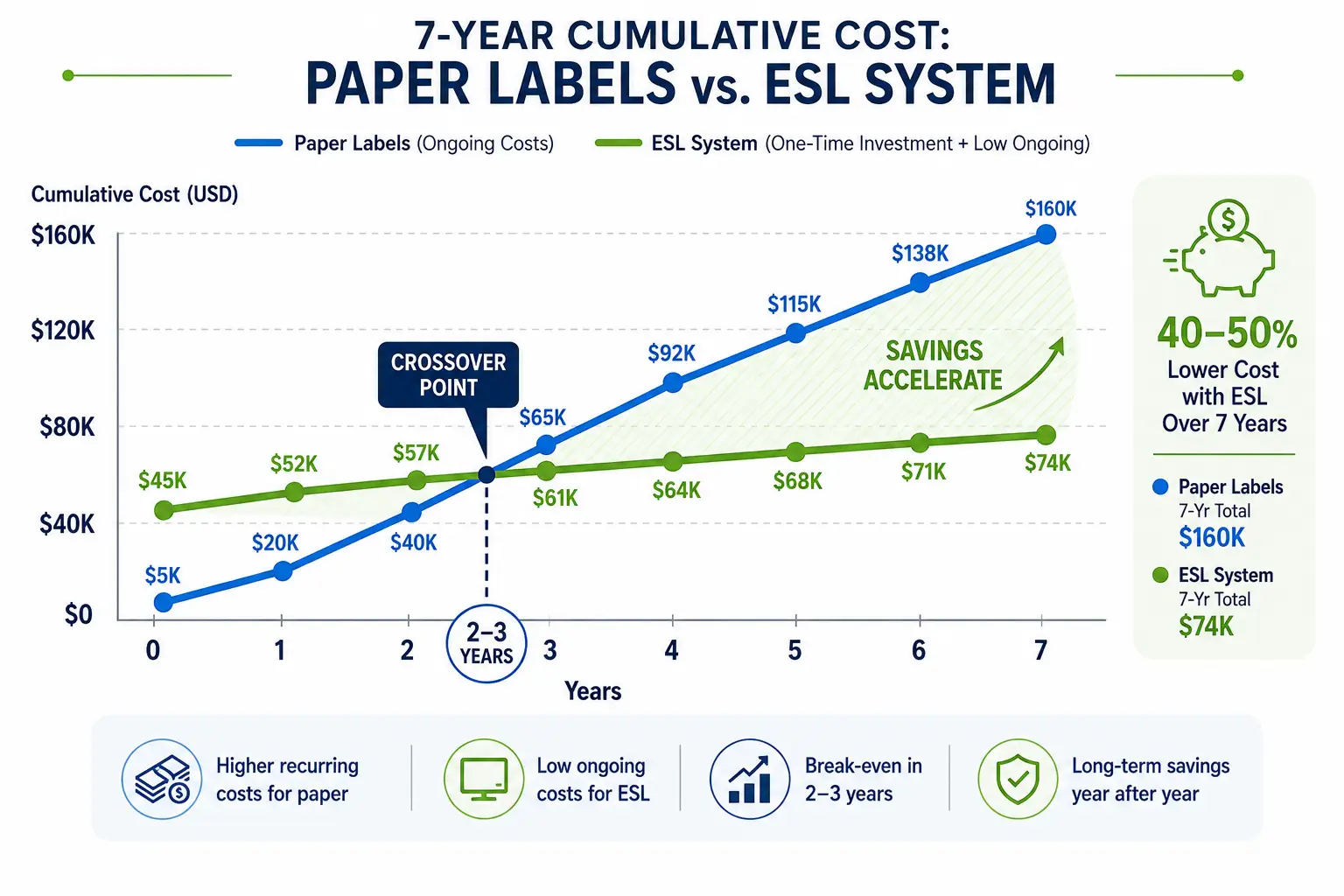
Take a 20,000-SKU mid-size supermarket as the model. This store currently runs a paper-based pricing system: staff spend 30 to 50 hours per week printing, sorting, and swapping shelf tags. That labor, at an average $18 per hour, costs $28,000 to $47,000 per year. Paper, ink, and printer maintenance add another $3,000 to $8,000 annually. Pricing errors add more: the Food Marketing Institute found that even well-run supermarkets carry a 2–5% error rate on shelf prices, creating a steady drip of checkout disputes, regulatory fines, and margin erosion from accidental undercharging. In a store this size, those errors cost $8,000 to $15,000 per year.
Over seven years, the paper system’s cumulative cost: roughly $390,000 or more.
Now the ESL system for the same store. Hardware, amortized over the 7-year lifecycle: roughly $120,000 to $160,000, including one battery replacement cycle around year 5. Software (perpetual license model): $5,000 to $8,000 once. Ongoing maintenance and support: $12,000 to $25,000 over seven years. Total: $170,000 to $220,000.
The ESL system costs 40–50% less than paper over seven years. The crossover point — the year when cumulative ESL costs fall below cumulative paper costs — lands between year 2 and year 3 for most grocery and mid-size retail formats. After that point, the ESL system runs at a substantially lower annual cost for the remainder of its lifecycle. Paper costs keep climbing. ESL costs flatten.
| Cost Category | Paper System (7-Year) | ESL System (7-Year) |
|---|---|---|
| Label Change Labor | $196,000–$329,000 | $0 (automated) |
| Printing Materials & Consumables | $21,000–$56,000 | $0 |
| Pricing Error Losses | $56,000–$105,000 | $5,000–$10,000 |
| Hardware (Labels + Gateways) | $0 | $120,000–$160,000 |
| Software Licensing | $0 | $5,000–$8,000 (perpetual) |
| Maintenance & Support | $0 | $12,000–$25,000 |
| TOTAL | ~$390,000+ | $170,000–$220,000 |
Camp ROI Timeline — How Fast Different Store Types Get Their Money Back
Not every store recovers its ESL investment at the same speed. The two biggest variables are how frequently your prices change and how much you pay for labor.
| Store Type | Typical Payback | Primary Savings Driver |
|---|---|---|
| High-velocity grocery (frequent promotions) | 6–12 months | Labor reduction + dynamic pricing revenue uplift |
| Standard supermarket (10,000–25,000 SKUs) | 12–24 months | Labor reduction + pricing error elimination |
| Pharmacy / health retail | 12–24 months | Regulatory compliance + labor |
| Mid-size retail (moderate update frequency) | 18–24 months | Labor reduction + accuracy |
| Small format (500–1,000 SKUs) | 12–18 months | Labor reduction (proportionally largest impact) |
| Electronics / appliance (high-ticket items) | 18–24 months | Error elimination (single pricing mistake can cost hundreds) |
The ROI formula: divide total system investment by annual net savings. Annual net savings equals labor saved plus materials eliminated plus error reduction value plus any dynamic pricing upside, minus annual software subscriptions and maintenance fees.
Run the numbers on a real store. A mid-size supermarket with 10,000 SKUs currently spends 40 hours per week on paper label changes. ESL deployment costs $120,000 all-in. The annual saving: 35 hours per week freed at $18 per hour equals $32,760 in labor, plus $5,000 in paper and ink eliminated, plus roughly $8,000 in error-related losses avoided. Total annual saving: $45,760. Payback period: $120,000 divided by $45,760 gives approximately 2.6 years. After that, the store saves over $45,000 every year for the remaining 4 to 5 years of the hardware lifecycle.
05 — How Direct-from-Factory ESL Pricing Changes the Math
There is a structural reason ESL prices vary so widely between vendors, and it has almost nothing to do with the hardware itself. Most electronic ink labels use the same E Ink Corporation display panels. The price difference comes from how many hands touch the product between the factory floor and your store.
The traditional ESL supply chain works like this: a manufacturer produces the tags at a certain factory-gate price. A regional distributor adds 20–30%. A local system integrator — the company that actually installs and configures the system — adds another 20–30%. By the time a $6 factory-gate e-ink tag reaches the end customer, it is a $10 to $12 tag. The hardware did not change. The supply chain did.
The factory-direct model eliminates those intermediate markups. The retailer buys hardware, software, and support directly from the manufacturer, who also provides integration guidance and after-sales service. The same hardware specification can cost 30–50% less simply by removing two layers of margin. The software model often shifts too: factory-direct manufacturers are more likely to offer perpetual licenses rather than mandatory SaaS subscriptions, because their revenue model is built on hardware manufacturing scale, not recurring software rent.
Not every factory-direct supplier is equal, and evaluating them requires looking past the quote. A credible direct manufacturer should clear three thresholds: annual production capacity in the millions of units (proving they serve enterprise-scale deployments, not just sample orders), a full set of international certifications (CE, ISO 9001, RoHS, and ideally automotive-grade standards like IATF 16949), and self-developed software rather than white-labeled third-party platforms. If the manufacturer does not control the software roadmap, you will be dealing with two companies when something breaks.
Some manufacturers combine these capabilities under one roof. Zhsunyco, for instance, operates 12 production lines across a 20,000-square-meter facility with an annual ESL capacity of 7.2 million units, holds CE, ISO 9001, RoHS, and IATF 16949 certifications, and sources core components directly from DKE, 3M, Panasonic, and E Ink — the same supply chain as the brands you already recognize. Their ESL software runs on a one-time purchase model with free lifetime updates (verified manufacturer profile, quality management system). The value proposition is not “cheaper because worse.” It is “cheaper because shorter supply chain.”
06 — How to Evaluate ESL Proposals and Get the Best Value
You are now equipped to read an ESL quote the way a procurement professional reads it: not as a single number, but as a set of assumptions about cost structure, software model, and lifecycle economics. Use these five filters when comparing proposals.
- Total cost transparency. Ask every vendor for a five-year TCO model that breaks out hardware depreciation, software licensing, battery replacement cycles, and technical support. A vendor who gives you only a per-tag price and a monthly SaaS fee is not being transparent. They are being selective.
- Software pricing architecture. Is it SaaS-only, or is a perpetual license available? Is the API open (MQTT, REST) or proprietary? If the answer is “proprietary and SaaS-only,” model the five-year cost before comparing it to alternatives.
- Hardware provenance and certification. Are the displays genuine E Ink panels? Which international certifications does the manufacturer hold? What is the stated battery warranty — and does the contract specify per-unit replacement cost and response time?
- Deployment and support capability. Does the vendor provide a free on-site RF survey before quoting? What is the stated SLA for technical support? Is there a local service presence, or is all support remote?
- Manufacturing scale. Annual production capacity in the millions of units is a reasonable proxy for supply chain maturity and the ability to support a multi-store rollout without delays. Ask for the number.
A vendor who answers all five questions clearly and in writing is almost certainly a vendor worth shortlisting. A vendor who deflects or answers vaguely on any of them is showing you how the relationship will work after the contract is signed.
If you are evaluating factory-direct options and want to compare a supplier’s full specifications, pricing model, and deployment support against these five filters, Zhsunyco offers free consultations with a custom TCO breakdown — request a free consultation to start that conversation.
References
- Food Marketing Institute. “Shelf Price Accuracy in Supermarkets That Scan.” 2001. fmi.org
- Fortune Business Insights. “Electronic Shelf Label Market Size, Share & Industry Analysis, and Regional Forecast, 2026–2034.” 2026. fortunebusinessinsights.com
- Global Market Insights. “Electronic Shelf Label Market Size & Share 2026–2035.” 2026. gminsights.com

 English
  Russian
  Spanish
  German
  Arabic
  French
  Bulgarian
  Polish
  Romanian
  Turkish
  Portuguese