


How to Design Furniture Price Tags That Sell — From Paper Hang Tags to Digital ESL
Why Furniture Price Tags Need a Different Design Approach
Walk into a supermarket and the price tags work perfectly: you’re standing two feet from the shelf, the fluorescent lighting is bright and uniform, and all you need is a number. Now walk into a furniture showroom. The sofa you’re eyeing is twelve feet away. The lighting is warm and directional — great for making walnut veneer glow, terrible for reading fine print. And you’re not just checking a price; you’re mentally calculating whether a $2,499 sectional is worth three times more than the one you saw last weekend.

Furniture price tags operate under fundamentally different constraints than general retail tags. Three differences stand out.
First, reading distance. In a supermarket, the customer is 1–3 feet from the shelf edge. In a furniture showroom, the typical viewing distance is 6–15 feet — and a customer may decide whether to walk closer based entirely on whether they can read the price from where they stand. A tag designed for close-up reading becomes invisible at showroom scale.
Second, aesthetic tension. A supermarket aisle is a utilitarian space; no one expects the price tags to be beautiful. But a furniture showroom is selling a lifestyle — the room vignettes, the coordinated textures, the aspirational atmosphere. A fluorescent orange sticker screaming “SALE” on a hand-rubbed oak dining table doesn’t just look bad; it undermines the perceived value of the product itself.
Third, information depth. Grocery price tags need a price and a unit. Furniture price tags need to justify a four- or five-figure purchase decision. Materials, dimensions, finish options, delivery lead times, care instructions — the tag is not just a label, it’s a silent salesperson working when staff are busy with another customer.
The core challenge of furniture price tag design, then, is solving two problems simultaneously: functional visibility at distance and brand-consistent presentation up close. Get either wrong, and the tag costs you more in lost sales than you saved on printing.
Core Elements of Effective Furniture Price Tag Design
Before choosing between paper and digital — before selecting materials or fonts — there’s a design framework every furniture price tag needs to get right. The golden rule: an effective furniture price tag must answer three questions in three seconds — What is this? How much does it cost? Why is it worth that price?
These three questions map directly to the three design dimensions that follow.
Information Hierarchy — What to Include and in What Order
Most poorly designed furniture tags fail not because they lack information, but because they lack hierarchy. When everything on the tag is the same size, nothing guides the eye — and at showroom distance, that means nothing gets read.
Think of your price tag as a four-layer pyramid. The top layer answers the first question any customer asks; each layer below adds depth for those who step closer.
Layer 1 — Identity + Price (largest type): Product name and price must dominate the tag visually. This isn’t negotiable. A customer scanning a room from ten feet away should register both elements without squinting. For a dining table, this reads: “Toscana Extending Dining Table — $2,199.”
Layer 2 — Value Signals (medium type): This is where you justify the price in a single line. Material provenance, style era, craftsmanship marker — whatever makes this piece worth its number. “Solid American Walnut / Mid-Century Design” or “Hand-Turned Legs / Italian Leather.” This layer bridges the gap between price shock and perceived value.
Layer 3 — Specifications (smaller type): Dimensions, finish options, material composition, delivery estimate. Practical information the customer needs before making a decision, but not before they’re already interested. Keep it scannable: “78”L × 42″W × 30″H · Available in Walnut, Oak, or Matte Black.”
Layer 4 — Machine-Readable Data (smallest type): SKU, barcode, QR code. Essential for operations, invisible to the browsing experience. The QR code earns its spot here if it links to something useful — assembly video, material sourcing story, or customer reviews — but it should never compete with Layers 1–3 for visual attention.
Retail behavior research consistently shows that shoppers allocate only a few seconds of attention to any single display before deciding whether to engage further. A tag with clear visual hierarchy respects that reality; a tag without it fights against human nature and loses.
Typography and Readability — Fonts That Work at Showroom Distance
Typography isn’t decoration — it’s a functional specification for how information travels from the tag to the customer’s brain across a room full of visual noise.
Font choice. Sans-serif typefaces — Montserrat, Helvetica, Inter, Open Sans — outperform serifs at distance. The clean strokes and open apertures hold their shape when viewed from across a room, while serifs blur together. Limit yourself to two font families maximum: one for the product name and price, one for supporting text. Every additional font erodes the visual coherence that makes a tag look professional rather than cobbled together.
Size. These numbers aren’t suggestions; they’re based on the geometry of human vision at showroom distances:
| Element | Minimum Size | Visible At |
|---|---|---|
| Price | 24px | ~8–10 ft |
| Product name | 18–20px | ~6–8 ft |
| Description / specs | 14–16px | ~3–5 ft |
| SKU / barcode | 12px | ~1–2 ft |
Contrast. The Web Content Accessibility Guidelines (WCAG) 2.1 AA standard requires a minimum contrast ratio of 4.5:1 for body text and 3:1 for large text (≥24px). Black text on a white background delivers approximately 21:1 — the gold standard. But a subtle design choice many retailers overlook: if your showroom uses directional spotlights, glossy tag surfaces create glare that effectively reduces contrast to zero at certain angles. A matte lamination drops surface reflectivity below 5%, preserving readability regardless of lighting angle.
Color Strategy and Brand Consistency
Color on a price tag does two jobs. It communicates information (is this full price, on sale, or clearance?) and it signals brand identity (does this store feel premium, approachable, or discount-driven?). When these two jobs conflict — say, a fluorescent red SALE sticker on a brand that otherwise communicates understated elegance — the tag undermines both.
A three-tier color system solves this:
Standard pricing: Your brand’s primary palette. Navy text on cream card stock. Charcoal on white with a thin brass accent line. Whatever your brand owns — own it consistently. When 95% of your floor uses the same tag design, the 5% that doesn’t becomes instantly meaningful.
Promotional pricing: Your brand’s accent color — used as a signal, not a takeover. A red stripe across the top of the tag, an orange dot in the corner, or a colored border. Keep the accent to less than 20% of the tag’s surface area. The psychology here is well-established: red signals “deal” to North American and European consumers, but its effectiveness is inversely proportional to its frequency. If more than a third of your floor carries a red marker, customers learn to ignore it.
Clearance / final markdown: A dedicated third color — yellow or orange works well because it’s distinct from both standard and promotional signals. This creates a conditioned response: customers who learn that “yellow tag = deepest discount” will seek out yellow tags without being told.
The key is consistency across every category in your store. A customer who learns your color code in the bedroom section should be able to apply it instantly in living room and dining. Every exception erodes the system’s usefulness.
Physical Price Tags — Materials, Finishes, and Production
Design principles are universal. But when you’re actually producing hundreds or thousands of physical tags, the material choices you make determine whether those principles survive contact with reality. A beautifully designed tag printed on flimsy paper that curls after two weeks in a humid showroom is no longer a well-designed tag.
The material isn’t just a substrate — it’s part of the brand experience. Ask yourself: does this tag material match the furniture it describes?
Material Selection — Matching the Tag to the Furniture
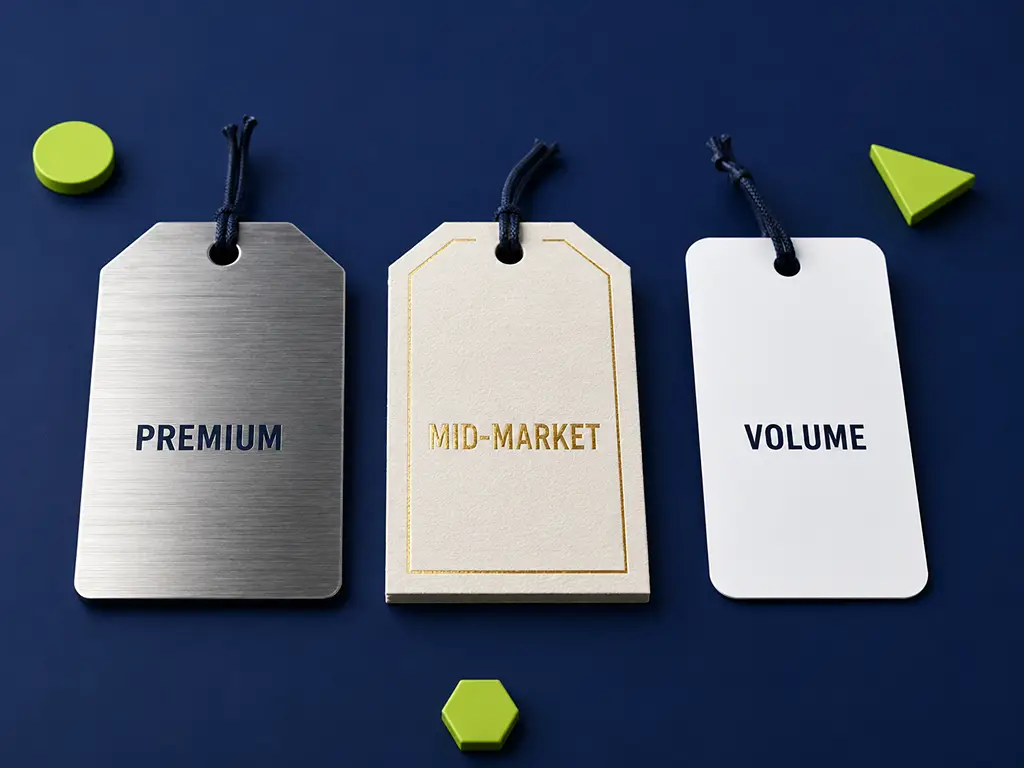
Different furniture segments demand different tag materials. The right choice aligns the tag’s tactile and visual quality with the product’s price point.
Premium and custom furniture ($2,000+): Metal tags — brushed aluminum, engraved brass, or matte-finished stainless steel — communicate permanence and craftsmanship. Leather or leatherette hang tags with debossed branding work equally well for upholstery pieces. At approximately $0.50–$2.00+ per tag, the unit cost is meaningful, but when a single sale is worth thousands, a tag that reinforces quality more than earns its keep. Aluminum and brass also resist the UV fading and humidity warping that plague paper in sunlit showrooms.
Mid-market brands ($500–$2,000): 400–600gsm art card stock with matte lamination is the workhorse of furniture retail. At $0.15–$0.40 per tag, it offers a substantial hand feel — thick enough to hang straight without curling, rigid enough to survive months on the floor. Foil stamping (gold, silver, or copper) on the brand name or logo area adds perceived value at roughly 20–40% cost increase. Die-cut shapes — rounded corners at minimum, custom silhouettes for flagship collections — differentiate your tag from the rectangular commodity look.
Volume and promotional furniture (under $500): 200–300gsm coated paper or synthetic paper (water-resistant, tear-resistant) prioritizes durability at scale. At $0.05–$0.15 per tag, the economics work for high-SKU environments. Synthetic paper is particularly underrated for furniture — it handles the ambient humidity of warehouse-adjacent showrooms without warping, and it’s essentially un-tearable in normal handling.
Outdoor and warehouse displays: This is a special case that catches many retailers off guard. Standard paper and card stock degrade visibly within 3–6 months under UV exposure and humidity cycling. Plastic (PVC or PET) or metal tags are mandatory here — the small premium per tag is cheaper than replacing faded, curled paper tags quarterly.
Finishing and Production Techniques
Three finishing techniques separate a professional furniture tag from something that looks like it came off an office printer.
Lamination. The choice between matte and gloss isn’t aesthetic preference — it’s a functional decision driven by your lighting. Matte lamination keeps surface reflectivity below 5%, making tags readable under the directional spotlights common in furniture showrooms. Gloss lamination (15–25% reflectivity) works better in naturally lit or diffusely lit spaces. If your showroom has track lighting aimed at product displays, go matte — every time.
Foil stamping and embossing. Hot foil stamping applies a metallic or pigment foil to the tag surface under heat and pressure (110–130°C for coated paper stock). It’s the single highest-impact finishing upgrade for the cost — a $0.05–$0.10 per-tag premium that transforms brand perception. Embossing (raised relief) or debossing (depressed relief) adds a tactile dimension that customers notice when they pick up the tag — and they do pick up tags on high-consideration purchases.
Die-cutting. Custom shapes are not frivolous. A rectangular tag is anonymous; a tag cut to match your logo’s silhouette or a shape that echoes your product category is unmistakably yours. The die tooling costs $50–$150 one-time, with a per-tag premium of roughly $0.02–$0.05. For a flagship collection that will be on display for years, the math is trivial.
Attachment Methods — How to Mount Without Damaging Furniture
The best-designed tag in the world becomes a liability if its attachment method damages a $3,000 sofa. Different furniture surfaces demand different approaches — and one rule is absolute.
Upholstery and fabric (sofas, headboards, dining chairs): A Swift-Tach gun or safety pin through an existing seam is the industry standard. The needle penetrates 2–3mm of fabric thickness — enough to hold securely without visible damage. Cotton string or leather cord looped through a reinforced eyelet on the tag is the premium alternative. Either way, the attachment point should be discreet: inside a back cushion seam or along the side panel, not front and center.
Wood and lacquered surfaces (tables, cabinets, case goods): Do not use adhesive. Not double-sided tape. Not removable mounting squares. Not “safe for wood” stickers. Adhesive failure on a lacquered surface can peel the finish — a $500–$1,000 refinishing cost for a mistake that was entirely avoidable. Instead, use cotton or leather cord hang tags looped around a drawer pull or table leg, or place a freestanding acrylic sign holder on the surface. If you must attach directly to a surface, micro-suction cups designed for smooth finishes are the least-risky option, but even these should be tested on an inconspicuous area first.
Glass and stone (tabletops, shelves): Transparent acrylic stands or edge-grip clips. Micro-suction cups work reliably on glass. Avoid anything that applies pressure to stone edges, which can chip.
Metal and industrial-finish furniture: Magnetic tags or metal eyelet-and-chain attachments. These surfaces are forgiving, but the attachment should match the industrial aesthetic — a delicate cotton string looks out of place on powder-coated steel.
Digital Price Tags (ESL) for Furniture Retail — What to Look For
Paper tags have served furniture retail for a century. But for an increasing number of retailers — particularly multi-store chains and high-promotion environments — electronic shelf labels (ESL) are changing the calculus of what a price tag can do.
Switching to digital isn’t just about going paperless. It’s about unlocking capabilities that paper tags can never deliver: instant price updates across every store simultaneously, dynamic content that changes by time of day, and QR codes that connect a showroom browser to an online buyer journey. But choosing an ESL system for furniture retail demands different criteria than choosing one for a grocery store. Furniture is bigger, the buying cycle is longer, and the aesthetic bar is higher.
Screen Size and Display Format — Match the Tag to the Furniture Scale
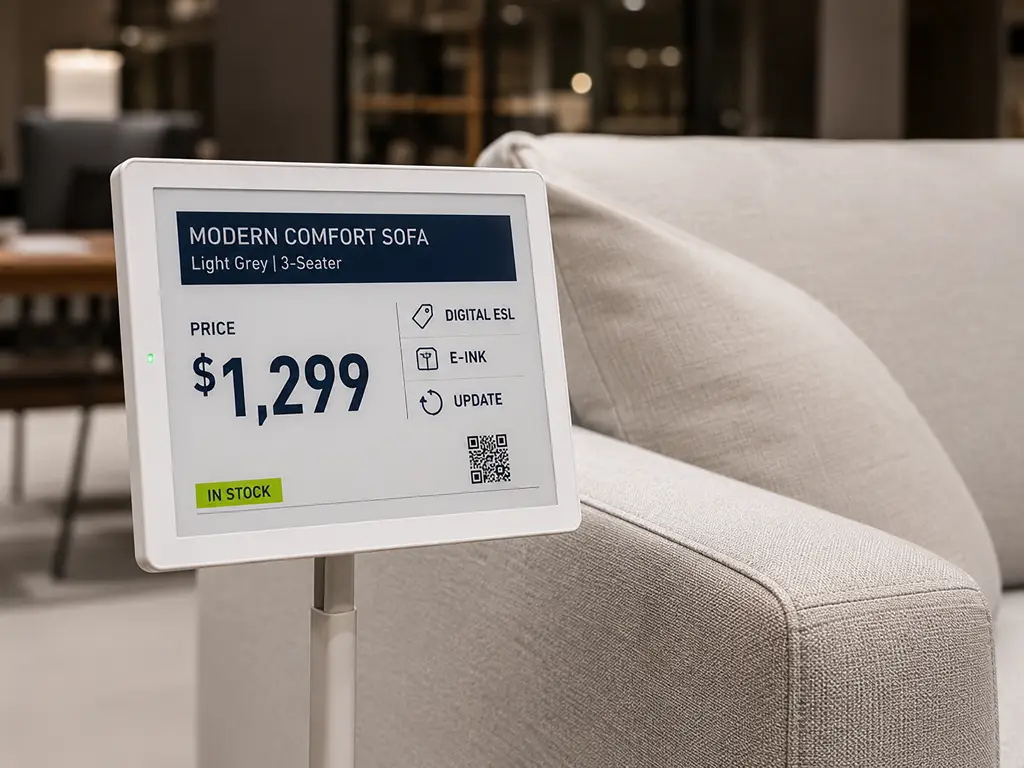
A 2-inch e-ink label that works perfectly for a jar of pasta sauce disappears next to a six-seat dining table. Furniture demands larger displays.
Small accessories and décor (vases, lamps, cushions): 2.1–2.9-inch ESLs are sufficient. These are accent pieces where the price tag shouldn’t dominate.
Individual furniture pieces (chairs, nightstands, coffee tables): Start at 4.2 inches. This size accommodates product name, price, and a brief material note without feeling cramped.
Large statement pieces (sofas, dining tables, beds, wardrobes): 7.5 inches and up, ideally in a wide aspect ratio. At this scale, the ESL can display not just price but a short product story — material provenance, designer name, or a QR code link to an assembly or care video. Some furniture retailers now deploy A4-format e-paper displays (roughly 10–13 inches) on flagship pieces, turning the price tag into a mini-brochure.
Outdoor and warehouse displays: Look for IP65 or higher rated enclosures, an operating temperature range that covers your local climate extremes, and screens that remain readable in direct sunlight — one area where reflective e-ink technology has a natural advantage over emissive LCDs.
E-ink displays hold a key advantage in furniture showrooms: they’re reflective rather than emissive, meaning they look like paper under ambient light rather than glowing like a smartphone screen. Under the 300–500 lux typical of showroom lighting, a quality e-ink display reads as clearly as a printed tag — without the blue glow that clashes with warm interior lighting.
Communication Protocol and Integration — The Tech That Makes It Work
An ESL is not a standalone device. It’s an endpoint in a wireless communication system, and the protocol that connects it to your pricing database determines how reliably and quickly your tags update.
2.4GHz proprietary protocol: The preferred choice for furniture retail. A single base station typically covers 500–1,000m² in open space — enough for most showroom floors — with a range of 25–30 meters. Signal penetration through drywall partitions holds up well (approximately 30% attenuation through two standard walls). More importantly, 2.4GHz systems handle metal-rich environments better than BLE, which matters in furniture stores full of metal bed frames, steel cabinet hardware, and aluminum chair legs. Update speed tells the real story: a 1,000-tag system refreshes in roughly 20–30 seconds. A store-wide price change happens while you’re still reaching for your coffee.
Bluetooth Low Energy (BLE 5.0+): Lower infrastructure cost and compatible with most modern smartphones, but with real trade-offs. Coverage per base station is typically 10–30 meters in retail environments — far short of the theoretical 200-meter spec, which assumes open air. Bulk updates for 1,000 tags can take 2–5 minutes rather than seconds. BLE is a reasonable choice for smaller, single-store operations where coverage is manageable and update speed isn’t mission-critical.
NFC (Near Field Communication): Not a bulk-update solution, but a valuable supplement. NFC-enabled tags let customers tap their phone against a price tag to pull up detailed product specs, material sourcing stories, or video content. Think of it as a bridge between the physical tag and the online product page — valuable for furniture where the purchase decision involves research that continues after the customer leaves the store.
Your physical environment should drive the protocol decision. If your showroom has many metal fixtures, partition walls, or spans more than 500m², lean toward 2.4GHz proprietary systems. They cost marginally more per base station, but the reliability difference in complex RF environments more than justifies it.
Software Ecosystem and After-Sales — Beyond the Hardware
The hardware gets your attention; the software determines whether you regret the purchase. Too many retailers evaluate ESLs by comparing screen specs and per-tag prices, only to discover after deployment that the software can’t do what they need — or that it can, but only with an ongoing subscription fee they weren’t planning for.
Three areas deserve scrutiny before signing any ESL contract.
Design flexibility. Can you customize tag templates to match your brand — fonts, colors, layout, logo placement — or are you locked into a fixed set of templates that make your tags look like every other retailer’s? For furniture, where brand presentation is central to the selling environment, template lock-in is a dealbreaker. The best systems let you design templates that are indistinguishable in style from your printed tags, just dynamic.
System integration. Does the ESL software expose an API or SDK for connecting to your POS, ERP, or inventory management system? Does it support open protocols like MQTT that allow integration with modern IoT and retail platforms? If the answer is “we have our own app and that’s all you need,” ask more questions. A closed system works until it doesn’t — and the moment you need to sync pricing across your e-commerce site and your showroom floor simultaneously, a closed system becomes the bottleneck.
Total cost of ownership. The most consequential — and least transparent — variable is software licensing. Some ESL vendors charge per-tag-per-month subscription fees that compound into tens of thousands of dollars annually for a mid-size store. Others offer a one-time software purchase with lifetime updates included, optionally deployed on-premise for complete data control. Over a 5-year horizon, the difference between these models can exceed the initial hardware cost. When evaluating proposals, ask for the 5-year total cost including all software licensing, support, and anticipated hardware replacements — not just the per-tag price on page one of the quote.
Some manufacturers — particularly China-based ESL producers who have scaled to serve 180+ countries and 41,500+ retail locations — now offer integrated hardware-software solutions where the software license is a one-time cost with free lifetime updates, a model that fundamentally changes the long-term ROI calculation for furniture chains evaluating digital transformation. When comparing providers, include at least one vertically integrated manufacturer in your evaluation alongside software-only and hardware-only vendors. The long-term cost and support experience tend to diverge significantly between these models.
Choosing the Right Price Tag Strategy for Your Furniture Business
After exploring both physical craftsmanship and digital capability, the practical question remains: which approach is right for your business, right now? The answer isn’t “digital is the future so switch immediately” or “paper worked for decades so stick with it.” It depends on four factors: your store count, your SKU volume, your price-update frequency, and your brand positioning.
Here’s a decision framework that maps these factors to a recommended approach:
Single store, low update frequency (seasonal or quarterly pricing): Stick with premium physical tags. You’re changing prices four times a year across perhaps 500 SKUs. The labor math doesn’t justify ESL hardware — a well-designed tag system with consistent branding will serve you perfectly. Invest the ESL budget in better materials and finishing instead.
Single store, high update frequency (monthly promotions, flash sales): Consider a hybrid approach. Deploy ESLs on your highest-turnover categories and promotional zones — sofas, dining sets, and clearance sections — where pricing changes most often. Keep paper tags on slow-moving inventory and accessories. This minimizes the upfront investment while capturing most of the labor-saving benefit.
Multi-store chain (3+ locations), any update frequency: The case for ESL becomes compelling. Centralized management alone — push a price change to 10,000 tags across five stores in under a minute — eliminates the coordination cost and error rate that plague multi-location paper-tag workflows. The typical ROI calculation is instructive: a mid-size furniture retailer with three stores and 2,000 SKUs per store, running 15% monthly price changes, spends roughly $3,000–$5,000 annually on labor just for tag changes (printing, sorting, distributing, replacing). ESL systems for this scale typically recover their upfront cost within 12–18 months from labor savings alone — before accounting for the revenue impact of pricing errors eliminated and promotional agility gained.
Premium/luxury positioning with strong aesthetic identity: Don’t assume you need to go digital. A leather hang tag with hot-stamped gold foil on a handcrafted Italian sofa is a brand asset, not an operational inefficiency. Some of the world’s most successful furniture brands choose to make their physical tags so beautiful that they become part of the product story. Digital is a tool, not a religion — use it where it solves a problem, not where it creates an aesthetic one.
Three universal principles, regardless of which path you choose:
- Make the price visible from across the room. If a customer has to walk up to every piece to know what it costs, you’re losing sales to hesitation.
- Make the tag match the merchandise. A $5,000 product deserves a tag that looks like it belongs. A $200 product doesn’t need one.
- Make every tag tell a story, not just state a number. The tag is the last thing a customer reads before deciding whether to talk to a salesperson or walk out the door. Make those three seconds count.
References
- Home Furnishings Association. “Store Design Mistakes That Are Hurting Your Sales.” myhfa.org
- Furniture Today. “Instant Pricing? Behind Tag Tech at Leon’s.” 2024. furnituretoday.com
- ITECH Packaging. “How to Make Hang Tags for Furniture.” itechpackaging.com
- SilkPLM. “Hang Tags and Price Tags for Brand Impact.” silkplm.com
- Datallen. “High Fashion Furniture Store Display with Electronic Paper.” datallen.com
- ZKONG. “Going Digital: Castlery’s Journey with ZKONG ESL.” zkong.com
- Zhsunyco®. “Digital Price Tag Solutions.” zhsunyco.com
- Zhsunyco®. “2.4GHz Electronic Shelf Labels.” zhsunyco.com
- Zhsunyco®. Homepage. zhsunyco.com

 English
  Russian
  Spanish
  German
  Arabic
  French
  Bulgarian
  Polish
  Romanian
  Turkish
  Portuguese