


Clothes Price Tag Design: From Paper Basics to Digital Innovation
Why Your Price Tag Design Matters More Than You Think
A $120 linen dress hangs on a boutique rack. Attached to it is a flimsy thermal-printed tag, already curling at the edges after three weeks under warm store lighting. Next to it, an $85 cotton shirt carries a textured kraft-paper tag with clean typography and a subtle embossed logo.
Which garment feels more expensive?
Your price tag is the first physical touchpoint between a customer and your product — they see it before they touch the fabric, before they check the stitching, before they step into the fitting room. In the 0.3 to 0.7 seconds that a shopper’s eyes land on your rack, the tag has already sent a signal about what your brand is worth.
Consumer psychology research consistently shows that packaging and labeling cues shape perceived value more than most retailers realize. A tag printed on cheap thermal paper — the kind that yellows within three to six months under retail lighting — silently tells customers to discount the garment before they’ve even looked at the price. A well-designed tag on coated cardstock, by contrast, anchors a higher mental price point. The number printed on it feels justified rather than surprising.
A Michelin-starred restaurant doesn’t print its menu on copy paper. Your price tag is your clothing store’s menu — and the design decisions you make about it directly shape what customers are willing to pay.
The Anatomy of an Effective Clothing Price Tag
Great price tag design follows three unbreakable rules, and they’re simpler than you think. Master typography, layout, and information hierarchy, and you’ve already won most of the battle.
Typography Rules: Font Selection for Maximum Legibility
The single most important font decision for clothing price tags is also the simplest: use sans-serif. Always.
Serif fonts — the ones with little decorative feet on each letter — can break apart under the warm 2700–3000K lighting common in clothing stores. At sizes below 12pt, thin serif strokes become illegible, especially for customers browsing from three feet away. Sans-serif fonts like Montserrat, Helvetica, or Open Sans render cleanly at any size and under any lighting condition.
Three typography specifications every clothing tag should follow:
- Price first, price largest. Set the price at 18pt minimum — bold and immediately scannable from browsing distance.
- Product name at 12–14pt. Secondary information sits below the price in a smaller but still readable weight.
- Maximum two font families. One for the price and headings, one for body text. More than two creates visual chaos on a small canvas.
One more thing: never compress the letter spacing on price numbers. “$120” with squeezed digits is harder to parse at a glance than one with default tracking. Those milliseconds of confusion are enough to lose a sale.
Layout and White Space: The Premium Look Formula
Customers don’t read price tags — they scan them. Your layout needs to work in that split-second window.
The most reliable layout pattern for clothing tags follows four rules:
- Price centered or right-aligned. This is where eyes naturally land after scanning a garment.
- Twenty percent margin rule. Leave at least 20% clear space around all four edges of the tag.
- Group information visually. Use a thin divider line or an 8pt spacing gap between the price zone, the product information zone, and the brand zone.
- Stick to standard sizes. The 2″ × 3.5″ format (business card size) is the most versatile for clothing.
The most common design accident on clothing tags? Punching the hang-hole straight through the logo. Always leave a 5mm clear zone around the hole position — no text, no graphics, no exceptions.
Information Hierarchy: What to Include and What to Leave Out
Information overload is the number one killer of effective price tag design. The solution is a simple three-tier system:
Must-Haves (the bare minimum): Price, brand name or logo, size, and any legally required information. Build your tag template around these legal anchors first.
Should-Haves (brand builders): Website URL or a QR code linking to the product page, and a short brand tagline.
Nice-to-Haves (extra touches): Limited-edition numbering, bundle pricing, or a one-line sustainability note.
The golden rule: if you’ve filled the tag to the edges, you’ve put too much on it. Pack like you’re traveling with a carry-on — essentials first, nice-to-haves only if space allows.
Paper Tags Done Right: Materials, Finishes, and Production
Choosing materials isn’t about picking what looks nice on a screen — it’s about matching your tag quality to your brand’s price tier. A $120 garment demands a better tag than an $18 t-shirt, and customers notice the mismatch instantly.
Material Selection: Matching Tag Quality to Your Brand Tier
| Material | Best For | Cost per Tag | Why It Works |
|---|---|---|---|
| Coated cardstock (300–400gsm) | Mid-range to premium fashion | $0.08–0.25 | Crisp, professional, holds color vibrantly |
| Kraft or recycled paper | Eco-conscious brands, denim, heritage | $0.05–0.15 | Inherent texture signals authenticity |
| Textured specialty paper | High-end boutiques | $0.25–0.50 | Tactile memory is powerful — customers feel the difference |
| Synthetic/waterproof stock | Activewear, swimwear, outdoor | $0.10–0.30 | Survives moisture and harsh retail environments |
Anything below 250gsm is too thin for a hang tag — it will curl, tear, and undermine your brand before the first customer touches the garment. Order samples before committing to a full print run; most suppliers offer minimums of 50–100 pieces for testing.
A 2025 trend worth noting: eco-friendly materials are rapidly becoming the baseline expectation. Recycled paper, biodegradable substrates, and plant-based inks are what customers increasingly expect — especially from clothing brands that market sustainability.
Finishing Techniques That Signal Quality
Finishing techniques are the highest-leverage investment in tag design. They cost pennies per unit but create the tactile experience customers associate with premium products.
- Foil stamping — metallic gold, silver, or rose gold for logo highlights
- Embossing / debossing — raised or recessed texture; requires a die ($50–150), economical at 500+ pieces
- Spot UV — glossy highlight on logos or key graphics; must register within 0.5mm precision
- Die-cut shapes — circles, bookmarks, or logo-outline cuts for instant rack recognition
- Matte lamination — soft-touch, glare-free, the sartorial equivalent of a well-cut blazer
Attachment Methods: The Overlooked Detail
The string that connects your tag to the garment is the last centimeter of your design — and the easiest place to undo all your hard work. A premium tag on a plastic barb looks cheap; that same tag on a waxed cord looks intentional.
- Cotton string — natural, handcrafted feel for sustainable and artisanal brands
- Waxed cord — refined and durable, the versatile mid-to-premium default
- Satin ribbon — soft, feminine, strongest for women’s apparel and lingerie
- Metal chain or safety pin — industrial edge for streetwear and denim
The Hidden Cost of Paper: What Manual Tag Management Really Costs You
You’ve just learned how to design a beautiful paper price tag. Now here’s the part that nobody in the label-printing business wants you to think about: the tag itself is only half the cost.
Every time you run a promotion, mark down last season’s inventory, or adjust prices, someone has to physically find every garment, remove the old tag, and attach a new one. That process eats time, generates waste, and introduces errors — more often than most retailers realize.
| Hidden Cost | What Happens in Your Store | Annual Impact (~500 SKUs) |
|---|---|---|
| Labor for re-tagging | Staff replace tags during sales and changeovers instead of serving customers | 20–40 hours (~$300–720) |
| Pricing errors | Tag-POS mismatch leads to disputes, refunds, and damaged trust | 3–5% error rate |
| Material waste | Every re-tagging cycle discards old tags — paper, ink, consumables | 5,000–10,000 tags/year |
| Missed opportunities | Flash sales and dynamic promos are impossible when retagging takes hours | Lost revenue from every delayed promo |
If you operate a single boutique with 200 SKUs and change prices twice a year, paper tags work fine. But at three or more stores with frequent promotions, the combined cost of manual tag management can reach $10,000–25,000 per year.
This is where the conversation shifts from “how to design a paper tag” to “what your price tag system should actually do.”
The Digital Evolution: Electronic Shelf Labels for Clothing Retail
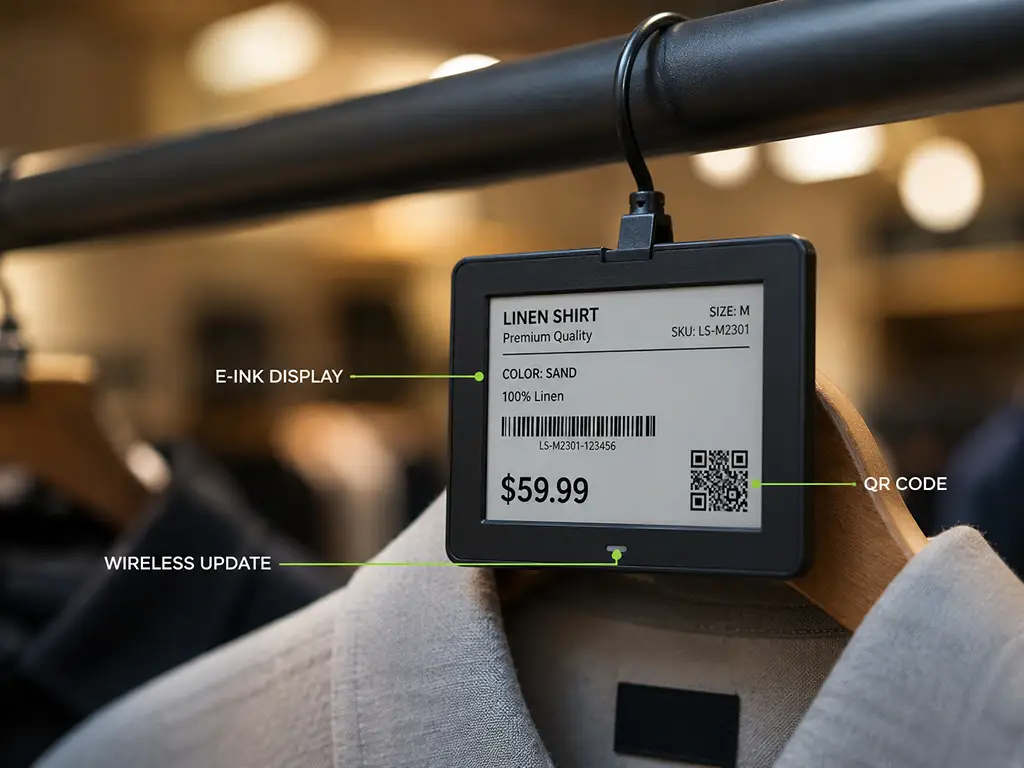
Electronic shelf labels — ESLs for short — aren’t simply digital versions of paper tags. They fundamentally change how prices exist in your store: from static, disposable pieces of paper into dynamic, remotely managed digital assets.
What Are ESLs and How Do They Work?
An ESL looks like a small electronic ink display — the same technology used in e-readers like Kindle. It shows price and product information on a screen that reads like paper: crisp, high-contrast, and visible under bright store lighting without any backlight glow. A single coin-cell battery powers each tag for five to ten years because e-ink consumes zero power when the display isn’t changing.
A wireless base station in your store communicates with every ESL tag via radio frequency. When you update a price in the cloud-based management software — from your desk or your phone — every tag in every store updates within minutes. A typical 3,000-SKU clothing store can be fully deployed in one to two days.
The technology is scaling rapidly. The global ESL market is growing at roughly 17% annually and is projected to reach over $4 billion by 2029. Walmart alone plans to deploy ESLs across 2,300 stores by 2026. What started in grocery is now moving decisively into apparel.
Why ESLs Make Sense for Clothing Stores Specifically
Clothing retail changes prices more frequently than almost any other format — seasonal collections, mid-season markdowns, holiday promotions, flash sales, end-of-season clearance. Each change triggers the manual re-tagging cycle.
ESLs solve four clothing-specific pain points:
Seasonal turnover efficiency. When a new collection arrives and last season’s pieces go on sale, updating every affected tag takes minutes instead of hours. Staff who would have spent an afternoon swapping paper tags are now on the sales floor.
Online-to-offline price consistency. A customer tries on a jacket, finds it $30 cheaper on your own website, and walks out. With ESLs, in-store tags and online store sync in real time — rack price always matches web price.
Premium presentation. E-ink displays have a matte, paper-like surface that looks sophisticated under boutique lighting. Unlike printed tags that fade and curl, ESLs maintain a consistent, professional appearance for years.
Tags that sell. Modern ESLs display QR codes that customers scan to see available sizes and colors, read care instructions, or access loyalty offers. The tag becomes a miniature sales associate on every garment.
Designing for Digital: How ESLs Execute Classic Design Principles
Moving to digital doesn’t mean abandoning design. It means design becomes more powerful because it’s consistently executed — every store, every rack, every time.
The design constraints of e-ink actually enforce good discipline. Four-color ESL displays use black, white, red, and yellow — a limited palette that prevents over-designing. Screen resolution (130–150 dpi mainstream, 200 dpi-plus premium) is more than adequate for clean typography at tag-viewing distances.
For clothing brands that want their tags to match their visual identity, manufacturers now offer extensive customization: sizes from 1.6 to 7.5-plus inches, custom housing shapes and colors, brand logo integration, and communication protocol selection. Some providers — Shenzhen-based Zhsunyco, for example — offer tailored ESL design options from screen dimensions to firmware features, with customizable samples delivered within seven days for in-store testing. The point isn’t any single supplier — it’s that the technology has matured to where “digital” no longer means “generic.”
Digital isn’t the end of price tag design. It’s the beginning of design that actually stays designed.
Paper vs. Digital: Which Price Tag System Fits Your Store?
Not every clothing store needs electronic shelf labels. The right choice depends on your scale, your pricing rhythm, and how much time your team spends on tag management today.
| Dimension | Traditional Paper Tags | Electronic Shelf Labels (ESL) |
|---|---|---|
| Upfront cost | $0.02–0.75 per tag (near zero) | $5–15 per tag plus base station |
| Long-term cost | Continuous — printing, labor, waste every cycle | Near zero — 5–10 year battery, no consumables |
| Update speed | Hours to days (manual) | Minutes (remote, one-click) |
| Accuracy | 3–5% error rate typical | Near 100% — always synced with POS |
| Design flexibility | Unlimited — any color, finish, technique | 4-color, fixed res — but 100% consistent |
| Best fit | Single store, infrequent changes, ≤500 SKUs | 3+ stores, frequent promos, 1,000+ SKUs |
If you run a single boutique with a few hundred SKUs and change prices twice a year, paper tags are the right tool. But if you manage three or more stores, run monthly promotions, or find your team spending meaningful time on tag changes instead of customers — it’s worth running the numbers. The typical break-even for an ESL deployment falls between 12 and 18 months. After that, the system saves you money every month.
Future-Proofing Your Clothing Price Tag Strategy
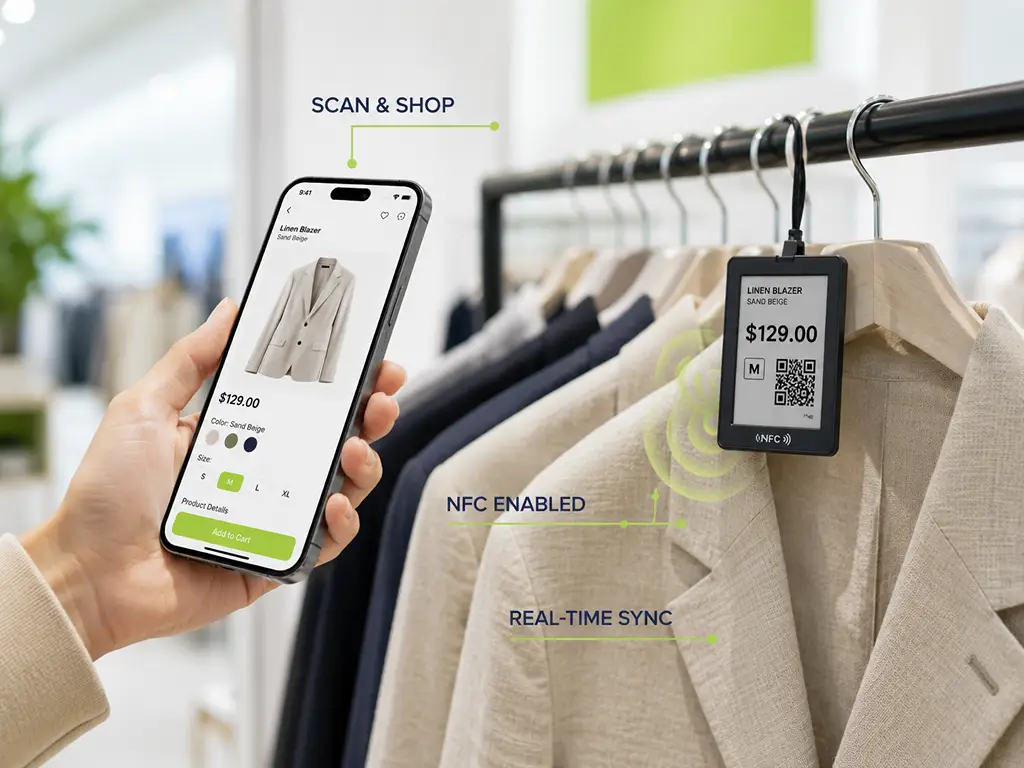
The price tag is evolving faster than most retailers realize. Three trends are reshaping what that small rectangle of information can do:
Tags are becoming interactive gateways. QR codes and NFC chips — now as affordable as $0.15–0.60 per tag in RFID formats — turn tags into bridges between the physical store and digital. Early NFC implementations report 20–30% customer engagement lifts. The RFID market alone is projected to reach nearly $16 billion by 2032.
AI-powered dynamic pricing is coming to the rack. Airlines and hotels have done this for decades. Imagine tags that adjust prices automatically based on inventory, weather, or competitor moves — without anyone touching a tag. The infrastructure exists today.
Sustainability is shifting from differentiator to baseline. Customers increasingly expect environmental responsibility as a default. For paper, that means recycled substrates and plant-based inks. For digital, it means e-ink’s near-zero operating power and eliminating thousands of paper tags per store per year.
The thread that connects every section of this guide: a great price tag makes customers feel that the garment is worth its price. Whether kraft paper with a cotton string or a four-color e-ink display with a QR code, that job doesn’t change. You just have more tools to do it well.
References
- Technavio. “ESL Market Growth Analysis.” technavio.com
- VusionGroup. “ESL vs Traditional Labels.” vusion.com
- Modern Retail. “Walmart digital price tags.” modernretail.co
- DATAGROUP. “Louis digital price tags.” datagroup.de
- Apex Fashion Lab. “Hang Tag Design Guide.” apexfashionlab.com
- W3C. “WCAG Contrast Minimum.” w3.org
- Hanshow. “Fashion Retail with Electronic Price Tags.” hanshow.com
- Zhsunyco. Customized Service · Clothing Store Cases · Homepage · Contact

 English
  Russian
  Spanish
  German
  Arabic
  French
  Bulgarian
  Polish
  Romanian
  Turkish
  Portuguese