


Benefits of Electronic Shelf Labels — The Complete ROI Case for Retailers
01 The Hidden Cost of Paper Labels — What You’re Already Losing
Picture a Wednesday morning in a mid-size supermarket. Two staff members clock in at 6:00 AM. They are not here to restock shelves or prep the bakery. They are here to spend the next six hours walking the aisles with a cart stacked with paper tags, a pricing gun, and a printed spreadsheet. By noon, they have changed roughly 800 price tags. Tomorrow, they will do it again for a different set of SKUs. Next week, a seasonal promotion hits, and the entire cycle restarts from zero.
This is not an exceptional day. It is the operational baseline of paper shelf labels. And it is quietly making everything harder.
The visible cost of paper labels is small: ink, paper, printing equipment. But the hidden costs are where the real damage sits. Labor hours consumed by manual tag changes: in a typical mid-size store, price changes affect 500 to 2,000 SKUs per week during non-promotional periods, and over 5,000 during peak seasons. Each tag takes 30 to 60 seconds to locate, remove, replace, and verify. That is anywhere from 25 to 100 labor-hours per store, per week, spent on nothing but moving paper. Pricing errors compound the problem. A shelf tag that says $3.99 when the register says $4.29 creates a dispute at checkout, erodes customer trust, and generates refund-processing costs. Opportunity cost is the least visible but largest line item. Every hour spent changing paper tags is an hour not spent on customer service, restocking high-turnover items, or fulfilling online pickup orders.
Annual U.S. retail shrink — and paper labels are a significant contributor to the operational delays driving it. The hidden costs of manual pricing far exceed the investment in electronic shelf labels within 12 to 18 months.
The real benefits of electronic shelf labels do not start with technology. They start with stopping the bleed.
Key takeaway: Before you evaluate what ESLs add, calculate what paper labels are already costing you — in labor, errors, and lost opportunities. Most retailers find the hidden cost exceeds the ESL investment within 12–18 months.
02 The Direct ROI Engine — Labor, Accuracy, and Operational Speed
If paper labels are the bottleneck, electronic shelf labels are the release valve. Three operational dimensions form a self-reinforcing ROI triangle: labor savings, pricing accuracy, and operational agility. They do not work in isolation. Improvements in one dimension amplify the others.
Labor Savings and Staff Redeployment — The Biggest Line Item
The most immediately visible benefit of electronic shelf labels is the near-elimination of manual price-change labor. U.S. retail pilots consistently report 60% to 90% reductions in tag-change labor after switching to ESL systems (IW Technologies, 2024). In a mid-size grocery store, that translates to 40 to 60 hours per week freed up. That is the equivalent of a full-time employee whose time can now be redirected to higher-value work (U.S. Chamber of Commerce, 2024).
Where do those hours go? In stores that have made the switch, the pattern is consistent. Staff move from the aisles with pricing carts to customer-facing roles. Some are redeployed to fresh-produce sections, where personalized service directly increases basket size. Others take on buy-online-pick-up-in-store (BOPIS) order fulfillment, where LED pick-to-light indicators on ESL tags can shorten picking time by 30% to 40%. Still others handle restocking and visual merchandising. That is work that directly drives sales rather than maintaining the status quo.
The math is straightforward. If a store spends 50 hours per week on paper tag changes at an average hourly labor cost of $18, that is $46,800 per year in labor dedicated to a task that electronics can handle in minutes. Across a 50-store chain, the annual figure crosses $2.3 million — before accounting for the revenue impact of redeploying those hours to customer-facing activities. This is why Forrester’s Total Economic Impact study of ESL deployments found a five-year ROI of 277% and a payback period of 18 months for a composite 500-store grocery chain (Forrester Consulting, 2024).
Pricing Accuracy — Eliminating the Shelf-to-Register Trust Gap
Price inconsistency between the shelf and the checkout is the single largest source of customer complaints in grocery retail. Studies consistently find that shoppers rank pricing accuracy among their top three trust factors — and nothing erodes that trust faster than reaching the register and seeing a different number than the one on the shelf.
Paper labels create this problem by design: price data lives in a central system, but execution depends on human beings physically walking to thousands of shelf positions and replacing tags correctly. The failure rate is baked in. Traditional retailers see shelf-to-register mismatch rates of 2% to 5% under normal conditions, rising during promotion cycles when the volume of changes overwhelms manual processes.
Electronic shelf labels eliminate the execution gap. Because ESLs pull pricing data directly from the same central source that feeds the POS system, the shelf tag and the register display are always reading from the same record. Retailers that have deployed ESLs report mismatch rates dropping below 0.5% (IW Technologies, 2024), with some operators seeing pricing disputes fall by 50% to 80% (Progressive Grocer, 2024). A separate analysis of temporary price deviations after ESL adoption found a mere 0.0006 percentage-point change — statistically indistinguishable from zero (AP News, 2024).
The secondary benefit is operational: fewer pricing disputes mean fewer service-desk interventions, fewer refunds processed, and fewer compliance flags from weights-and-measures inspections. The shelf becomes auditable.
Operational Agility — From Days to Minutes
Speed is the benefit that transforms ESLs from a cost-reduction tool into a competitive weapon. The full paper-label update cycle — plan changes at headquarters, print tags, distribute to stores, assign staff, physically replace, verify accuracy — typically takes three to5 days. With ESLs, a price change approved at 9:00 AM reaches every shelf in the chain by 9:02 AM.
This gap creates an asymmetric advantage in three scenarios. First, competitive price response: when a competitor drops prices on a key category, the paper-label retailer needs days to react. The ESL retailer responds before the competitor’s promotion gains traction. Second, seasonal promotion execution: ESLs enable chain-wide promotional pricing to activate simultaneously, with consistency rates exceeding 98%. Paper-based rollouts typically hit 60% to 80%, with some stores inevitably missing or delaying tag changes. Third, clearance markdown timing: the faster a markdown reaches the shelf, the higher the sell-through rate. ESL-driven markdown execution is 20% to 30% faster than manual processes, directly reducing end-of-season inventory carryover and the margin erosion that comes with it.
The compound effect is what separates ESL adopters from the rest. Faster pricing execution improves sell-through. Better sell-through reduces inventory holding costs. Lower holding costs free working capital for higher-margin purchases. It is not just speed. It is speed that compounds.
| Dimension | Paper Labels | Electronic Shelf Labels |
|---|---|---|
| Price change cycle | 3–5 days | Minutes |
| Labor per store/week | 25–100 hours | 2–5 hours (review & approve) |
| Shelf-register mismatch rate | 2–5% | <0.5% |
| Promotion execution consistency | 60–80% | >98% |
| Markdown response speed | Baseline | 20–30% faster |
03 From Cost Center to Revenue Driver — Strategic Value Beyond Operations
The discussion so far has centered on saving money. But some of the most important benefits sit on the revenue side of the ledger. Specifically, what happens when the shelf becomes a data-connected node instead of a static piece of paper.
Dynamic Pricing and Revenue Optimization
Dynamic pricing has an image problem. The term makes people think of surge pricing. A retailer cranking up the cost of bottled water during a heatwave. That is not what ESL-enabled dynamic pricing looks like in practice. The model that retailers are actually deploying is rule-based optimization. Prices adjust automatically based on inventory age, sell-through velocity, competitor pricing, and predefined promotional calendars. All within guardrails set by category managers.
Concretely, consider a fresh produce department. A batch of strawberries with a three-day shelf life can follow a pre-programmed markdown ladder: full price on day one, 20% off on day two, 40% off on day three in the final hours. Each price change happens at the shelf automatically, without any staff member touching a tag. The result: sell-through rates improve by 5% to 15% on perishable categories, directly reducing shrink costs that are otherwise written off as unavoidable waste (IW Technologies, 2024).
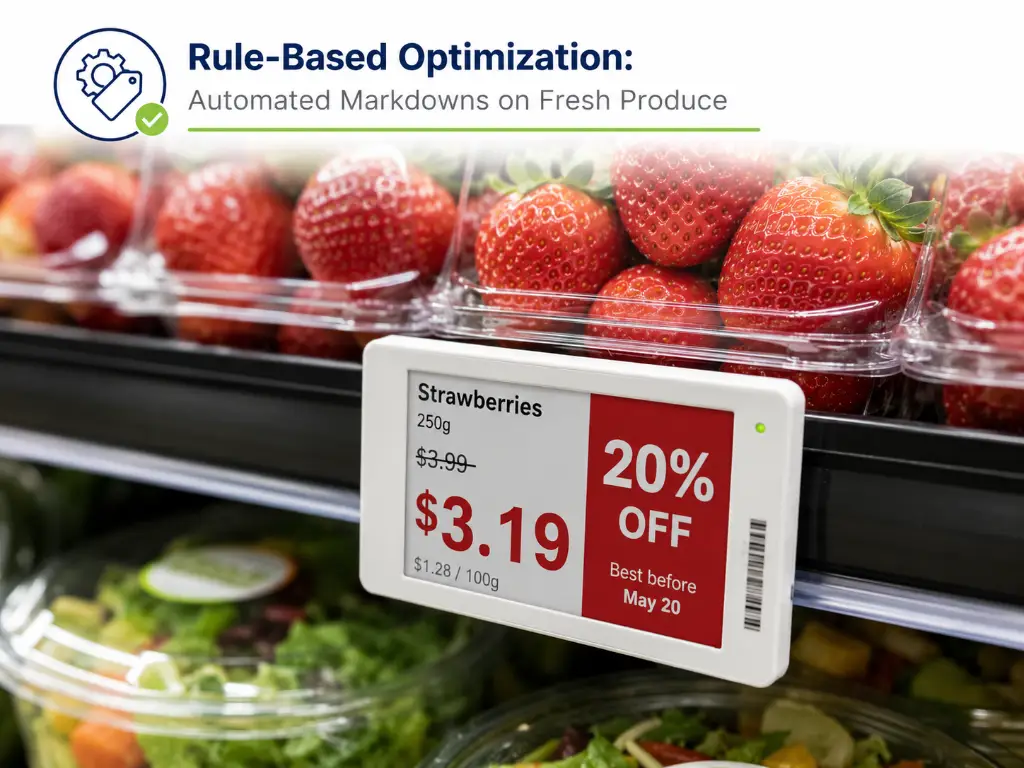
The same logic extends to seasonal clearance, end-of-life SKU transitions, and competitive price matching. In each of these scenarios, timing is the difference between selling at margin and selling at loss. European retailers like Spain’s Condis and Bon Preu have already integrated ESL-driven dynamic pricing into their operations, using expiration-date-based markdowns to reduce food waste while protecting margins on fresh categories (Slimstock, 2024).
Here is the distinction that matters: this is automated pricing governance, not algorithmic price gouging. The rules are set by merchants. The labels execute them at speed. The customer benefits from lower prices on items approaching their sell-by date. A transparent value exchange, not a hidden markup.
Automated Governance, Not Price Gouging
Dynamic pricing with ESLs is rule-based optimization — merchants set the guardrails, labels execute at speed. Prices adjust automatically based on inventory age, sell-through velocity, and competitor pricing, all within predefined parameters. The result: better margins on fresh categories, reduced waste, and transparent value for shoppers.
Omnichannel Consistency and the Customer Trust Dividend
A customer browsing a retailer’s app sees a patio set listed at $299. She drives to the store, finds the same set on the shelf, and the paper tag reads $329. Which price is real? The answer, in her mind, is neither — because the brand has just communicated that its pricing cannot be trusted.
Price inconsistency between digital and physical channels is surprisingly common. Research suggests that 10% to 20% of SKUs in omnichannel retailers show pricing discrepancies between online and in-store listings during active promotion periods. These mismatches generate 15% to 25% of customer service inquiries in retail call centers — an entirely avoidable cost.
ESLs resolve this at the infrastructure level. Because the shelf tag pulls from the same pricing engine that feeds the e-commerce platform and the POS system, omnichannel consistency is not a process to manage. It is a structural property of the system. Post-deployment, omnichannel price mismatch rates fall below 0.5%, effectively eliminating the shelf-to-app trust gap.
The business impact extends beyond complaint reduction. Consistent pricing across channels has been linked to higher customer lifetime value. When shoppers trust that the price they see online is the price they will find in-store, they are more likely to use click-and-collect services, browse across channels, and return for repeat purchases. In an industry where customer acquisition costs continue to rise, retaining existing shoppers through trust is one of the highest-ROI investments a retailer can make.
04 Sustainability That Pays for Itself — Environmental and Compliance Benefits
Electronic shelf labels are often framed as a sustainability win, and the numbers back that up. But the more compelling story is that the environmental benefit pays for itself operationally. Going green and staying profitable is not a trade-off here. It is the same investment producing both outcomes.
A large grocery chain prints millions of paper tags annually. Each tag carries the cost of the paper itself, plus the ink, the printer consumables, the energy to run the printers, the logistics to distribute tags across stores, and the labor to dispose of the old ones. It is a continuous consumption cycle. Every price change restarts it. ESLs, by contrast, use e-paper technology that consumes power only during a screen refresh. In static display mode, which is over 99% of a label’s lifecycle, power draw is zero. Typical battery life spans five to ten years, and modern systems include centralized battery-health monitoring so that replacement happens proactively rather than reactively.
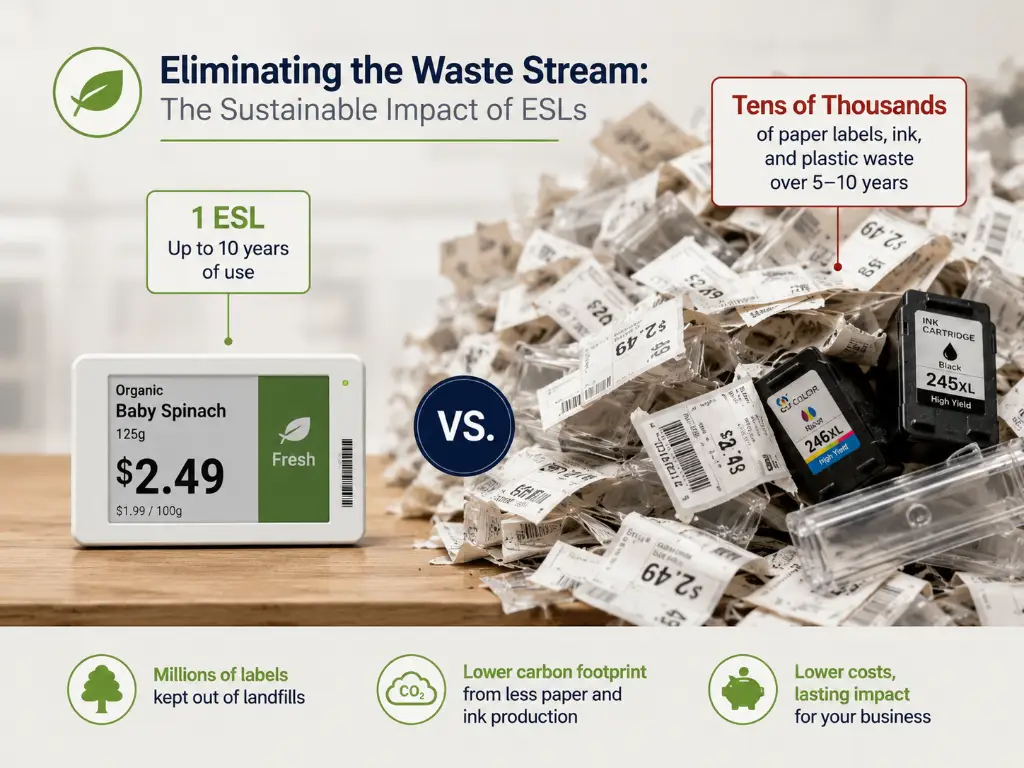
The net effect: a single ESL deployment eliminates a recurring, multi-million-unit paper waste stream while simultaneously improving price accuracy and reducing labor. All from the same capital investment. For retailers reporting against ISO 14001 environmental management standards or corporate ESG metrics, the paper-reduction figure is directly quantifiable and auditable. Unlike many sustainability claims that rely on estimates and offsets, this one shows up in procurement records.
There is a regulatory dimension as well. U.S. consumer protection laws already require price accuracy at the point of sale, and several states are actively reviewing shelf-labeling regulations in light of ESL adoption (National Retail Federation, 2025). ESLs provide a built-in compliance advantage: centralized price governance with a complete audit trail of every change. Who approved it, when it was pushed, and when it appeared at the shelf. In an environment of increasing regulatory scrutiny, that auditability is not a nice-to-have.
05 Making the Benefits Real — What Determines Whether ESL Delivers
Every benefit described so far depends on one factor: execution. ESLs are infrastructure. Their value is determined by how they are chosen, how they are integrated, and how they are deployed. These three decisions make the difference between an ESL system that transforms operations and one that is, in practice, expensive digital paper.
Technology Fit and Integration — The Ecosystem Question
The single most important question a retailer should ask before selecting an ESL system is not “how does the screen look?” but “how does it talk to everything else?”
An ESL tag that only displays prices is a commodity. The value multiplies when the tag is connected to the broader retail technology stack. At the base layer, price synchronization with the POS system is table stakes. Nearly every ESL solution offers this. But the higher-value integration layers are where differentiation happens. At the intermediate layer, ESLs connect to inventory management systems, enabling stock-level-triggered alerts: when an item reaches low-stock threshold, the associated label can flash an LED to guide replenishment staff. At the advanced layer, ESLs integrate with warehouse management and demand-forecasting platforms, feeding real-time shelf data into automated ordering algorithms.
The key enabler is not the tag hardware. It is the communication architecture. Open-protocol systems that support multiple wireless standards give retailers flexibility that single-protocol, closed-ecosystem solutions cannot match: 2.4GHz for high-density shelf environments, 433MHz for large-format stores requiring long-range penetration, BLE and Wi-Fi for integration with existing network infrastructure. Similarly, base stations built on open messaging protocols like MQTT allow bidirectional communication between tags, POS terminals, ERP systems, and IoT platforms. This makes the ESL network a programmable layer rather than a sealed appliance.
A cautionary example: a retailer that selects a closed, single-protocol ESL system because it offers the lowest per-tag cost may discover two years later that it cannot connect the labels to its warehouse management system — limiting the ESL investment to basic price display, the lowest-value use case. The cost of switching is then far higher than the per-tag savings. An alternative approach — exemplified by manufacturers like Zhsunyco, whose multi-protocol ESL solutions support 2.4GHz, 433MHz, NFC, BLE, and Wi-Fi on MQTT-open base stations, backed by quality-certified manufacturing under ISO 9001, CE, RoHS, and TF16949 standards — enables internal development teams or third-party system integrators to build custom workflows that turn the shelf into an active operations node, not a passive display.
Integration check: Before committing to an ESL vendor, verify that their system supports your existing POS/ERP/WMS platforms. Ask about API access, supported communication protocols, and whether the base station uses open messaging standards. A lower per-tag price that locks you into a closed ecosystem is the most expensive option in the long run.
Deployment Design and Scalability — Why Execution Determines Everything
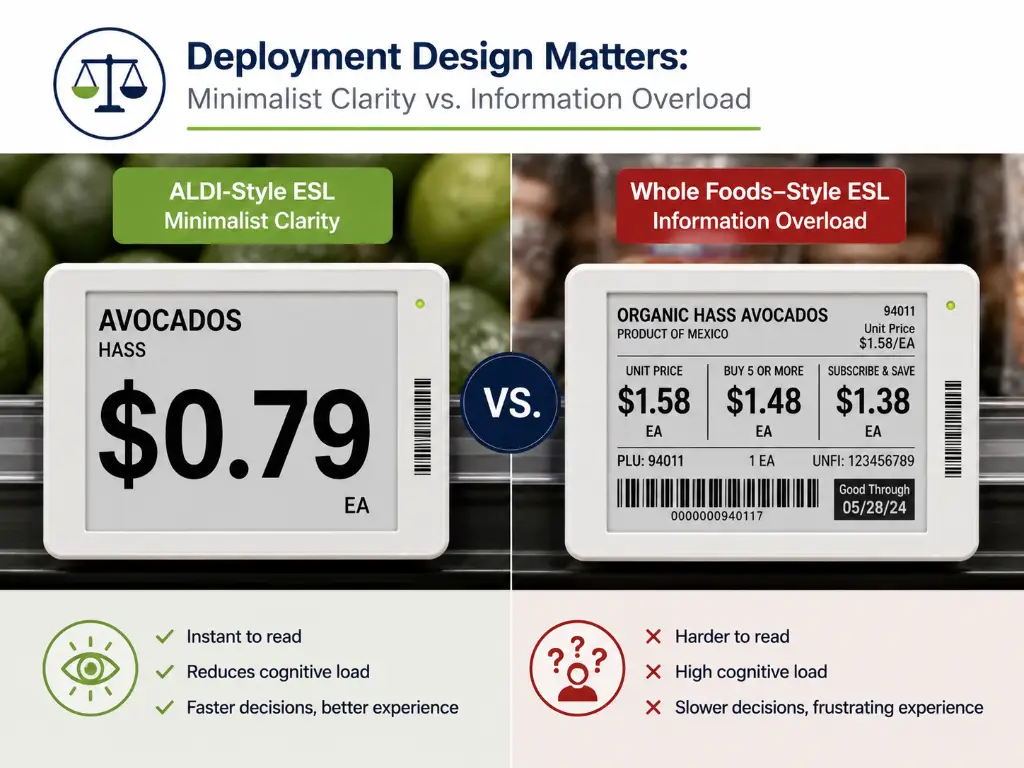
Even the best ESL hardware can fail to deliver its promised benefits if the deployment is poorly designed. The most instructive real-world contrast comes from two retailers that adopted ESLs at roughly the same time: Aldi and Whole Foods.
Aldi’s approach is minimalist. Its ESLs have one job: communicate the price. A single large numeral on a white background, with red backgrounds reserved for sale items. Readable from across the aisle. The design philosophy: shelf labels should reduce cognitive load, not add to it. Whole Foods took the opposite approach, cramming three price tiers (regular, sale, Prime member) onto a 2.7-inch screen. The text was so small that customers reported needing to stand inches away to read the information (Grocery Dive, 2025). The same technology produced opposite customer experiences. The difference was not hardware quality. It was deployment design.
One job: communicate the price. A single large numeral on a white background, with red backgrounds reserved for sale items. Readable from across the aisle. Minimalist design reduces cognitive load.
Three price tiers (regular, sale, Prime member) crammed onto a 2.7-inch screen. Text so small that customers reported needing to stand inches away to read it. Information overload, not clarity.
This lesson applies across four critical dimensions of ESL deployment.
Start with tag-to-category matching. A 2.13-inch label that works for a convenience-store candy aisle is too small for a warehouse-store bulk display, where a 5.8-inch or larger tag is needed for readability.
Next, information hierarchy. The number of data fields on a label should be inversely proportional to the distance from which it needs to be read. Price first, unit price second, promotional badges third. Supplementary information like QR codes and nutrition data should live on the interaction layer, not on the primary display.
Third, pilot scope. Industry practitioners recommend a 50-store pilot as the minimum to generate statistically meaningful ROI data (IW Technologies, 2024). Smaller retailers can start with one to two stores and a single category before expanding.
Finally, phased rollout tempo. A structured cadence produces more reliable results than a rushed chain-wide flip: four to six weeks of pre-pilot planning, eight to twelve weeks of pilot deployment, four weeks of evaluation, and twelve to twenty-four weeks of scaled rollout.
The common thread across these dimensions is that ESL benefits are not a product feature. They are an operational outcome. The technology provides the capability. Deployment design determines whether that capability translates to measurable improvement or joins the graveyard of well-intentioned retail tech investments that never delivered.
ESL Deployment Checklist
- Match tag sizes to category shelf formats — not one size fits all
- Design information hierarchy: price > unit price > promo badge > interaction layer
- Start with a 1–2 store pilot (small retailers) or 50-store pilot (chains)
- Follow a 4-phase rollout: plan → pilot → evaluate → scale
- Verify POS/ERP/WMS integration before finalizing vendor selection
For retailers ready to explore what an ESL deployment would look like in their specific store format, the lowest-risk first step is a no-cost software trial. Zhsunyco, for instance, offers free test versions of its eDesigner 3.0 and Config Tool 3.0 platforms alongside project consultation covering sizing, functionality assessment, and cost analysis — letting you model your store layout, experiment with label templates, and assess integration requirements before committing to hardware. You can request a consultation or test the software directly.
Deploy ESLs on Your Terms
From a no-cost software trial to full-chain rollout — get a consultation tailored to your store format, integration requirements, and timeline.
Start Your Free TrialReferences
- Ernst & Young. “U.S. Retail Shrink Landscape.” 2022. https://www.ey.com/
- IW Technologies. “5 Ways Retail Chains Use ESLs Beyond Price Tags.” 2024. https://www.weareiw.com/blog/electronic-shelf-label-benefits-retail/
- IW Technologies. “Electronic Shelf Labels in Grocery: ROI, Cost Savings, and Implementation Guide.” 2024. https://www.weareiw.com/blog/electronic-shelf-labels-grocery-roi/
- U.S. Chamber of Commerce. “Grocery Retail Labor Study.” 2024. https://www.uschamber.com/
- Forrester Consulting. “The Total Economic Impact of Pricer ESL.” 2024. https://www.pricer.com/press-release/pricer-esls-deliver-investment-payback-period-of-18-months-new-shows
- Progressive Grocer. “Pricing Accuracy in the Digital Shelf Era.” 2024. https://progressivegrocer.com/
- AP News. “Study Finds Minimal Price Deviation After ESL Adoption.” 2024. https://apnews.com/
- Slimstock. “Electronic Shelf Labels: A Step Forward in Retail Digitalisation.” 2024. https://www.slimstock.com/blog/electronic-shelf-labels/
- Grocery Dive. “More Than a Store: Electronic Shelf Labels Pose Pricing Conundrum.” 2025. https://www.grocerydive.com/news/more-than-a-store-electronic-shelf-labels-grocers-pricing-value/817515/
- National Retail Federation. “Making the Case for Electronic Shelf Labels.” 2025. https://nrf.com/blog/making-the-case-for-electronic-shelf-labels
- Vusion. “FAQ Electronic Shelf Labels.” 2024. https://www.vusion.com/faq-esl/
- Zhsunyco. “Digital Price Tag Solutions.” https://www.zhsunyco.com/digital-price-tag/
- Zhsunyco. “Corporate Profile.” https://www.zhsunyco.com/corporate-profile/
- Zhsunyco. “Contact Us.” https://www.zhsunyco.com/contact-us/

 English
  Russian
  Spanish
  German
  Arabic
  French
  Bulgarian
  Polish
  Romanian
  Turkish
  Portuguese