


Price Display Ideas That Work: Traditional, Creative & Tech-Driven Approaches for Retail
Customers who can’t find a price usually don’t ask — they walk. It’s one of the quietest and most expensive problems in physical retail. Every blank shelf edge, every faded sticker, and every hand-scrawled number that contradicts what the register says costs you a little more trust and a little more revenue.
The challenge isn’t that retailers lack options. It’s that most “price display ideas” articles stop at the craft-fair level — chalkboard tags, mason jar signs, and printable templates. Those are great ideas. But if you’re running more than a single booth or boutique, you need a bigger playbook.
This guide covers the full spectrum: the classic tag formats every retailer should know, creative approaches that make prices impossible to ignore, smart grouping strategies for high-SKU environments, and — for the first time in this kind of guide — what changes when you’re managing pricing across 5, 20, or 100 stores instead of one.
Traditional Price Tags & Labels: The Classics That Still Work
Before you get clever, get the fundamentals right. Traditional price tags aren’t boring — they’re battle-tested. The key is matching the format to three variables: your product form (does it hang, stand, or lie flat?), your update frequency (daily, weekly, or seasonal?), and your brand feel (polished, practical, or minimalist?). Once you know those three answers, the right format usually becomes obvious.
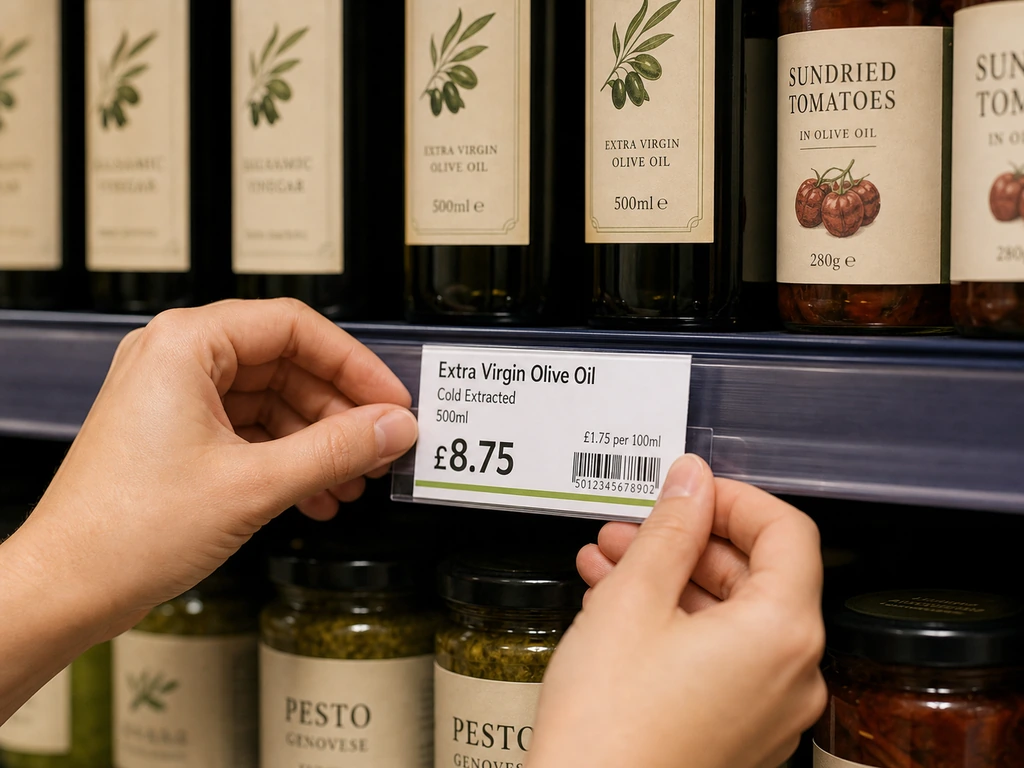
Adhesive Labels & Stickers: Quick, Versatile, and Budget-Friendly
For high-SKU environments where speed matters more than aesthetics, adhesive labels are the workhorse format. They stick to glass, cardboard, plastic, and metal — no tools, no holders, no setup time.
The material choice matters more than most people realize. Standard paper labels work fine on dry shelf edges and cardboard packaging. But they fail fast in cold or humid environments — condensation fogs the ink, adhesive loses grip, and your pricing becomes illegible within days. BOPP (biaxially-oriented polypropylene) film labels solve this: they’re waterproof, tear-resistant, and the adhesive stays strong across a wider temperature range. For refrigerated or outdoor displays, BOPP is the minimum viable spec.
Removable adhesive is another underappreciated variable. Labels labeled “removable” typically stay cleanly peelable for 6 to 12 months. Beyond that window, the adhesive can cure and leave residue that requires solvent to remove — a small detail that becomes a big headache when you’re re-tagging hundreds of products.
Shelf Talkers & Wobblers: Your Silent Sales Team at the Shelf Edge
A shelf talker is a small sign that attaches to the shelf edge directly in front of the product — the exact spot where a shopper’s eyes land when they’re deciding whether to pick something up. Unlike a price tag whose only job is displaying a number, a shelf talker can carry a feature headline, a short benefit, and a price — all in one glance.
The standard options range from printed cardstock (cheap for one-off promotions, swap them out weekly) to snap-in acrylic holders (reusable, just replace the insert). Wobblers — those shelf-edge signs mounted on a flexible plastic arm that moves slightly with air currents — are especially effective in categories where products sit side by side with little differentiation, like wine, spirits, and packaged food. The motion draws peripheral attention without being aggressive.
One installation detail that trips up first-timers: shelf-edge channels come in multiple widths — commonly 25mm, 30mm, and 40mm. Measure your shelf channel before ordering holders, because a 25mm clip won’t grip a 40mm rail, and a 40mm holder won’t fit a 25mm slot.
Hang Tags & Product-Attached Pricing: The Premium Touch
When the tag is physically attached to the product — hung from a neck, looped around a bottleneck, or pinned through a seam — it signals a level of care that shelf labels can’t match. This is the format for clothing, accessories, handmade goods, and anything positioned at a premium price point.
The attachment material does as much brand work as the tag itself. A simple cotton string says “artisanal.” A thin leather cord says “luxury.” A metal ball-chain says “industrial.” Each choice sets a price expectation before the customer even reads the number. The practical catch: natural fibers like jute and linen absorb moisture and can develop mildew in humid climates. For stores in tropical or coastal regions, synthetic cords or coated metal chains are the safer bet.
Creative Formats That Make Prices Stand Out
The line between “visible price” and “persuasive price” is where creativity earns its keep. These approaches layer on top of whatever base format you’ve chosen — they’re amplifiers, not replacements.
But here’s the constraint that keeps creativity from becoming self-indulgent: a customer must be able to identify both what the product is and what it costs within three seconds. If your creative treatment adds even one second of confusion, it’s costing you sales. That rule applies to everything that follows.
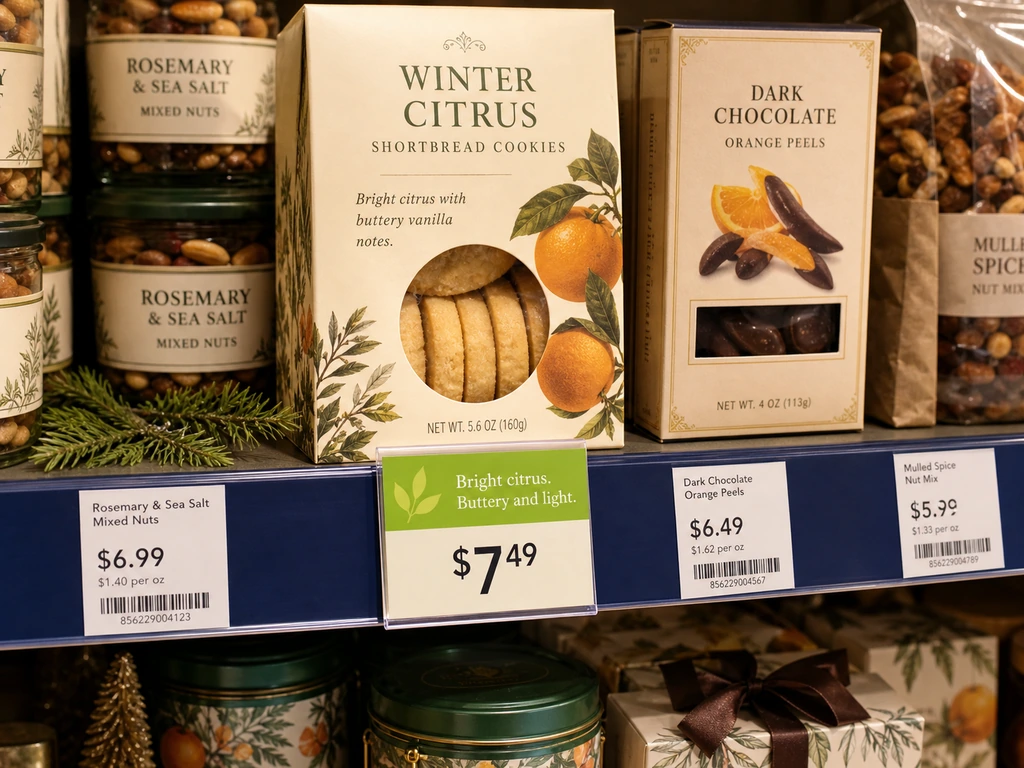
If a customer can’t identify both the product and its price within three seconds of glancing at your display, the design is working against you — not for you. Every creative choice should make pricing faster to find, not prettier to ignore.
Seasonal & Themed Price Displays: Freshness That Drives Urgency
Rotating your price display aesthetics with the calendar does two things at once: it keeps the store feeling current (avoiding the “same-old” fatigue that makes regulars stop noticing your signage), and it creates a subtle urgency signal — a Christmas-themed tag tells the shopper this price is event-linked and won’t last.
The execution timeline is tighter than people expect. Best-practice scheduling: begin teasing seasonal treatment about four weeks before the event, roll out the full look at two weeks, and pull every seasonal tag within 48 hours of the event ending. An expired seasonal tag — a Christmas sticker still up on January 5th — signals neglect, and neglect erodes pricing trust faster than almost anything else.
One compliance note worth bookmarking: in many jurisdictions, when you display a promotional price alongside a strikethrough “original” price, the original price must be one you actually charged for a defined period before the promotion. Fake reference pricing isn’t just bad practice — in markets like the EU, UK, and Australia, it’s a regulatory violation with real penalties.
Color-Coded Pricing Systems: Navigation Without Words
When a customer can scan a shelf and instantly know which products fall into their budget range without reading a single tag, you’ve removed a significant cognitive barrier. A color-coded system — green tags for entry-level, blue for mid-range, gold for premium — acts as a silent navigation layer on top of the actual price numbers.
The design trap to avoid is red-green coding. Approximately 8% of men and 0.5% of women have some form of color vision deficiency that makes red-green distinctions unreliable. The fix is simple: always pair color with a secondary differentiator. Red tag + star symbol. Green tag + circle. Blue tag + square. The combination keeps the system accessible to everyone while preserving the visual scanning speed that makes color coding valuable in the first place.
Eco-Friendly & DIY Materials: Price Tags as Brand Statements
Sustainability in price display isn’t just about material choice — it’s about what your tags tell customers about how you think. Recycled kraft card, FSC-certified paper (typically 15-30% more expensive than standard stock), bamboo veneer, and chalkboard-style reusable tags each project a different value system. The material becomes part of the brand message.
The practical ceiling: chalkboard tags with liquid chalk markers (never traditional chalk — the dust settles on merchandise) are perfect for farmers’ markets and weekly-update scenarios. Wood and bamboo tags look distinctive but absorb ambient moisture and can warp in humid environments. For most retailers, the sweet spot is a mixed approach — recyclable paper for everyday pricing, with a handful of higher-impact sustainable materials reserved for hero products and window displays.
Smart Grouping: One Display, Many Products
When you’re pricing 50 or 500 SKUs, individual tags become a maintenance burden. Smart grouping strategies reduce the number of price points you need to manage without making customers hunt for information.
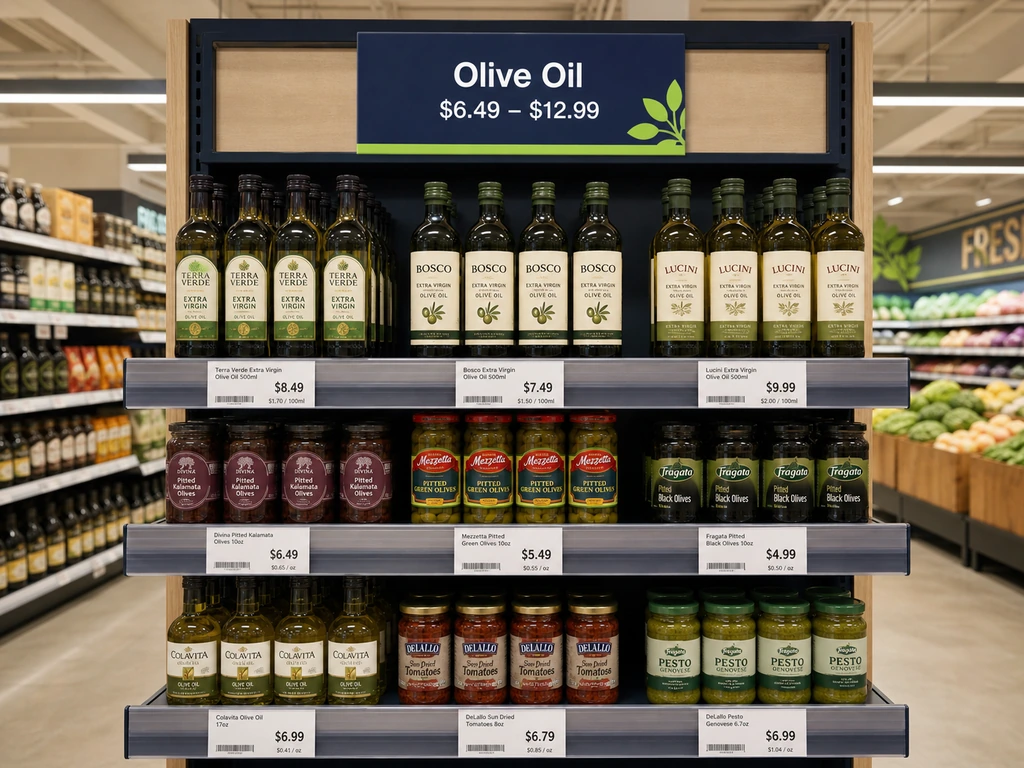
| Strategy | Best For | Recommended Format | Watch Out For |
|---|---|---|---|
| Single master price board | ≤10 similar products | Large frame, chalkboard, or wood sign | Products must be physically adjacent; customers need to map items to prices instantly |
| Category section signage | Products grouped by type or brand | Hanging chalkboard, A4 acrylic frame | Category names must be customer-facing (“Body Care”) not internal (“Aisle 3B”) |
| Tiered price table | Same product in multiple sizes/variants | Standing table tent or counter card | List largest/most expensive at top; use clear size→price mapping |
| Promo dump-bin header | Impulse/promotional end-cap displays | Bold single-price header card | The price IS the message; product names are secondary |
The readability rule of thumb worth memorizing: body text at 36pt is legible from about 3-4 feet. Price numbers on a header sign should be at least 72pt — roughly an inch tall — to be readable from 10 feet away, which is about the distance a shopper first notices an end-cap display.
The Scale Problem: What Changes When You Add More Stores
Most “price display ideas” guides ignore a basic question: what happens when there isn’t just one store, but five? Or twenty? Or fifty?
A mid-size supermarket carries roughly 10,000 SKUs. A full-store repricing — the kind that happens when a competitor drops prices or a seasonal reset kicks in — takes a team of three to five people two to three days. That’s 80 to 120 total labor hours for a single store. Multiply by the number of stores in a chain, and you’re looking at a recurring operational cost that shows up nowhere on a single-store budget sheet.
full-store repricing
per store on promos
a 20-store chain
Weekly promotional updates tell an even sharper story. If each store updates 200 to 500 promotional SKUs per week, that’s 4 to 8 labor hours — every single week, per store. Annualized across one location: 200 to 400 labor hours. Across a 20-store chain: 4,000 to 8,000 hours — the equivalent of two to four full-time employees doing nothing but changing price tags.
And that’s assuming everything goes right. It doesn’t. UK government audits in 2024 found pricing error rates ranging from 4.2% in supermarkets to 14.4% in convenience stores (UK Competition and Markets Authority, 2024). Sixty percent of those errors resulted in customers being charged more than the displayed price. Industry estimates from automated shelf auditing put the real-world baseline at roughly one mispriced item for every 30 SKUs. When you’re pricing 30,000 items across a chain, that’s potentially 1,000 wrong prices active at any moment — each one a possible customer complaint, a regulator flag, or a trust erosion you never hear about.
This isn’t a failure of effort. It’s a failure of process design. Manual price updates don’t scale linearly — they degrade. Each additional store, each additional promotion cycle, and each additional part-time staff member adds entropy to the system. The question isn’t whether errors will occur. It’s how many you’re willing to accept before the method itself needs to change.
Digital Price Tags: When Technology Becomes the Creative Choice
If the previous section described the problem, this one describes the solution. Electronic shelf labels — ESLs — have been quietly reshaping retail pricing for the past several years and are no longer confined to giant chains with seven-figure IT budgets. The global ESL market reached approximately $1.7 billion in 2024 and is projected to grow past $5 billion by 2031 (MarketsandMarkets, 2024). What started as niche hardware for hypermarket chains now sits at price points and usability levels that make it relevant to mid-size and growing retailers.
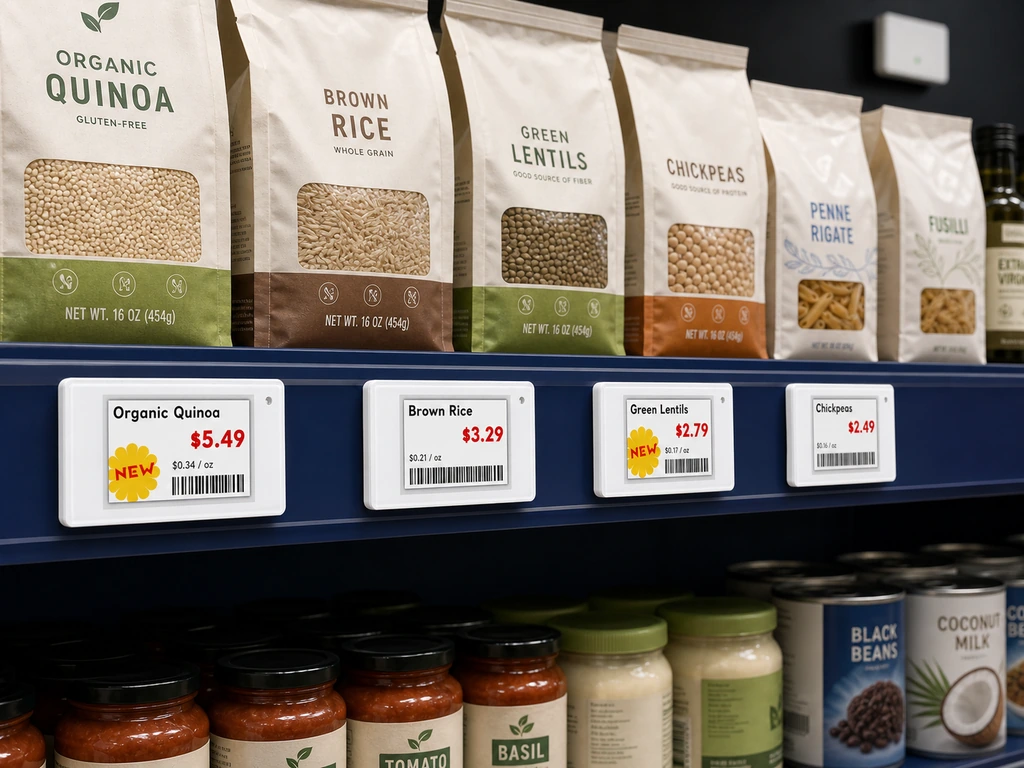
What Are Electronic Shelf Labels? A Quick Primer
An ESL is a small digital display — usually E Ink, the same screen technology as a Kindle — that replaces a paper price tag on the shelf edge. It communicates wirelessly with a base station connected to your pricing software. Change a price in the software, and every tag in every store updates within minutes.
The hardware is simpler than it sounds. A standard 2.9-inch ESL runs on a single CR2450 coin battery for three to five years, even with multiple daily updates. The E Ink screen holds its image indefinitely without power — if the battery dies, the last price stays visible until the tag is replaced. Indoor wireless range is typically 25 to 30 meters to the nearest base station, and a single base station can manage thousands of tags across a typical retail floor.
Real-Time Promotions: Creative Pricing at the Speed of Retail
With digital tags, price display stops being static and starts being programmable.
A convenience store chain can set breakfast-combo pricing to display from 7 to 9 AM, revert to standard pricing during the midday window, then trigger an afternoon snack promotion from 2 to 4 PM — all automatically, across every location, without a single staff member touching a label. Modern four-color ESLs (black, white, red, yellow) render the promotional price in red to catch attention, while the standard price stays in black.
Multi-page tags add another layer: a single label can cycle through the price, a short product description, and a QR code for loyalty points or product information — up to eight pages of content from one tag. LED-equipped models can flash in one of seven colors to mark flash sales or last-chance clearance items. These aren’t gimmicks. They’re conversion tools that paper fundamentally cannot replicate.
Multi-Store Consistency Without the Headache
This is the direct answer to the scale problem. Remember those 1,000 wrong prices active across a 30,000-SKU chain at any moment? ESLs reduce pricing errors by approximately 76% — from the double-digit error rates common with manual paper tags to well under 1% (Simbe Robotics / Nielsen, 2023). A European supermarket chain with 120 locations cut its weekly pricing disputes from 14 to 3 after switching, while recovering over 400 labor hours per month that had been spent on manual label changes.
The operational model is equally transformative. A regional chain of 30 stores running a weekend-wide 15%-off promotion on Friday evening can push the price update from a central dashboard. Every tag in every store reflects the new pricing within minutes. Store managers get pricing accuracy without spending their Saturday mornings racing through aisles with a label gun. The system logs every update — when it was made, by whom, and which tags received it — creating an audit trail that paper pricing can never provide.
Building a Price Display Strategy That Works
Price display isn’t one decision — it’s a series of decisions that should ladder up to how you operate, not just how you want things to look. Here’s a practical framework for matching your approach to your reality.
First, what’s your scale? A single boutique with 500 SKUs and quarterly price adjustments can thrive with beautifully designed hang tags and seasonal creative treatments. A chain of 15 convenience stores with weekly promotions on 300 SKUs per location needs process efficiency as much as visual appeal. The crossover point — where manual methods start costing more in errors and labor than the investment in automation — typically arrives somewhere between 3 and 5 locations, depending on your SKU count and promotion frequency.
Second, how often do your prices change? If you adjust prices quarterly, the labor cost of manual updates is manageable. If you run weekly promotions across hundreds of SKUs, the math shifts fast. At 4 hours per week per store on manual label changes, you’re spending over 200 labor hours per store per year — on a task that automated systems handle in minutes.
Third, how important is price consistency to your brand promise? A discount retailer with a “prices may vary” sign has a different consistency burden than a premium grocer whose customers expect shelf price and register price to match every single time. The more your brand depends on pricing trust, the more a 4-14% error rate becomes unacceptable.
3 stores · 800 SKUs each · seasonal repricing. Tags are part of the brand aesthetic. Best path: premium hang tags, seasonal creative rotations, acrylic shelf holders. Tech investment: minimal — manual still wins on the labor math.
25 stores · 8,000 SKUs each · weekly promos on 400+ items. Price accuracy is a daily operational headache. Best path: ESL deployment with cloud central management. Labor savings alone (4k–8k hrs/year) justify the switch.
Most retailers fall somewhere between these extremes, and the right answer is rarely all-or-nothing. A phased approach — digitize your highest-frequency promotional categories first, keep standard categories on traditional tags — is often the most practical and budget-friendly path forward.
The goal is not to replace every paper tag overnight. It’s to recognize the point on your growth curve where manual pricing stops being a minor annoyance and starts being a measurable drag on operations and customer trust. For many retailers, that point arrives sooner than they expect.
For retailers ready to explore the digital end of the price display spectrum, real-world deployment examples across supermarkets, pharmacy chains, and specialty retail in 180+ countries are available at Zhsunyco’s case studies library. To discuss which pricing display approach fits your specific store format and scale, visit the contact page.
References
- UK Competition and Markets Authority. “CMA calls on grocery stores to make accurate pricing a priority.” 2024. https://www.gov.uk/government/news/cma-calls-on-grocery-stores-to-make-accurate-pricing-a-priority
- Simbe Robotics / Nielsen. “Smart Pricing Drives Sales Growth — and Customer Trust.” 2023. https://www.simberobotics.com/resources/insights/smart-pricing-drives-sales-growth-and-customer-trust
- Displaydata / Planet Retail RNG. “Global Retailers Spent $104 Billion on Manually Changing Price Labels in 2017.” BusinessWire, 2018. https://www.businesswire.com/news/home/20180522005419/en/New-Research-Displaydata-Planet-Retail-RNG-Estimates
- MarketsandMarkets. “Electronic Shelf Labels Market Report 2024-2029.” 2024. https://www.marketsandmarkets.com/Market-Reports/electronic-shelf-label-market-40815676.html
- 6Wresearch. “Global Electronic Shelf Label Market (2025-2031).” 2025. https://www.6wresearch.com/industry-report/global-electronic-shelf-label-market
- Zhsunyco. “Case Studies.” https://www.zhsunyco.com/case-studies/
- Zhsunyco. “Contact Us.” https://www.zhsunyco.com/contact-us/
- Zhsunyco. Homepage. https://www.zhsunyco.com/

 English
  Russian
  Spanish
  German
  Arabic
  French
  Bulgarian
  Polish
  Romanian
  Turkish
  Portuguese