


Retail Pricing Tools: What to Buy, When to Buy It, and What to Skip
If you run a retail business and you’re still setting prices in a spreadsheet, you’re not alone—but you are leaving money on the table every single day. The hard part isn’t finding pricing tools. A Google search will give you fifty of them. The hard part is knowing which category of tool you actually need, and whether your business is ready for it.
This guide works differently from the typical “10 best pricing tools” list. Instead of dumping thirty vendor names on you and hoping one sticks, we start with your pricing strategy, walk through the three tool categories that actually matter, and give you a framework for matching the right solution to your business. By the end, you’ll know exactly which type of tool to evaluate first—and which ones can wait.
Retail Pricing Strategy Comes First — Define Your Approach Before Choosing Tools
Most retailers buy pricing tools backwards. They see a demo of a flashy AI platform, get excited about dynamic pricing, sign a contract—and then realize their team still can’t answer basic questions like “which products actually drive our margin?” The tool gathers dust, and a year later they’re back in Excel.
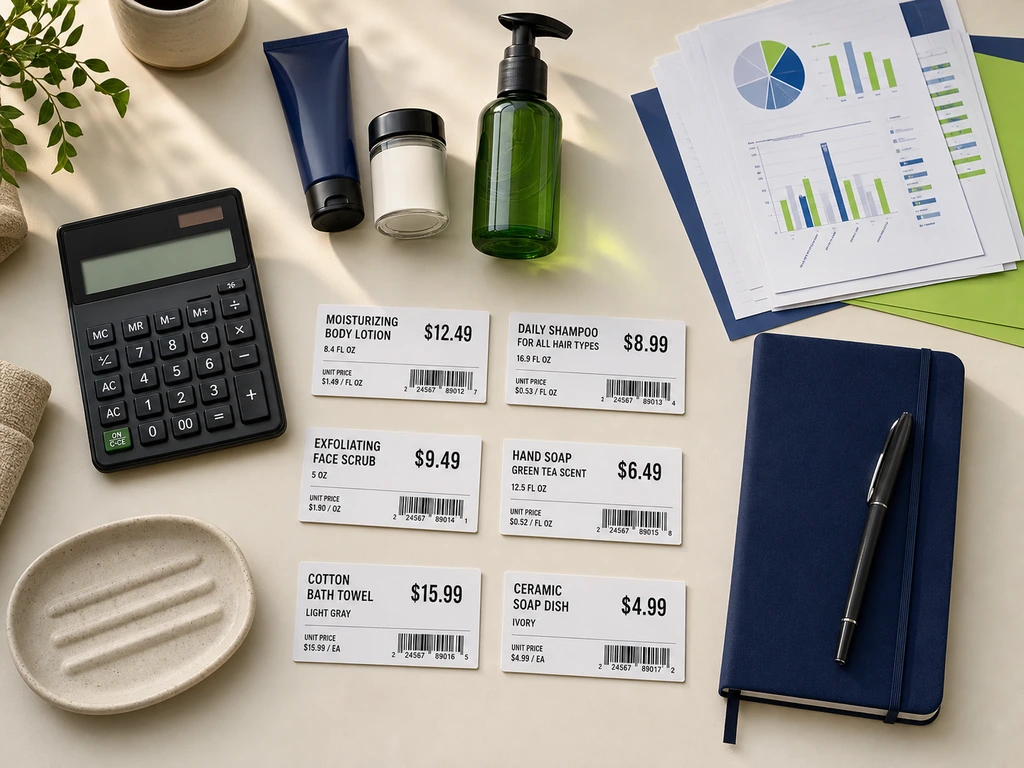
The right order is strategy first, tools second. Here’s how to build that foundation before you evaluate a single vendor.
Spreadsheet to Systematic — Recognizing When Manual Pricing Stops Working
Excel is a remarkable tool. But for retail pricing, it has an expiration date. Here are the signals that manual pricing has crossed the line from “good enough” to “costing you money”:
If two or more of these hit home, it’s time to move beyond the spreadsheet. But move to what? That depends on what you’re trying to achieve.
Define Your Pricing Objectives — Margin, Volume, or Competitive Position?
Pricing tools don’t serve one universal goal. They serve one of three, and which one you pick determines which tool category you should look at first:
- Margin-first retailers protect profit per unit. They ask: “What’s the highest price the market will bear without killing volume?” These retailers need tools that model price elasticity—how demand shifts as price moves.
- Volume-first retailers chase market share and throughput. They ask: “What price moves the most units?” These retailers need competitive monitoring to stay at or below market price.
- Competition-first retailers benchmark everything against rivals. They ask: “What’s everyone else charging, and where do we need to match or beat them?” These retailers need real-time price intelligence.
Here’s a concept worth understanding early: Key Value Items, or KVIs—the products everyone knows the price of. Eggs and milk in a grocery store. The latest iPhone at an electronics retailer. KVIs shape your entire price image in the customer’s mind. Smart retailers price KVIs aggressively, sometimes at break-even, while taking margin on the long tail of products nobody bothers to comparison-shop. Your pricing tool needs to handle these two tiers differently—because your customer treats them differently.
Audit Your Current Pricing Data — What Do You Actually Know?
Before you spend a dollar on tools, take an honest inventory:
| Data Type | Do You Have It? |
|---|---|
| Competitor prices for your top 100 SKUs | ☐ Yes ☐ Partial ☐ No |
| Historical sales data with corresponding prices | ☐ Yes ☐ Partial ☐ No |
| Inventory turnover rates by SKU | ☐ Yes ☐ Partial ☐ No |
| Promotion performance data (lift vs. margin impact) | ☐ Yes ☐ Partial ☐ No |
Here’s an uncomfortable truth: roughly two-thirds of retail promotions lose money once you account for the margin given up. Most retailers never measure this—they see the sales bump and call it a win. If you can’t answer “did that 20%-off promotion actually leave us with more profit?” for your last three campaigns, you need a monitoring tool before you need an optimization tool. You can’t optimize what you can’t measure.
The Three Types of Retail Pricing Tools — A Simple Framework
Here’s the mental model that will save you more time than any feature comparison table: pricing tools fall into exactly three categories, and they solve fundamentally different problems. Most vendor websites blur these lines on purpose—they want you to think their monitoring tool does optimization, or vice versa. It usually doesn’t.
| Dimension | Price Monitoring | Price Management | Price Optimization |
|---|---|---|---|
| Problem it solves | What are competitors charging? | How do I push correct prices everywhere, fast? | What price maximizes my profit? |
| Core capability | Web scraping, SKU matching, price change alerts | Rules engine, batch updates, multi-store sync, approval workflows | AI/ML elasticity modeling, demand forecasting, dynamic pricing |
| Typical user | E-commerce ops, category managers | Chain retail pricing teams, omnichannel ops | Revenue management, pricing strategy |
| Example tools | Prisync, Price2Spy, Intelligence Node | Omnia Retail, ESL management systems, ERP pricing modules | Competera, DemandTec, Quicklizard |
| Best for | Retailers who need to see the market | Retailers who need to execute prices reliably | Retailers ready to let data decide the price |
As Kevin Sterneckert—former Gartner retail research lead and current DemandTec CSO, who cut his teeth managing pricing at H-E-B and Walmart—puts it: “Buy monitoring when you need eyes. Buy optimization when you need a brain.” Most retailers buy optimization because it sounds smarter, then discover they didn’t have the data foundation to make it work.
Price Monitoring Tools — Your Eyes on the Competition
Monitoring tools are the shallow end of the pricing pool: easiest to adopt, lowest cost, and the natural starting point for most retailers. But “monitoring” covers a massive range—from a $99/month SaaS tool tracking 100 SKUs to an enterprise platform ingesting millions of price points across 40 countries. Here’s how to find your spot on that spectrum.
The question that determines your tier: “How many SKUs, across how many competitors, and how fast do you need to know when they move a price?”
Entry-Level Monitoring — For Small Retailers Getting Started
If you run an independent retail business or a small e-commerce operation with 50 to 500 SKUs, your needs are straightforward: know when your main competitors change prices, and get an alert before you lose a week of sales.
Tools like Prisync (starting around $99/month) and Price2Spy (from roughly $79/month) are built for this exact use case. They monitor competitor websites, match your products to theirs, and send email alerts when prices shift. Price2Spy holds a 4.8/5 on G2 across 84 reviews and 4.7/5 on Capterra across 98 reviews—solid numbers for this class of tool. Users consistently praise the alert reliability and ease of setup. The main complaints: billing friction and plan limits on how many competitor sites you can track.
What entry-level tools do well: show you competitor prices and tell you when they change. What they don’t do: tell you what your price should be, sync prices across channels, or analyze promotion performance. That’s fine—you’re not paying for that.
The upgrade signal: when you hit roughly 1,000 SKUs or start needing to monitor competitors across multiple countries, the entry tier’s SKU caps and daily refresh limits begin to pinch.
Enterprise-Grade Monitoring — When Scale Changes Everything
For retailers managing 5,000-plus SKUs across multiple markets, monitoring turns into a data engineering problem. The hard part isn’t crawling competitor sites—it’s matching your products to theirs when the naming doesn’t line up. Your “Blue Cotton Crew Neck Tee – Size M” is someone else’s “Men’s Classic Fit T-Shirt, Navy, Medium.” If the matching is wrong, every price comparison that follows is garbage.
Intelligence Node claims 99% matching accuracy, sub-10-second price refreshes, and coverage spanning $600 billion in retail revenue tracked globally. Wiser Solutions focuses on MAP (Minimum Advertised Price) compliance alongside competitive intelligence, with seller-level visibility that helps brands police unauthorized discounting. Both are quote-based enterprise tools—you won’t find pricing on their websites.
A word of caution: every “99% accuracy” and “real-time refresh” claim in this space comes from the vendor’s own marketing. No independent auditor checks these numbers. The only way to know if the matching works for your catalog is to run a proof of concept with your own SKUs before signing.
Free and Lightweight Options — What You Can Get Without a Budget
Not every retailer is ready to pay for a monitoring tool. Here’s what you can do for free:
Google Merch Intel is Google’s open-source pricing dashboard, built on Looker Studio and Google Cloud Platform. It pulls competitive pricing signals from Google Merchant Center and Google Ads data, generates AI-powered price suggestions, and breaks down benchmarks by brand and category. The catch: it only works within the Google ecosystem. If your competitors don’t use Google Shopping, they’re invisible to this tool.
For the truly budget-constrained: a combination of Google Sheets, Google Alerts on competitor brand names, and manual weekly checks on your top 20 SKUs won’t win any technology awards—but it will tell you when the market moves. Think of free tools like binoculars: they show you what’s on the horizon. They won’t steer the ship for you.
Price Optimization Tools — Let Data Find Your Best Price
Price optimization is where the pricing software conversation gets serious—and expensive. These tools use AI and machine learning to answer the question every retailer eventually asks: “What price gives me the best outcome?” But “AI” is the most abused word in retail technology, and optimization tools vary wildly in what they actually do under the hood.

The core value is simple: instead of you guessing the right price, the system calculates it from how demand has historically responded to price changes at the SKU level—combined with competitor pricing, inventory position, seasonality, and sometimes external signals like weather or local events.
Rule-Based vs. AI-Driven Optimization — Know What You’re Buying
When a vendor says “AI-powered pricing,” they could mean any of three very different things:
- Rules engine with automation. You set the logic: “If competitor A drops below my price by more than 5%, match them—but never go below cost plus 15%.” This isn’t AI. It’s a dressed-up if-then statement. But for retailers with stable markets and predictable competitors, it works well and costs far less.
- Machine learning elasticity models. The system analyzes your historical sales data to understand how much volume changes when price moves, SKU by SKU. This requires at least a year of clean transaction data and enough SKU-level price variation to build a reliable model. This is real optimization—but it lives or dies on your data quality.
- Multi-factor deep learning. The most advanced tier: the system processes 20-plus variables at once—competitive prices, inventory levels, seasonality, promotional calendars, weather forecasts, even social media sentiment. Competera claims 930-plus sub-models trained on over 10 billion transactions and 9 million products, processing 20 pricing factors alongside up to 180 additional variables. Their published customer results: 6–8% profit improvement and 50% faster repricing cycles. Quicklizard takes a different approach with what they call “Glass Box AI”—every recommendation comes with a full data trail showing exactly why the price was suggested, so pricing managers can override with confidence. Their reported customer average: 11% profit uplift.
The rule of thumb from practitioners: rules engines give you control; ML models give you optimization; deep learning gives you sophistication. But sophistication without clean data is just an expensive screensaver.
Does Your Business Have Enough Data for AI Optimization?
This is the question that separates serious buyers from tire-kickers. AI optimization tools need fuel, and the fuel is your historical transaction data. Here’s a realistic minimum:
- At least one full year of transaction-level sales data with corresponding prices. Less than a year, and seasonality will mislead the model.
- A catalog of at least 500–1,000 SKUs to hit statistical significance. Below that, there’s not enough price variation for the model to learn from.
- Ongoing competitive data input. Optimization isn’t a one-time setup—prices, competitors, and demand shift constantly.
If you don’t meet these thresholds, don’t buy an optimization tool. Buy a monitoring tool, accumulate data for 12–18 months, then revisit optimization. Most vendors will happily sell you an optimization platform whether you’re ready for it or not. They won’t call a year later to ask why you’re still using 20% of the features. As one industry practitioner told us: “Buying AI optimization without historical data is like buying a gym membership and never going—the tool is great, but without the inputs it’s useless.”
Promotion Optimization — The Other Half of Pricing
Pricing isn’t just about your everyday shelf price. For most retailers, promotions are where the real margin leakage happens. The math is brutal: sell a $50 item at 20% off for $40, and you need to move 50% more units just to earn the same total profit. Most retailers have never run that calculation per promotion.
Good promotion optimization tools answer three questions: (1) How much incremental volume does this discount actually drive? (2) What happens when the promo ends—does the product return to its old price without a volume crash? (3) Is this promotion cannibalizing full-price sales of related items?
Tools like Eversight specialize in AI-powered promotion testing, while DemandTec (now part of Acoustic) combines promotion and everyday price optimization in a single platform. More than 70% of retailers surveyed by NielsenIQ say they plan to invest in promotion forecasting tools within the next 12 months. This is becoming table stakes.
| Approach | How It Works | Data Required | Monthly Cost Range | Best For |
|---|---|---|---|---|
| Rules Engine | “If competitor drops by X%, match down to floor price” | Minimal — just competitor data | $0–500 | Stable markets with predictable competitors |
| ML Elasticity | Models price-demand relationship from historical sales | 1+ year transaction data, 500+ SKUs | $500–5,000 | Mid-size retailers with clean sales history |
| Multi-Factor Deep Learning | 20+ variables processed simultaneously for per-SKU optimal price | All of the above plus real-time competitor & external data | $2,000–10,000+ | Enterprise retailers in volatile categories |
The IDC MarketScape 2025–2026 report provides the most comprehensive independent assessment of the space, formally evaluating 21 vendors across criteria including AI capability, customer satisfaction, and market presence. If you’re evaluating optimization tools at the enterprise level, it’s worth the read. (IDC, 2025)
Across all three approaches, one pattern holds: the tools that deliver the biggest ROI are the ones adopted by teams who committed to clean data first. The software amplifies what you already have — it doesn’t create pricing intelligence from nothing.
Price Management — The Execution Layer That Connects Everything
Between monitoring the market and optimizing prices sits a less glamorous but essential layer: price management. This is the plumbing of retail pricing—the systems that take a pricing decision and make sure it actually reaches every channel, every store, and every customer touchpoint, correctly and simultaneously.
Price management tools handle the operational workflow: rules engines that enforce margin guardrails, batch price update capabilities across thousands of SKUs, approval workflows so no single person can accidentally price a category below cost, and scheduled publishing so price changes go live at the right moment—not when someone remembers to click “save.”
The distinction matters because you can buy the world’s best optimization tool, but if your management layer can’t execute its recommendations, the AI’s insights never leave the dashboard. This is especially critical for omnichannel retailers: your website, your physical stores, your marketplace listings, and your wholesale price sheets all need to reflect the same pricing reality.
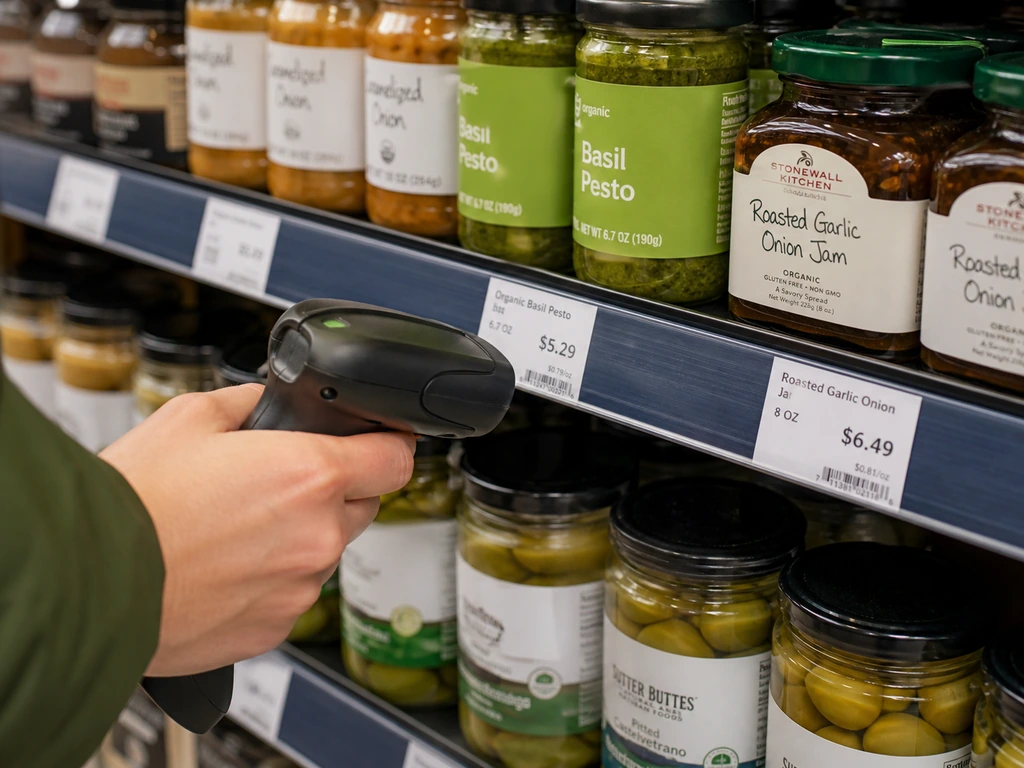
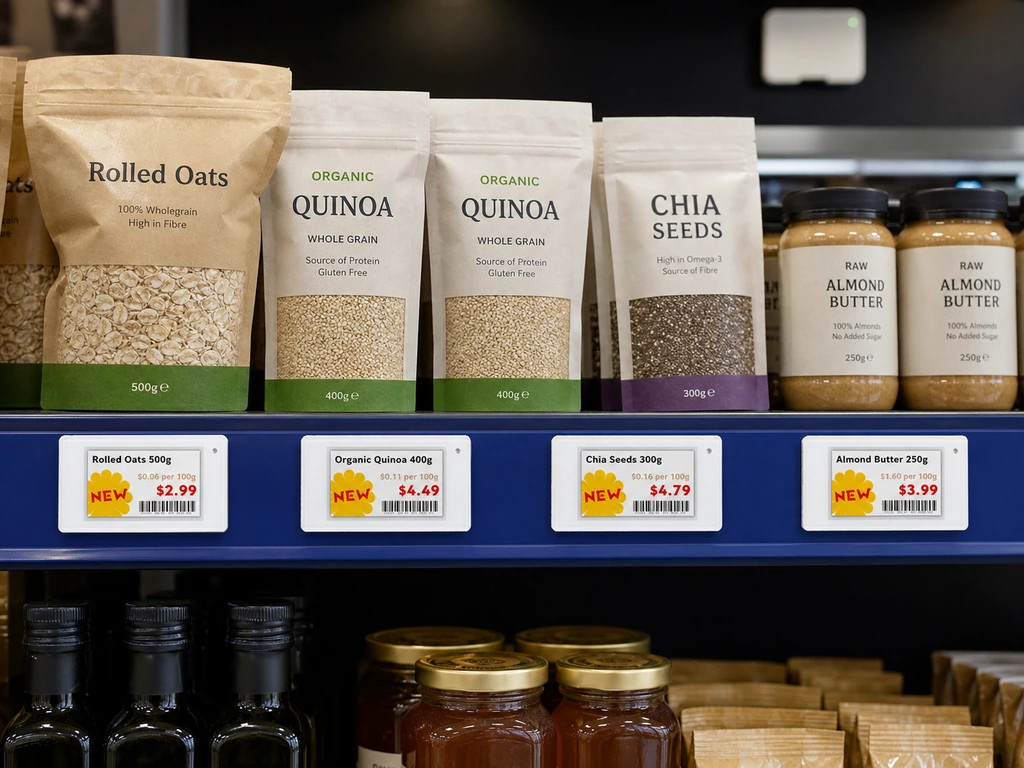
In physical retail, there’s an additional dimension: the gap between what your software says the price is and what the customer sees on the shelf. When your central system pushes a price change, someone still has to print and replace paper tags—or you invest in electronic shelf labels (ESL) that update in seconds. ESL systems use multiple wireless protocols (2.4GHz, 433MHz, BLE, NFC, WiFi) to push price updates from your management software directly to the digital display on the shelf, eliminating the lag between a pricing decision and its real-world execution. For retailers managing 10-plus stores, this hardware-software link is what turns a pricing strategy from a back-office exercise into something customers actually experience.
Most retailers don’t buy price management as a standalone product. It comes embedded in larger systems: ERP platforms like SAP or Oracle, e-commerce engines like Shopify or Magento, or specialized retail suites. Omnia Retail is one of the few independent price management tools with published pricing, starting around €399/month for its SMB tier.
How to Match the Right Tool to Your Retail Business
You now know the three tool categories and roughly what each costs. Here’s how to map that to your specific situation.
| Your Situation | Start With | Typical Monthly Cost | Upgrade When |
|---|---|---|---|
| Independent store, under 200 SKUs | Free tools + manual process | $0 | Manual repricing starts causing errors or delays |
| Growing e-commerce brand | Entry-level monitoring (Prisync, Price2Spy) | $79–199 | You pass 1,000 SKUs or start running regular promotions |
| Regional chain, 5–50 locations | Monitoring + management combo | $200–1,000+ | Cross-store price inconsistencies start hurting customer trust |
| Large chain, 50+ locations | Full stack: monitoring + management + optimization | $2,000–10,000+/month | Margin pressure demands precision on every percentage point |
| Omnichannel (online + physical stores) | Management first (solve online-offline sync), then optimization | Custom | — |
Three additional factors to weigh:
Category velocity. If you sell fashion or consumer electronics—where product lifecycles are measured in weeks and competitor prices shift daily—you need monitoring that refreshes at least hourly, and optimization that can react same-day. If you sell building materials or industrial supplies with stable pricing, daily or even weekly monitoring may be enough.
Team readiness. The best pricing tool in the world is worthless if your team won’t use it. Before you demo anything, ask: who will own this tool day to day? Do they have the analytical skills to interpret optimization recommendations? Will store managers trust AI-generated prices enough to implement them—or will they override everything manually?
Integration reality. A pricing tool that doesn’t talk to your POS, your e-commerce platform, and your ERP is an island. Every manual data export between systems is a reason your team will eventually abandon the tool. Ask every vendor: “Show me your integration with [your specific platform]. Not the API documentation—a live customer using it.”
For additional independent validation, platforms like G2 and Capterra aggregate real user reviews. Price2Spy’s 4.7–4.8 average across 180-plus reviews tells a different story than Competera’s 4.9–5.0 across 60-plus reviews—not because one is “better,” but because they serve completely different customer sizes with different expectations. Read the 3-star and 4-star reviews, not just the 5-star ones. They’re where you learn what actually breaks.
Getting Started Without Getting Overwhelmed
You’ve just absorbed a lot of information about pricing tools. Here’s what to do next, in order:
One final thought: pricing software is only half the equation. The other half is the physical shelf. A perfectly optimized price that never reaches the customer’s eye—because the paper tag still shows last week’s number—is worse than no optimization at all.
The retailers winning on price in 2026 are the ones who’ve closed the loop from strategy, to software, to shelf. That loop is what turns pricing from a back-office spreadsheet exercise into a competitive advantage your customers can actually see.

 English
  Russian
  Spanish
  German
  Arabic
  French
  Bulgarian
  Polish
  Romanian
  Turkish
  Portuguese