


Retail Pricing Optimization: Why Your Strategy Is Only as Fast as Your Shelf
Why Static Pricing Breaks in Modern Retail
For decades, retail pricing followed a comfortable rhythm: review costs, apply a margin, print the labels, and revisit next quarter. That rhythm is broken. Three forces have turned static pricing from a minor inconvenience into an active threat to margins.
First, manual price updates can’t keep pace with market velocity. Competitors on digital channels now adjust prices by the hour. A physical retailer running on paper labels might need days to push through a single round of price changes. The result is what industry analysts call a “latency tax” — research from Anaplan estimates that slow retail decision-making costs roughly five cents on every dollar of revenue, or $50 million annually for a billion-dollar retailer (Anaplan, 2025).
Second, consumer price visibility has reshaped the power dynamic in the aisle. A shopper can scan a barcode and compare prices across five competitors in under three seconds. When your shelf price doesn’t match what they find online — or when your own website lists a different price than your store — trust erodes fast. Research from the Food Marketing Institute found that paper-based pricing systems carry a 5–10% error rate across SKUs. That means one in every ten to twenty price tags in a typical store is wrong right now.
Third, blanket promotions have become a margin-destroying habit. Industry data suggests roughly two-thirds of retail promotions deliver negative ROI — they discount prices without generating enough extra volume to recover the lost margin. Static pricing leaves retailers with one lever: “discount everything by X%.” What they actually need is surgical precision.
The question is not whether your pricing needs to improve. It’s whether your entire pricing infrastructure — from analytics to the shelf edge — can operate at the speed today’s market demands.
The Data-Driven Pricing Stack: AI, Competitor Intelligence, and Value-Based Frameworks
Modern pricing optimization is not a single tool or tactic. It’s a stack of three capabilities that work together. Predictive analytics determines what price will work. Competitor intelligence tells you where the market sits. Value-based frameworks make sure you’re capturing what your product is worth, not just matching everyone else. These three layers compound each other — they don’t compete.
AI-Powered Dynamic Pricing: From Rules to Real-Time Learning
The gap between a rule-based pricing engine and an AI-driven one is the gap between a thermostat and a weather forecasting system. A thermostat reacts to the current temperature. A forecast model anticipates what’s coming.
AI-powered dynamic pricing continuously ingests a broad set of variables — historical sales patterns, competitor price feeds, inventory positions, seasonal coefficients, regional weather, holiday calendars, and social media sentiment signals — to predict the price point that maximizes margin at any moment. Instead of a fixed rule like “if competitor drops 5%, match it,” the model learns which competitor moves actually shift demand for your assortment and which ones you can safely ignore.
This matters because pricing errors compound across your SKU base. IHL Group’s 2025 inventory distortion study pegged the global cost of retail inefficiency — including price and offer mismatches — at $1.73 trillion annually. Pricing and promotion misalignment alone accounts for over $77 billion in preventable losses (IHL Group, 2025).
The real shift is from periodic batch pricing — “let’s review this category next Tuesday” — to continuous optimization. Retailers who have moved to weekly or real-time forecast updates capture 2.3× higher sales growth and 2.5× higher profit growth compared to peers still running legacy planning cycles, according to IHL’s data.
Competitor Price Intelligence: Know the Market in Real Time
Pricing optimization without competitor visibility is navigation without a map. You might be moving efficiently, but you have no idea whether you’re heading in the right direction.
Effective competitor intelligence runs at three maturity levels. Level 1 is manual spot-checking — someone on your team visits competitor sites and writes down prices. Level 2 adds weekly automated reports from tools like Prisync or PriceShape. Level 3 is real-time web crawling with automated alerts that flag only high-priority price movements on the SKUs that matter most.
What should you monitor? Not just list prices. Smart retailers track promotional prices, bundled offers, membership discounts, and channel-specific pricing. A competitor might hold their shelf price steady while quietly giving loyalty members 15% off.
The discipline centers on Key Value Items (KVIs) — the 20% of SKUs that shape how consumers perceive your prices. These are the products people know the price of by heart: milk, eggs, bananas in grocery; bestselling phone models in electronics. For KVI categories, the response window is measured in hours, not days. High-velocity categories like consumer electronics may need price responses within four hours. Slower categories like home furnishings can handle 24–48 hour cycles.
Value-Based Pricing: Stop Leaving Margin on the Table
The third layer moves pricing from a reactive exercise — “what is everyone else charging?” — to a strategic one: “what is this product actually worth to the customer buying it?”
Every SKU in your assortment plays one of three roles. Traffic drivers are the KVIs — priced aggressively, sometimes at near-zero margin, because they pull shoppers in and shape overall price perception. Profit generators are where you earn your living: specialty items, private-label goods, and categories where you have genuine differentiation. These carry higher margins because customers benchmark them less. Image builders are premium products where the price itself signals quality — picture the $40 bottle of olive oil sitting next to the $8 one.
The discipline is knowing which role each SKU plays and pricing it accordingly. Too many retailers price everything like a traffic driver and wonder why margins never improve. Others price everything like a profit generator and wonder why foot traffic keeps falling.
Psychological pricing is not just marketing folklore. Behavioral economics research consistently shows that crossing integer price thresholds — $9.99 versus $10.00 — produces a 3–8% conversion difference. Not because consumers can’t do the math, but because the left-digit effect operates below conscious reasoning.
From Strategy to Shelf: Why Pricing Execution Needs Digital Infrastructure
A pricing strategy runs only as fast as its slowest execution point. For physical retail, that point is the shelf edge. Every minute between a pricing decision and its arrival at the shelf is margin you lose or a customer you confuse. This is the layer nearly every pricing optimization article skips — and it’s where the biggest competitive gap lives.
Electronic Shelf Labels: The Missing Layer in Pricing Infrastructure
Paper price tags carry an invisible tax that most retailers never add up. A single full-store price update in a mid-size supermarket takes between four and eight labor hours. Multiply that across 50 stores running weekly promotions, and you burn 200–400 labor hours every week on a task that creates zero customer value — you’re just maintaining the status quo. The Food Marketing Institute’s finding that 5–10% of paper labels carry errors at any moment means those labor hours are not even buying accuracy.
Electronic Shelf Labels (ESLs) compress this from hours to seconds. A cloud-based pricing engine pushes updated prices to a base station, which broadcasts to thousands of shelf labels at once. The communication protocol shapes the deployment fit: 2.4GHz systems cover a 30-meter+ radius and handle tens of thousands of labels, ideal for large-format supermarkets and hypermarkets. NFC and BLE variants suit smaller-footprint stores like convenience chains and pharmacies, where label counts run in the hundreds rather than thousands.
The ROI math keeps getting stronger. Walmart is scaling ESLs to 2,300 U.S. stores by 2026. The UK’s Co-op is equipping all 2,400 locations. Neither is doing this because it’s futuristic — they’re doing it because the operational economics have tipped. A real-world example: a pharmacy chain in Greece deployed a 2.4GHz ESL solution and reported a 90% improvement in price update efficiency, turning what had been a store-wide manual process into a near-instant digital operation (ZhSunyco Case Studies).
Real-Time Execution: When Pricing Data Meets the Shelf Edge
ESLs are not just digital price displays. They’re IoT endpoints that close the loop between strategy and execution. The data flow works like this: a pricing engine generates a recommended price, the cloud management platform pushes it to the store’s base station, the base station broadcasts to individual labels, each label updates and sends a confirmation signal back, and the management dashboard marks the update as verified. Labels that fail to confirm trigger automatic retries.
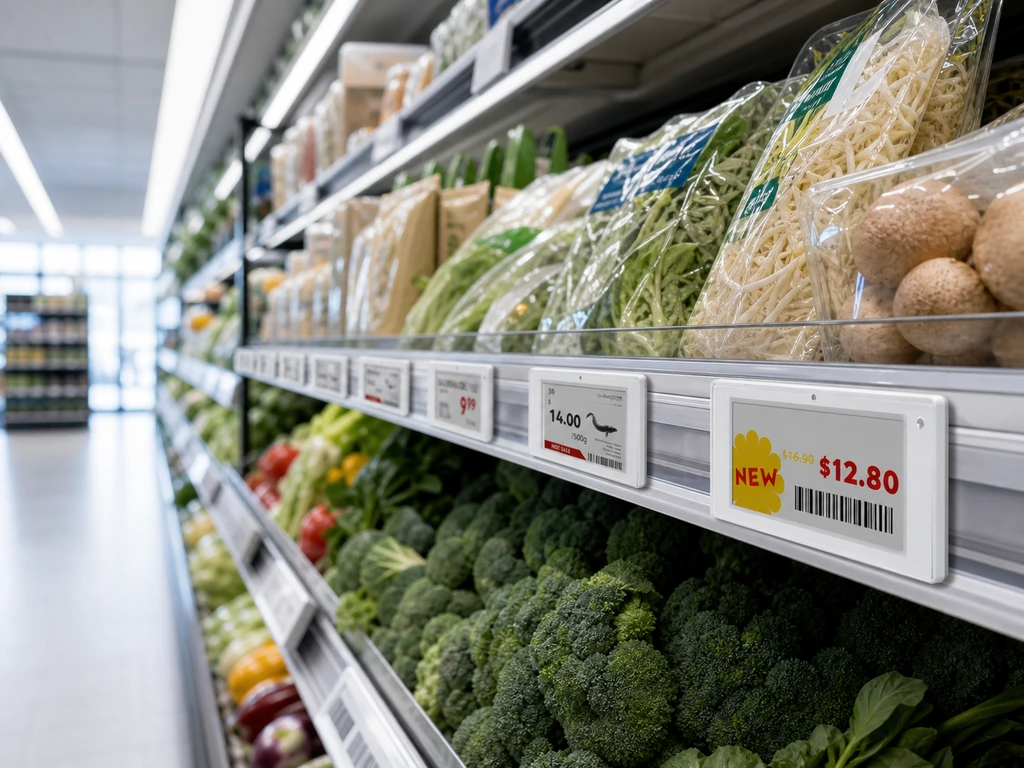
This closed-loop architecture solves a problem that paper-based retailers don’t even know they have: execution visibility. With paper labels, a pricing manager at headquarters has no way to confirm that 500 stores actually changed the price. They trust that someone followed the memo. With ESLs, they know — label by label, store by store, in real time.
Beyond price display, ESLs enable dynamic markdowns on perishable goods. A bakery can program labels to drop prices by 25% at 6 PM, cutting waste without asking staff to manually retag every item. They support QR-code-based product traceability, nutritional information, and inventory status indicators. And they guarantee chain-wide price consistency: the same SKU shows the same price across 500 locations, updated together, with zero drift.
For multi-location retailers, this is the difference between having a pricing strategy and actually running it.
Choosing Pricing Technology That Fits Your Scale
The right pricing technology depends on three things: your store count, your integration complexity, and whether you need online-only pricing or full shelf-level execution. There is no universal answer — but there is a right fit for your operation.
Enterprise-Grade Platforms: When Pricing Is a Competitive Weapon
For retailers with 100+ locations, pricing optimization typically lives inside a broader retail planning suite. Platforms like Revionics, Blue Yonder, and Oracle Retail cover the full pricing lifecycle — regular price management, promotional optimization, markdown planning, and competitive response — all integrated with supply chain, merchandising, and ERP systems.
These are not plug-and-play tools. Implementation timelines run 6–18 months, and the hidden cost is data preparation. Historical transaction data usually needs 30–40% of the deployment timeline just for cleaning and standardization before any AI model can learn from it. The payoff: pricing that operates as a continuous strategic function, not a periodic administrative chore.
Accessible Tools for the Mid-Market: Start Where You Are
For retailers with 5–100 locations, the pricing technology landscape has opened up dramatically. Pure competitor monitoring tools like Prisync and PriceShape start at $99–$599 per month with automated price tracking and basic alerting. Mid-tier platforms add dynamic pricing rules and demand-based recommendations in the $599–$2,000 per month range.
The hardware side has shifted even more. ESL unit costs have dropped from over $10 per label in 2019 to $3–$5 in 2025, putting full-store digital shelf deployments within reach for independent chains. At current pricing, a 50-store chain deploying 5,000 labels per location can expect combined ROI — labor savings plus pricing efficiency gains — within 12–18 months.
The key: avoid the urge to boil the ocean. Start with one category, one channel, and one tool. Prove the concept. Then scale.
Your Pricing Optimization Roadmap: Where to Start
If one idea sticks from this article, make it this: pricing optimization is not a software purchase. It’s an operational capability you build in layers. Here is where to begin.
Step 1: Audit your current pricing reality. Before you look at any tool or technology, understand where you actually stand. How often do your prices update today? How many competitor prices can you name with confidence? Do you know which of your promotions actually make money? Most retailers find they have far less visibility than they assumed. That is not failure — it’s a baseline.
Step 2: Pick one category, one channel, and run a pilot. Choose a high-velocity category where pricing hits hardest — fresh produce in grocery, bestselling SKUs in electronics, seasonal items in home goods. Run a pricing optimization approach, even a lightweight one, for 30–60 days. Measure margin, volume, and sell-through against the same period last year. Let the data argue for expansion.
Step 3: Add the physical execution layer. If you operate physical stores, your pricing strategy is incomplete until it reaches the shelf. Once your pricing capability produces consistent results, evaluate ESL deployment starting with your highest-traffic locations. A data-driven pricing engine plus digital shelf execution turns pricing from a cost center into a competitive edge.

The retailers winning today are not the ones with the most advanced algorithms or the largest technology budgets. They are the ones who saw that pricing optimization is a system — strategy, data, tools, and shelf execution working as one — and started building it before their competitors did.
References
- Anaplan. “The Latency Tax: Avoiding the Cost of Delayed Retail Decisions.” 2025. https://www.anaplan.com/blog/latency-tax-avoiding-cost-delayed-retail-decisions/
- IHL Group. “Retail Inventory Crisis Persists Despite $172 Billion in Improvements.” 2025. https://www.ihlservices.com/news/analyst-corner/2025/09/retail-inventory-crisis-persists-despite-172-billion-in-improvements/
- IW Technologies. “ROI of Electronic Shelf Labels for Retail.” 2025. https://www.weareiw.com/blog/roi-electronic-shelf-labels-retail/
- Food Marketing Institute. Pricing accuracy benchmark (5–10% paper label error rate). Cited via IW Technologies ROI analysis.
- ZhSunyco®. “Case Studies — ESL Deployments in Retail.” https://www.zhsunyco.com/case-studies/
- ZhSunyco®. Corporate Homepage. https://www.zhsunyco.com/

 English
  Russian
  Spanish
  German
  Arabic
  French
  Bulgarian
  Polish
  Romanian
  Turkish
  Portuguese