


Retail Pricing Strategies: A Practical Guide to Choosing and Implementing the Right Approach for Your Store
Why Your Pricing Strategy Matters More Than You Think
Most retail store owners pour 80% of their mental energy into buying, merchandising, and foot traffic. Then they price their products with a rough “cost plus 30%, more or less” rule of thumb. It feels safe. It feels normal. And it leaks profit every single day.
Here is a number worth sitting up for: McKinsey & Company’s analysis of S&P 1500 companies found that a 1% improvement in pricing drives an 8% increase in operating profits (McKinsey & Company, 1992–2003). Compare that to a 1% volume increase, which yields roughly 3.3% profit growth, or a 1% reduction in variable costs at around 7.8%. Pricing is, by a wide margin, the most powerful profit lever any retailer can pull.
The catch: “pricing strategy” is not the same thing as “picking a markup percentage.” It is a multi-layered discipline — from how you position against competitors to how you trigger purchase decisions at the shelf edge. The strategies ahead are not academic theory. They are the operating system of every retailer that consistently outperforms its market.
So ask yourself: what pricing strategy are you actually running right now — and is it the right one?
The Core Retail Pricing Strategies Explained
There is no single best pricing strategy. There is only the strategy that fits your product mix, your competitive position, and your customer base. Before you can choose, you need to see the full map.
Every pricing strategy can be evaluated along three dimensions: is it driven primarily by your costs, by your competitors, or by your customers’ perceived value? The table below lays out the eleven strategies you need to know — what they are, when they work, and what can go wrong.
| Strategy | How It Works | Best For | Watch Out For |
|---|---|---|---|
| Cost-Plus Pricing | Add a fixed percentage markup to product cost. Keystone pricing (doubling wholesale cost) is the most common variant. | Stable-cost categories, private label goods, long-tail SKUs | Ignores what competitors charge and what customers are willing to pay |
| Competitive Pricing | Set prices relative to competitors — below, matched, or above depending on positioning intent | Key Value Items (KVIs), commoditized categories where price comparison is easy | Blindly matching competitors erodes margins without a strategic reason |
| Value-Based Pricing | Price according to what customers believe the product is worth, not what it costs you | Differentiated, curated, or hard-to-compare products | Requires genuine customer insight; guessing perceived value leads to overpricing or underpricing |
| Dynamic Pricing | Algorithm-driven real-time price adjustments based on demand, inventory, competitor moves, and time factors | Seasonal inventory, high-competition categories, perishables | Without transparency guardrails, customers perceive unfairness and lose trust |
| Psychological Pricing | Leverage cognitive biases — charm pricing ($9.99), anchoring, decoy options | Layered on top of any other strategy for conversion optimization | Overuse trains customers to ignore the tactics; subtlety wins |
| Penetration Pricing | Launch at a deliberately low price to capture market share, then raise prices once established | New market entry, private label launch against established brands | Customers anchor to the low introductory price and resist increases |
| Price Skimming | Launch at a premium price for early adopters, then progressively lower over time | Innovative, trend-driven, or first-to-market products | The high-price window closes fast once competitors enter |
| Loss Leader Pricing | Price select high-visibility items below cost to drive store traffic | Traffic-driving KVIs in grocery, electronics, and general merchandise | Must demonstrably generate basket lift — or you are just losing money |
| Bundle Pricing | Offer combined products at a price lower than the individual sum | Moving slow inventory, increasing average transaction value | Every bundle needs its own margin calculation; do not guess |
| Everyday Low Price (EDLP) | Maintain consistently low base prices with minimal promotional activity | Retailers whose brand promise is price leadership (e.g., Walmart) | Requires a genuine cost-structure advantage to sustain |
| Hi-Lo Pricing | Set higher base prices but run frequent, deep promotions | Promotion-responsive categories like fashion and seasonal goods | Trains customers to wait for the sale and ignore full-price offerings |
These strategies are not mutually exclusive. A well-run grocery store might use EDLP on staple items, competitive pricing on national-brand KVIs, cost-plus on private label, and dynamic markdowns on perishables approaching their sell-by date — all under one roof, at the same time. The art is not picking one strategy. It is knowing which strategy to assign to which part of your assortment.
1% price increase
1% volume increase
1% variable cost reduction
Psychological Pricing Tactics That Drive Purchases
The strategies above define your pricing architecture. Psychological pricing operates at the point of decision — the split second when a customer looks at a price and decides yes or no. These tactics do not replace your core strategy; they sharpen its edge.

Charm pricing ($9.99 instead of $10.00) exploits the left-digit effect: our brains anchor on the first digit, making $9.99 feel meaningfully cheaper than $10.00 even though the difference is one cent. Anchor pricing places a higher-priced item next to your target product, making the target feel like the smart choice. Put a $150 jacket beside an $80 jacket, and the $80 one suddenly looks like a bargain. Decoy pricing introduces a third, less attractive option to steer customers toward your preferred pick — the classic small-medium-large menu where medium is deliberately priced to feel like the obvious value.
The Rule of 100 gives a practical guideline: for items under $100, frame discounts as a percentage (“25% off”); for items over $100, use dollar amounts (“$25 off”). The absolute number registers more powerfully at higher price points. And for premium positioning, prestige pricing uses round numbers ($200, not $199.99) — because exact-change pricing signals a deal, while round numbers signal quality and confidence.
These techniques lift conversion, but only when applied to a product that already has the right underlying strategy. The psychology layer optimizes the sale. It does not fix a strategy that is fundamentally wrong for your market position. Which brings us to the hardest question: which combination belongs in your store?
Matching Strategy to Your Store Type and Product Mix
Choosing a pricing strategy is not a theoretical exercise. It is a diagnostic. Before mapping strategies to your assortment, answer three questions about your business:
- Are your core categories price-sensitive commodities or experience-driven purchases?
- Is your primary competitor a big-box chain or another independent store of similar scale?
- How often do you change prices today — and what does each price change actually cost you in time and labor?
Your answers place you in one of three profiles. Each gets a different playbook.
Strategy Playbook for Single-Store Independents
As an independent retailer, your competitive advantage is not — and will never be — price. It is proximity, curation, and the relationship you build with every customer who walks through the door. Your pricing strategy should amplify those advantages rather than fight a losing war on price.
The recommended combination for most independent stores: value-based pricing on differentiated products, layered with psychological pricing tactics, and backed by cost-plus as a margin floor on basic staples. The reasoning is straightforward. Nearly 60% of consumers are willing to pay a premium for convenience, according to a 2024 Vontier consumer survey — and that premium is your margin. When a customer can walk to your store instead of driving 20 minutes to a big-box retailer, the price comparison becomes irrelevant.
Do not blindly match Walmart or Amazon on price. You cannot win that game — their cost structures are fundamentally different from yours. What you can do is make price comparison difficult by curating products that are not available on every shelf in town. When a customer cannot find the same item elsewhere, the question shifts from “is this the cheapest?” to “is this worth it?” That is a conversation you can win.
Strategy Playbook for Small Chains (2–10 Stores)
Running multiple locations creates a pricing challenge that single-store owners never face: price consistency across stores. You can decide on the perfect price for every SKU, but if Store A executes the change while Store B still has last week’s labels on the shelf, your strategy is only half-implemented. Half-implemented pricing is worse than none at all.
This is not hypothetical. Research cited by RELEX Solutions shows that 62% of shoppers will switch stores for a better deal. If your own stores display different prices for the same product, you have created the inconsistency that drives customers away — through your own execution gap, not through competitive pressure.
For small chains, the recommended strategy stack: competitive pricing on KVIs to protect your price image, EDLP on everyday staples to build consistency, and dynamic pricing on seasonal or trend-driven categories to capture margin when demand peaks. But the strategy is only the first half. The second half — the part most pricing guides overlook — is how you make those prices actually appear on every shelf, in every store, at the same time. More on that shortly.
Strategy Playbook for Mid-Size Chains (10–50 Stores)
At this scale, the math becomes unforgiving. A mid-size chain managing 10,000 SKUs across 20 stores is responsible for 200,000 individual price points. Adjust prices on just 10% of your assortment each week, and that means 20,000 label changes — every single week. Manual pricing processes that felt adequate at three stores have now become the single largest operational bottleneck between your strategy and your results.
The recommended approach at this tier is a data-driven strategy stack: competitive pricing informed by real-time market data, dynamic pricing on elastic categories, and a deliberate category-role segmentation. Assign every SKU to one of four buckets — Traffic Drivers (price aggressively to bring customers in), Margin Builders (protect profitability here), Basket Builders (bundle and cross-sell), and Long-Tail Fillers (cost-plus floor, competitive ceiling).
The category-role framework forces discipline. Instead of reacting to every competitor price change across all 10,000 SKUs, you focus competitive intensity on the 15–20% of SKUs that actually shape customer price perception — and run a different, more profitable playbook on the rest. But to execute that playbook across 20 stores, you need something the strategy textbooks never discuss: the technology layer between your pricing decision and your shelf edge.
From Strategy to Shelf: Closing the Technology Gap
Here is the truth most pricing strategy content skips: your pricing strategy is only as good as your ability to execute it at the shelf edge. A brilliant competitive pricing plan that takes three days to reach every store’s shelves is not brilliant — it is three days late. The gap between the speed of your strategic decisions and the speed of your in-store execution is where margin leaks, customer trust erodes, and competitive advantages dissolve.
The Hidden Cost of Manual Pricing Execution
If you have never calculated what it costs to change a price in your stores, the numbers will surprise you. Take a five-store chain adjusting 200 SKU prices per week. At a conservative two minutes per label change — printing, cutting, walking to the correct aisle, locating the product, removing the old tag, inserting the new one, verifying it is correct — that is 400 minutes per store, per week.
Labor is only the visible cost. The invisible ones are larger. Price errors — the label says one price, the POS rings up another — occur at an estimated 3–5% rate in manual environments. Each error means a customer complaint, a trust violation, or in regulated markets, a compliance risk. And the biggest cost of all: your competitor drops a price at 9 a.m., you decide to match at 10 a.m., but your labels do not update until Thursday. For four days, every price-conscious customer who walks in sees your higher price and walks out.
To put the speed gap in perspective: Amazon changes an estimated 2.5 million prices per day, algorithmically. Most physical retailers change prices once a week, manually. That is not a strategy gap. It is an infrastructure gap.
How Digital Shelf Technology Bridges the Gap
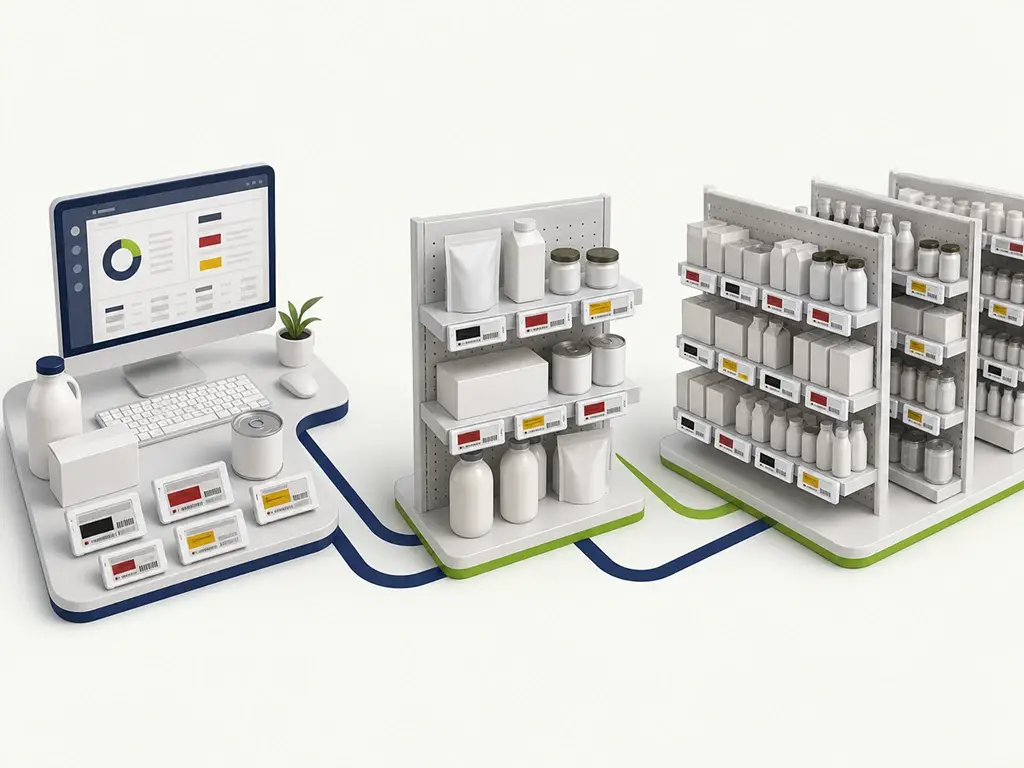
Electronic Shelf Labels (ESL) replace paper price tags with e-ink displays connected wirelessly to a cloud-based management platform. The mechanism is straightforward: a central system pushes price updates to every tag in every store at once, over a wireless protocol — typically 2.4GHz for medium-to-large retail environments, covering a 13–15 meter radius per base station with frequency-hopping spread spectrum technology to ensure reliable transmission even in signal-dense store environments.
What changes operationally is the unit of time for a price change: from hours or days to seconds. A category manager approves a price adjustment, and it appears on the correct shelf, in every store, before the next customer walks down that aisle. The strategy-to-shelf latency collapses from a multi-day logistics problem to a near-instant digital event.
The technology is not all-or-nothing. For a single-store independent, the ROI case depends on how often prices change and how much labor currently goes into label management. For a three-plus store chain, the efficiency gains typically justify the investment on labor savings alone — before accounting for the margin uplift from faster competitive response. For chains with ten or more locations and multi-category assortments, ESL becomes less of a productivity tool and more of a strategic prerequisite: without it, the pricing strategies discussed in this article — competitive, dynamic, segmented — simply cannot be executed at scale with acceptable accuracy and speed.
Companies such as ZhSunyco® provide integrated ESL systems that connect hardware, wireless infrastructure, and cloud management into a single platform — enabling retailers to push price changes across thousands of shelf labels in seconds. For a retailer evaluating whether their operations are ready for automated pricing execution, the practical starting point is an assessment of current label-change volume, error rates, and competitive response time (learn more about ESL systems that sync shelf prices across stores in seconds).
Real Results: When Strategy Meets Execution
The combination of a clear pricing strategy and digital execution infrastructure produces results neither can deliver alone. Bealls Inc., a 111-year-old retailer with over 660 stores, replaced its time-based markdown schedules with AI-driven pricing optimization and digital execution — and increased clearance sales dollars by 25% in a single year while improving margins, according to Oracle’s published case study on their Retail Lifecycle Pricing Optimization platform.
The pattern repeats across retail verticals. A European supermarket chain cut its price-update cycle from three days to under three minutes after deploying ESL infrastructure, unlocking promotional responsiveness that was previously impossible. A mid-size electronics retailer paired dynamic pricing rules with digital shelf labels and improved end-of-life inventory clearance margins by reducing the volume of stock liquidated below cost.
These results are not exclusive to enterprise-scale operations. The underlying principle — strategy speed must be matched by execution speed — applies at every scale. Whether you run one store or fifty, shrinking the gap between your pricing decisions and your shelf-edge reality is the single highest-ROI investment you can make in your pricing capability.
Your 90-Day Pricing Implementation Roadmap
Most pricing strategy articles end where this one is now: you have the taxonomy, the psychology, the store-type playbook, and the technology picture. What is missing — in every SERP result for this keyword — is a concrete answer to the question that matters most: what do I actually do on Monday?
The roadmap below is built on a single principle. Pricing optimization is not a switch you flip. It is a capability you build, in phases, with each phase validating the last before you scale further.
Month 1 — Audit and Segment
The first 30 days replace assumptions with data. Start by sorting every SKU in your assortment into four category roles: Traffic Drivers (the products that bring customers through the door — your milk, your bestsellers, your known-value items), Margin Builders (your primary profit generators, often private label or differentiated products), Basket Builders (complementary add-ons that lift transaction value), and Long-Tail Fillers (the niche items that complete your assortment but will never drive volume).
Next, calculate your actual gross margin by category — not your intended margin, but the real number after all discounts, promotions, and markdowns. The gap between intended and actual margin is your first signal of where pricing discipline has slipped. Finally, identify your single largest pricing pain point: which category has the thinnest margins? Which one demands the most frequent price changes? Which store has the worst execution? You are not solving these yet. You are building the list of what needs solving.
Month 2 — Pilot and Measure
Choose one or two categories for a controlled pricing experiment. Pick one elastic category where demand visibly responds to price changes (seasonal goods are ideal) and one inelastic category where demand stays stable regardless of price (household staples work well). Run the new strategy in one or two pilot stores only. Keep the rest of your locations on the existing approach as a control group.
Measure three things over a minimum two-week period: unit sales volume, gross margin dollars (not percentage — absolute dollars pay the bills), and customer feedback. One critical discipline: change nothing else during the pilot. Do not re-merchandise. Do not run a promotion. Do not move the category to a different aisle. Change multiple variables at once, and you will never know which one drove the result.
Month 3 — Scale and Systematize
Once your pilot produces a clear directional signal — even if the data is not statistically perfect, directionally clear is enough for a small to mid-size retailer — lock in three things.
First, a category-strategy mapping table: one or two assigned strategies per category, written down, shared with every store manager. Second, price-change trigger rules: decide in advance what conditions justify a price adjustment (competitor drop exceeding X%? inventory exceeding Y days of supply? supplier cost change?) and write them down. Rules-based pricing replaces gut-feel pricing — and rules scale. Gut feel does not.
Third, and critically: assess your technology readiness. By Month 3, you have real data on how many price changes your strategy requires, across how many stores, at what frequency. That data — not a vendor’s pitch — tells you whether ESL or other automation tools have a positive ROI for your specific operation. The 90-day output is not a perfect pricing strategy. It is a pricing capability: a system that keeps improving long after the 90 days are over. That is the real competitive moat.
Measuring Success and Adapting Over Time
Pricing is not a set-and-forget decision. It is a living system that needs periodic check-ups — not daily obsession, but quarterly discipline.
Track three metrics. Gross margin dollars is the number that matters; percentage alone misleads because 50% margin on zero sales is zero profit. Price realization rate — your actual average selling price divided by your listed price, as a percentage — should fall between 85% and 95%. Below 85% signals over-reliance on discounts. Above 95% may mean missed promotional opportunities. Price image is qualitative but more useful than any algorithm for a local retailer: ask ten regular customers whether they think your store is good value, fair, or expensive.
Every quarter, revisit your category-strategy mapping. Have new competitors entered? Have supplier costs shifted? Has a previously niche category grown into a traffic driver? Adjust the strategy assignments without abandoning the underlying framework. The goal is not to find the perfect price. It is to build a system that keeps finding better prices, quarter after quarter, as your market, your customers, and your competition evolve.
The retailers who win on pricing are not the ones with the cleverest strategy on paper. They are the ones who close the gap between the pricing decisions they make and the prices their customers actually see. Close that gap, and your strategy stops being a document. It becomes a competitive advantage.
References
- McKinsey & Company. “Pricing: The next frontier of value creation in private equity.” mckinsey.com
- Vontier Consumer Survey. “New Vontier Consumer Survey Reveals Summer Roadtrippers Will Pay More, Drive Farther For Preferred Stops.” July 2024. finance.yahoo.com
- RELEX Solutions. “Retail pricing strategies: How AI keeps retailers profitable and popular.” June 2025. relexsolutions.com
- Oracle Retail. “Retailer Bealls Inc. Increases Clearance Sales Dollars by 25% With Oracle.” 2025. barchart.com
- Competera. “Retail pricing strategies: how to choose and combine them for your assortment.” June 2025. competera.ai
- ZhSunyco®. “WIFI ESL — Electronic Shelf Label Solutions.” zhsunyco.com/esl
- ZhSunyco®. Homepage. zhsunyco.com
- ZhSunyco®. Contact. zhsunyco.com/contact-us

 English
  Russian
  Spanish
  German
  Arabic
  French
  Bulgarian
  Polish
  Romanian
  Turkish
  Portuguese