


The Complete Blueprint for Supermarket Dynamic Pricing
The Reality of Supermarket Dynamic Pricing Beyond the Hype
In recent years, the concept of dynamic pricing within the retail sector has become a polarizing lightning rod for controversy. Driven by viral social media outrage and sensationalist news headlines, the general media has successfully—and dangerously—conflated supermarket dynamic pricing with “surge pricing.” Surge pricing, widely popularized by ride-sharing applications and ticketing platforms, is fundamentally a predatory practice: artificially inflating prices during periods of peak demand, extreme weather, or crisis. For supermarket executives, IT directors, and category managers, this media-induced hysteria has created a paralyzing fear. No grocery chain wants to find itself the target of a PR nightmare, legislative hearings, or a trending hashtag accusing them of price-gouging hard-working families simply because the store got busy during the 5:00 PM evening rush.
However, for the survival of brick-and-mortar grocery, it is time to definitively separate fact from fiction. Supermarket dynamic pricing, when architected and implemented correctly, has absolutely nothing to do with opportunistic surge pricing. In the high-volume, notoriously low-margin world of grocery retail—where net profit margins routinely hover perilously between 1% and 3%—dynamic pricing must be fundamentally redefined and communicated as Time-decay Pricing (often referred to internally as Markdown Optimization).
This strategic approach does not aim to extract more money from a thirsty customer buying bottled water during a heatwave. Instead, it is a highly calculated, algorithm-driven process designed to progressively and systematically reduce the price of perishable goods and aging inventory as they approach their expiration dates. By establishing the absolute legality, the ethical grounding, and the eco-friendly nature of Time-decay Pricing, grocery retailers can confidently deploy these systems. It is not a tool for exploitation; it is a critical business necessity designed to rescue margin that would otherwise end up rotting in a dumpster, all while offering genuine financial value to budget-conscious shoppers navigating an inflationary economy.
Navigating the PR Minefield and Regulatory Scrutiny
The operational and financial benefits of automated pricing are undeniable, but deploying them without a rigorous, airtight legal and public relations framework is a recipe for corporate disaster. C-suite executives must confront and neutralize the most profound internal fear: inadvertently crossing the line from smart inventory management into regulatory non-compliance and reputational suicide.
Consumer Perception vs. Predatory Pricing Accusations
To safely navigate the volatile waters of consumer perception, retail operators must adopt a strict, uncompromising taxonomy of what can and cannot be dynamically priced. The fundamental rule of physical retail remains unchanged: the price displayed on the shelf at any given second must be exactly the same for every single customer standing in that aisle. The absolute, uncrossable red line is Personalized Pricing or Surveillance Pricing—altering the price of an item based on an individual shopper’s loyalty data, purchase history, income bracket, or demographic profile. Doing so will instantly trigger accusations of discrimination and class-action lawsuits.
To operationalize this safety net, supermarkets should adhere to a strict Risk-Reward Matrix when selecting categories for dynamic pricing algorithms.
| Merchandise Category | Pricing Strategy | PR Risk Level | Consumer Acceptance | Strategic Rationale |
|---|---|---|---|---|
| Fresh Meat & Poultry | Time-Decay Markdown | Low | Very High | Consumers actively seek “manager’s specials.” Deeply aligned with anti-food waste and sustainability initiatives. |
| In-store Bakery & Deli | End-of-day Clearance | Low | High | Expected retail behavior. Recovers sunk labor and ingredient costs of daily production. |
| Dry Grocery (CPG) | Demand/Competitor Matching | Medium | Moderate | Acceptable if adjustments are infrequent, strictly downward, and universally applied (e.g., matching a local competitor’s promotion). |
| Emergency Supplies (Water, Batteries) | Weather-driven Surge | CRITICAL (DO NOT DO) | Zero | Guaranteed PR crisis, immediate violation of state anti-gouging laws, and permanent extreme reputational damage. |
Aligning with FTC Inquiries and Anti-Gouging Laws
The regulatory landscape is rapidly tightening, and B2B leaders must base their strategies on reality, not hypothetical futures. The U.S. Federal Trade Commission (FTC) has recently launched highly publicized 6(b) inquiries into several algorithmic pricing and revenue management vendors to investigate the impacts of “surveillance pricing” on everyday consumers. Furthermore, virtually every state enforces stringent Anti-Price Gouging Laws during declared emergencies, heavily penalizing any automated system that raises prices on essential goods without human oversight.
The ultimate defense strategy for corporate legal and store operations teams is System Log Transparency. Your pricing middleware must be configured so that every automated price change is strictly and exclusively tied to objective, non-personal data points. If audited by federal regulators, state attorneys general, or investigative journalists, your system logs must unequivocally prove that a price dropped by 15% at 3:00 PM solely because the ERP detected 40 units of ground beef expiring in 24 hours. Alternatively, it must show that the price of eggs fluctuated purely due to a verified wholesale cost increase from the supplier. By rigidly walling off consumer identity data from the shelf-pricing algorithm, supermarkets render themselves immune to surveillance pricing allegations and regulatory fines.
Combating Food Waste and Protecting Margins in Perishables
Once the legal guardrails are firmly established, the boardroom conversation must shift to raw financial impact. The fresh departments—produce, meat, seafood, deli, and bakery—are the undisputed lifeblood of a modern supermarket. They are the primary drivers of store traffic, customer loyalty, and overall basket size. However, they also represent a terrifying financial black hole if mismanaged.
The grocery industry average shrinkage rate (a combination of spoilage, expiration, and theft) in perishable departments consistently hovers between 4% and 7%. Unlike a box of dry cereal or canned soup that retains its full retail value for two years, fresh food experiences a phenomenon known as “cliff-edge financial depreciation.” Consider a container of premium fresh-cut fruit: it holds 100% of its retail value on day one. If it remains unsold at its original premium price, its financial value drops to absolute zero by the morning of day three, instantly converting potential gross margin into a costly waste disposal expense. Maintaining static pricing in the face of dynamic spoilage is a catastrophic failure of yield management.
Algorithmic Time-Decay Pricing Models
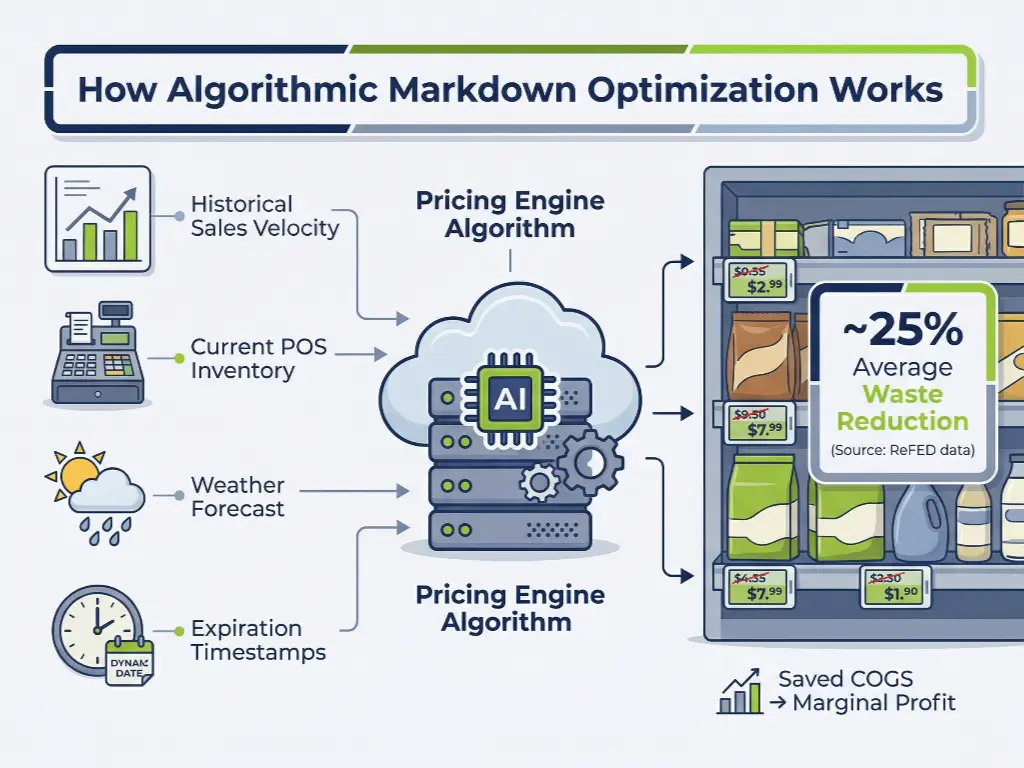
Manual markdowns using yellow stickers and sharpies are no longer mathematically or operationally sufficient to combat this cliff-edge depreciation. Store associates cannot physically monitor tens of thousands of expiry dates across a 40,000 square foot store in real-time. This is where Algorithmic Time-Decay Pricing becomes the most powerful weapon in a category manager’s arsenal.
We must look at concrete, verifiable industry baselines. According to extensive data from the Food Industry Association (FMI) and ReFED (the leading national nonprofit dedicated to ending food loss), optimized markdown strategies powered by predictive algorithms can reduce retail food waste by a staggering 21% to 30%. The AI engine does not guess; it ingests historical sales velocity data, current POS inventory levels, weather forecasts, and impending expiration timestamps. It uses this multi-variate data to calculate the precise moment a discount must be applied to move the product before it spoils. By automatically triggering a dynamically calculated 15% discount at the optimal hour, the supermarket salvages the cost of goods sold (COGS) and squeezes a marginal net profit out of an item that was otherwise destined for the landfill. This is how you transform corporate sustainability goals into a high-ROI business unit.
Calculating the True ROI of Automated Pricing Systems
For Chief Financial Officers, Operations VPs, and IT Procurement leads, the monumental decision to digitize an entire store network comes down to cold, hard, defensible mathematics. Deploying Electronic Shelf Labels (ESLs) and cloud-based dynamic pricing engines requires a significant upfront investment, but the return is highly predictable if the financial modeling is constructed correctly, accounting for both hidden costs and compound savings.
First, we must dissect the CapEx (Capital Expenditure). A standard large-format supermarket requires between 15,000 to 40,000 physical digital price tag displays. Add to this the cost of enterprise-grade IoT base stations, specialized structural mounting rails for different shelving types, and the substantial initial labor costs for physical installation and mapping. On the other side of the ledger is the OpEx (Operational Expenditure), which encompasses cloud server hosting, API call volumes to the pricing engine, software licensing fees, and the inevitable hardware maintenance and battery replacements over a 5-year lifecycle.
The financial justification for this massive outlay is built on a robust, dual-pillar savings model:
- Pillar 1: Complete Labor Eradication for Pricing. Traditional paper price changes require hundreds of dedicated labor hours per week per store. The process of printing batches of tags, manually sorting them, walking the aisles to locate the correct shelf edge, physically swapping the paper, and auditing for errors is a massive, low-value drain on payroll. Automating this process reallocates staff from mundane administrative tasks to high-value, customer-facing service and order fulfillment, saving tens of thousands of dollars annually per location in direct labor costs.
- Pillar 2: Shrink Reduction & Margin Recovery. As detailed in the ReFED data, algorithmically rescuing just 2% of the store’s total perishable volume from the trash bin injects pure cash directly back to the bottom line. Furthermore, an automated system entirely eliminates “price-mismatch” fines from local weights and measures authorities—a hidden cost that often plagues stores relying on manual paper updates.
When you aggregate the hard labor savings with the margin recovery from fresh departments and the elimination of compliance fines, the standard Payback Period (ROI) for a full-store dynamic pricing rollout typically lands squarely between 18 and 24 months. For major retail infrastructure, achieving a positive cash flow horizon in under two years is a highly compelling financial thesis.
The Hardware, Network, and Data Infrastructure Required
A beautiful financial model and a brilliant pricing algorithm are completely useless if the physical system crashes on the store floor. A robust dynamic pricing strategy demands a flawless, highly resilient end-to-end technological loop. To visualize this architecture, IT leaders must build the infrastructure around a strict 3-step data loop:
- Step 1: The Brain (ERP/Pricing Engine) – The central pricing algorithm detects an expiring batch of meat and triggers a JSON payload containing the new discounted price.
- Step 2: The Middleman (IoT Gateway) – The payload hits the in-store IoT Base Station, which formats the data into a lightweight MQTT transmission for high-concurrency broadcast across the store’s wireless spectrum.
- Step 3: The Edge (ESL Node) – The specific electronic shelf label wakes from its low-power sleep state, receives the packet, redraws its E-ink display with the new price, and sends a critical confirmation handshake back to the core database to verify the update.
Electronic Shelf Labels as the Frontend Enabler
When transitioning from static paper to digital pricing, Electronic Shelf Labels (ESLs) are the mandatory frontend enablers. However, selecting the right enterprise-grade ESL requires rigorous objective scrutiny. Procurement teams must evaluate labels based on strict criteria: operational temperature ranges (ensuring screens don’t freeze and shatter in sub-zero meat lockers), communication protocol overhead (avoiding interference with customer Wi-Fi), and multi-color support to visually highlight markdowns. Most importantly, buyers must understand physical limitations. In a high-frequency dynamic pricing environment, the true vulnerability is not the E-ink screen’s lifecycle, but the cliff-drop battery degradation caused by frequent radio wake-up calls.
By utilizing optimized sub-GHz or BLE protocols alongside smart sleep-wake mechanisms, enterprise ESLs can balance high-frequency fresh markdown needs (3-4 updates daily) while maintaining a viable 3-year battery lifecycle, avoiding crippling maintenance OpEx. As a global manufacturing leader, Zhsunyco® achieves this delicate engineering balance. Backed by a 20,000 m² facility and 11 stringent quality control stages, Zhsunyco suppresses defect rates to an astonishing 0.0018%. Their hardware ensures robust battery endurance under dynamic loads, while the 2024 four-color (Red/White/Yellow/Black) displays guarantee that critical markdown information remains strikingly visible to shoppers, driving immediate conversion.
IoT Gateways and Middleware: Bridging the Gap
Tens of thousands of battery-powered ESLs cannot directly query a cloud database or an on-premise ERP. Bridging this massive networking gap requires deploying enterprise-grade IoT Gateways (Base Stations) to act as the store’s communication central nervous system. These gateways utilize lightweight, high-concurrency messaging protocols—specifically MQTT (Message Queuing Telemetry Transport)—to act as the middleware. When the pricing algorithm decides to drop the price of 5,000 distinct items simultaneously prior to the evening rush, the middleware ensures a seamless, low-latency distribution of data packets. It orchestrates the traffic so that it does not overwhelm the store’s primary bandwidth, avoids interference with 2.4GHz consumer Wi-Fi channels, and prevents critical POS synchronization delays.
Preparing for Sunrise 2027: The GS1 Digital Link Transition
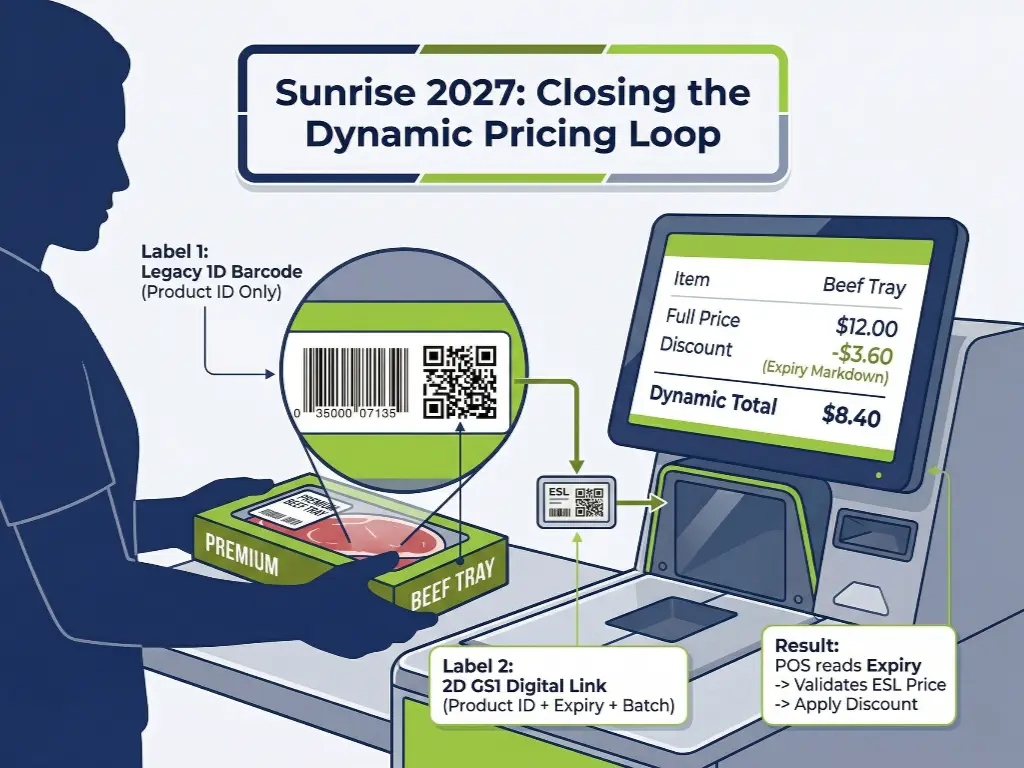
Finally, we must address the most formidable data silo in retail: the checkout counter. The industry must move past the exaggerated and unhelpful rhetoric that “the UPC is dead.” The traditional 12-digit barcode is not dying overnight; however, it is entirely inadequate for dynamic pricing because it only identifies the product class, not the specific expiration date or batch number of the exact unit in the customer’s hand.
To achieve a true commercial closed-loop, supermarkets must prepare for the global Sunrise 2027 initiative. For the foreseeable future, store systems must support “Dual-marking”—the ability to read both legacy 1D barcodes and advanced 2D barcodes side-by-side. While transitioning to 2D image scanners capable of parsing the GS1 Digital Link (QR Codes) requires significant CapEx at the checkout lanes and painful, complex integration with legacy POS systems, this hardware upgrade is the non-negotiable prerequisite for closing the dynamic pricing data loop. Only when the POS terminal can read the embedded dynamic batch number and expiration date can it recognize the exact package of meat the AI just discounted. Without this backend data upgrade, the cashier scans the old UPC, charges full price, the customer demands a refund, and the entire multi-million dollar dynamic pricing architecture collapses at the finish line.
A Strategic Roadmap for Phased Implementation
The transition to dynamic pricing is a profound structural and cultural transformation, not a simple software patch. For enterprise retail groups, attempting a simultaneous, store-wide “big bang” rollout across 40,000 SKUs is fraught with catastrophic operational risk. An agile, phased implementation roadmap is the only prudent path forward to ensure system stability and staff adoption.
Phase one should always be a highly controlled Proof of Concept (POC) restricted to the Bakery and Fresh Cut Meat departments. These categories possess the highest financial unit value, the highest shrink rates, and extreme sensitivity to expiration dates, making them the perfect proving ground to validate the AI algorithm and measure consumer response. A successful pilot requires defining strict, actionable KPIs: a network sync latency of under 3 seconds per 5,000 tags, and a battery drain impact of less than 0.5% per test cycle. Only once the hardware stability, data integration, and ROI are mathematically proven in the fresh zone should the system be expanded to the dairy aisles, and ultimately to ambient dry goods.
A successful dynamic pricing pilot depends entirely on defining strict KPIs, deploying hardware with near-zero failure rates, and partnering with a supply chain capable of rapid iterative response. As a premier ESL manufacturer and dynamic pricing hardware partner, Zhsunyco empowers system integrators and global retail groups with full-lifecycle custom support, from initial prototyping to massive deployments.
Get a Free Custom ESL Sample Kit
 English
  Russian
  Spanish
  German
  Arabic
  French
  Bulgarian
  Polish
  Romanian
  Turkish
  Portuguese