


Warehouse order picking is commonly known to be the most expensive operation in the logistics and supply chain management industry. According to industry analysis from firms like F. Curtis Barry & Company, order picking typically accounts for 50% to 55% of total warehouse operating costs. This single process usually defines the profitability of a fulfillment center and is directly related to customer satisfaction measures.
Order accuracy and speed are complicated issue to any operation. Although the most common aspect of optimization is the travel time, which is the physical movement between location A and location B, it is not the only component of the equation. Cognitive load (mental fatigue) and data integrity also have to be addressed to be truly efficient in order fulfillment operations.
If order pickers move quickly but select the wrong item due to mental exhaustion from reading thousands of serial numbers, the cost of the return logistics is much higher than the speed of the pick. When the system instructs a picker to a place where the inventory information is inaccurate, speed does not matter.
This guide offers an in-depth examination of typical order picking methods, the assessment of the technological environment, and the revelation of the so-called hidden killers of efficiency that are overlooked by the majority of operational audits. It is geared towards changing the emphasis from merely going faster to being smarter by ensuring data reliability and reducing human error.
Defining the Basics of Warehouse Order Picking
In its simplest form, warehouse picking involves the extraction of particular items in a warehouse inventory to meet customer orders. This may seem simple, but the magnitude and intricacy of contemporary business make this a complex logistical problem. It is the intermediary between the fixed storage and the moving distribution.
The picking process generally follows a structured sequence within the order fulfillment process:
- Order Generation: The Order Management System or Warehouse Management System (WMS) receives an order and generates a pick list.
- Routing: The system identifies the most efficient picking routes in the warehouse.
- Travel: The picker moves to the storage location.
- Search and Identification: The picker locates the specific bin and verifies the item (SKU) or specific order.
- Extraction: The product is literally taken off the shelf (often referred to as piece picking).
- Verification: The amount and the type of item are verified to prevent order errors.
- Transportation: The product is transferred to the packing or consolidation section.
In order to enhance this process, you have to measure it first. What you do not measure, you cannot optimize. Thus, to determine your picking efficiency, you must use the following measures:
| Metric | Définition | Why It Matters |
| Pick Rate | The number of order lines picked per hour per labor hour. | This measures raw throughput and labor productivity. It helps in workforce planning and managing labor costs. |
| Order Picking Accuracy | The percentage of orders picked without error. | This is the primary indicator of service quality. Errors lead to returns, which cost 3x more than outbound shipping. |
| Cycle Time | The total time from order release to order shipment. | This reflects the responsiveness of the warehouse operations to customer demand. |
| Perfect Order Rate | An aggregate metric measuring on-time, complete, undamaged, and correctly documented orders. | This is the holistic measure of supply chain health and reliability. |
Standard Picking Strategies for Different Order Profiles
No one picking strategy is the best one. The right approach will be solely based on your order profile, SKU quantity, warehouse size, and order volume. Using the incorrect strategy for your particular data profile will lead to bottlenecks and high labor expenses.
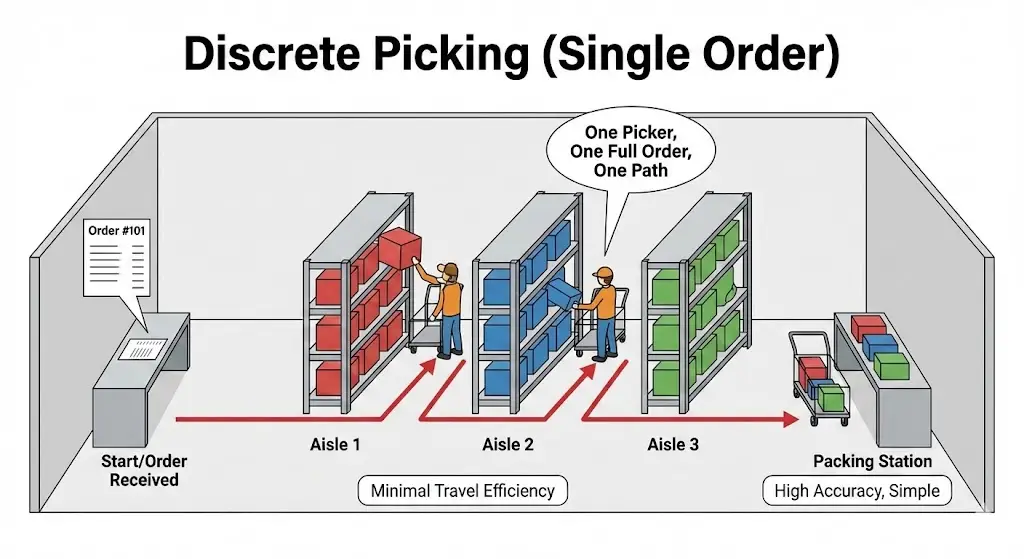
- Discrete Picking (Single Order): A single picker picks the entire order (all items) for one particular order and then proceeds to the next. This is often called discrete order picking or single order picking.
- Pour : Minimal error rate; simple to apply; minimal training is required; best in accountability tracking.
- Cons : Highest travel time per unit picked; very low efficiency for large warehouses.
- Use Case: Small warehouses with low SKU counts, heavy/bulky products, or a low number of orders.
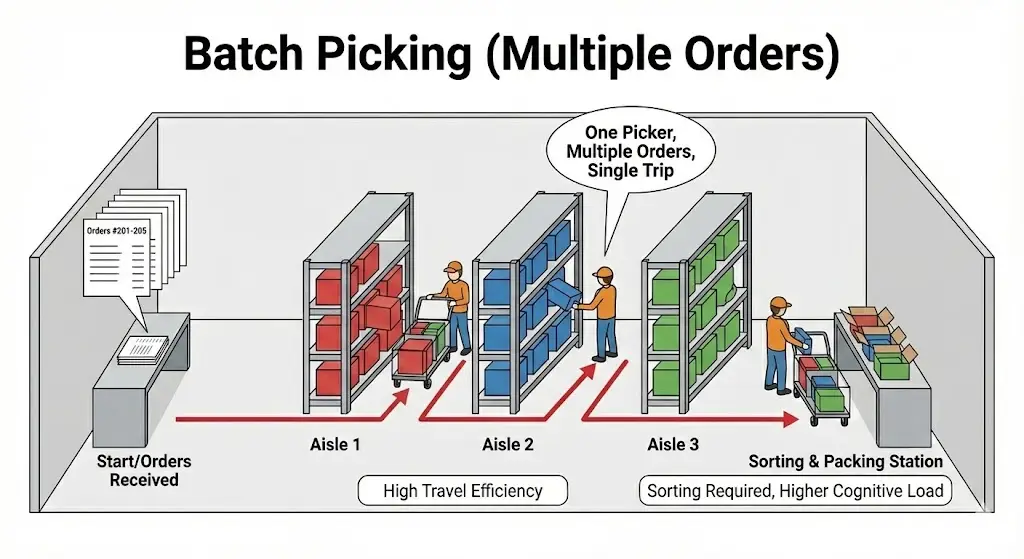
- Prélèvement par lots: A picker retrieves SKUs for multiple similar orders simultaneously in a single trip.
- Pour : Saves a lot of time in terms of travelling because it will be possible to have many customers visiting the same location.
- Cons : It needs to be sorted after picking to be sorted into individual orders; it puts a greater cognitive burden on the picker.
- Use Case: High order volumes with few lines per order (e.g., e-commerce), where SKU concentration is high.
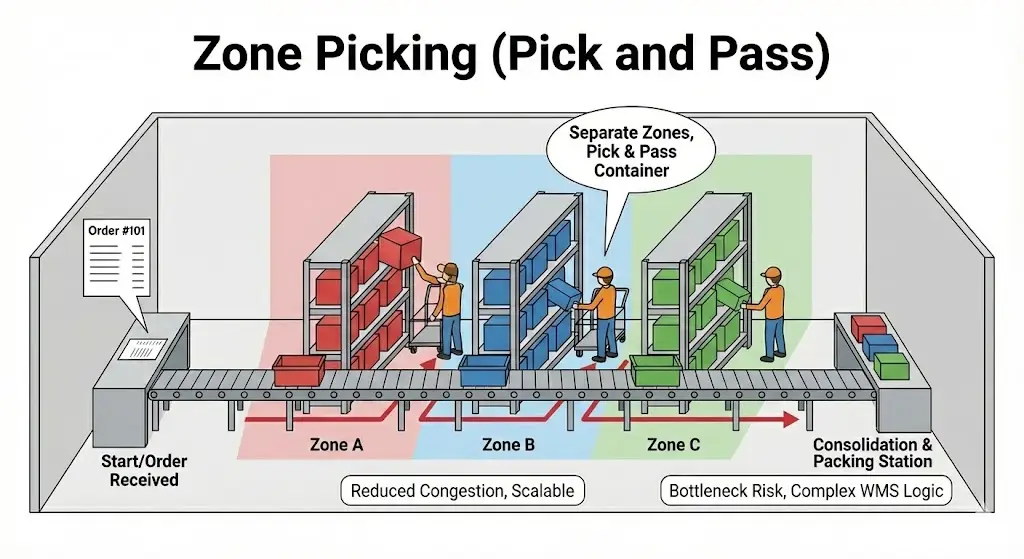
- Choix de la zone: The warehouse is separated into different zones. Pickers are assigned to an area and will only pick things in that area. The order container is transferred between zones (Pick and Pass) to the next zone.
- Pour : Reduces congestion in aisles; allows pickers to become experts in their specific inventory section; scalable.
- Cons : A single slow zone will cause the whole line to slow down; it will need sophisticated WMS logic to distribute workload between zones.
- Use Case: Large distribution centers with a wide range of SKUs and high volume.
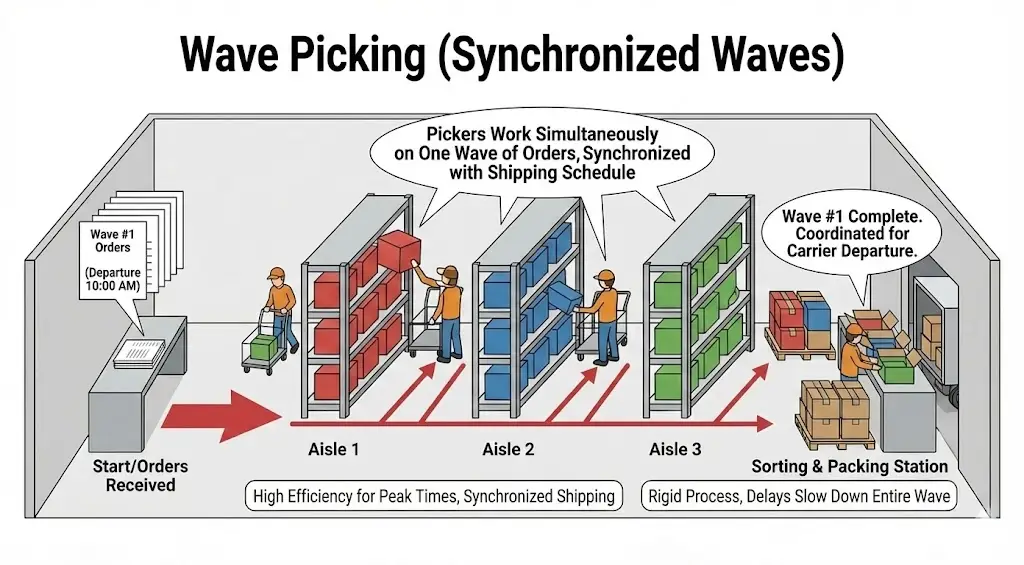
- Wave Picking: Orders are bundled and dispatched in waves depending on certain factors such as carrier departure time, shipping routes, or priority. This allows for better coordination of fulfillment operations.
- Pour : Picking activity is synchronized with shipping schedules; labor can be used with great efficiency during peak times.
- Cons : It may cause rigidity; when a wave is not completed in time, it slows down the particular truck or carrier.
- Use Case: High-throughput facilities with strict shipping cut-off times.
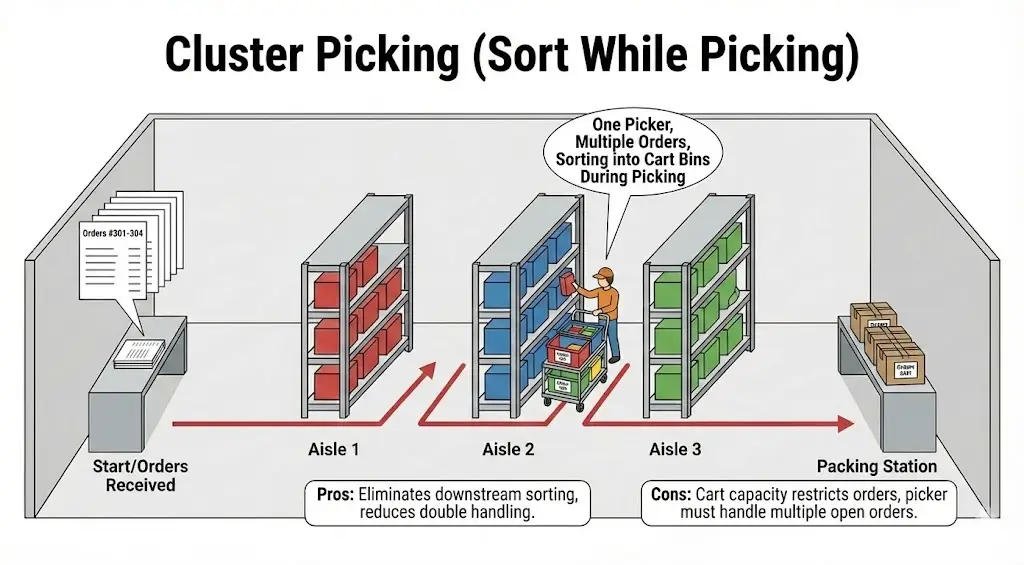
- Cluster Picking: Like batch picking, except that the picker sorts the items into separate order containers on the cart during picking.
- Pour : Eliminates the need for a separate downstream sorting process; reduces double handling in fulfillment centers.
- Cons : The cart capacity restricts the number of orders; the picker must be able to handle several open orders.
- Use Case: E-commerce order fulfillment in which the orders are small enough to fit on a cart with several bins.
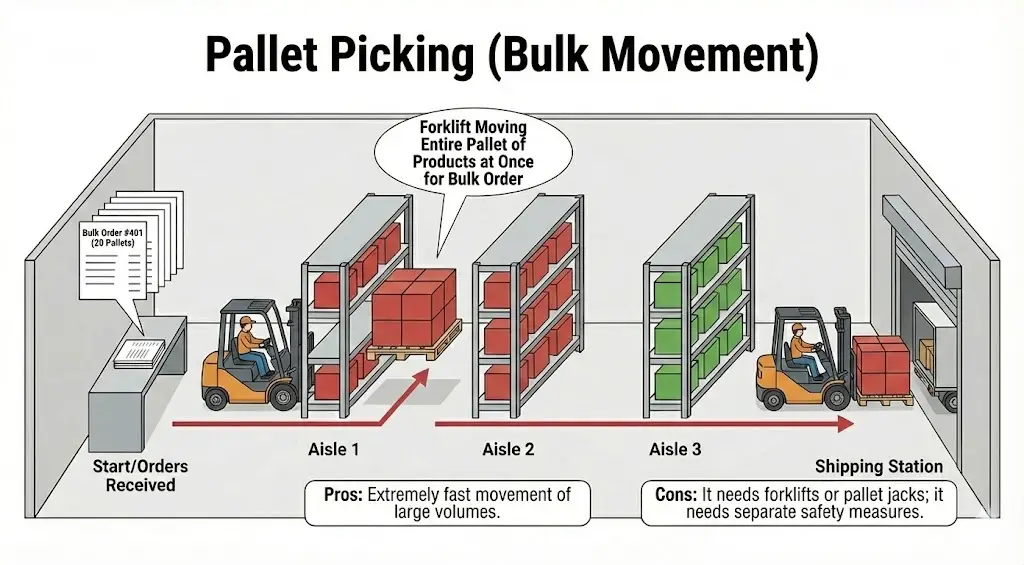
- Pallet Picking: Getting entire pallets of products instead of cases or items.
- Pour : Extremely fast movement of large volumes.
- Cons : It needs forklifts or pallet jacks; it needs separate safety measures.
- Use Case: B2B distribution, replenishing forward pick areas, or bulk orders.
- Hybrid Strategies: Integrating several approaches in the same facility to meet specific needs.
- Pour : Conforms to the fact that a warehouse can have multiple channels (e.g., wholesale and direct-to-consumer) operating at the same time.
- Cons : Warehouse management is complex; it needs a powerful WMS.
- Use Case: The majority of contemporary omni-channel fulfillment centers. As an illustration, fast-moving consumer goods can be picked using Zone picking, and oversized items can be picked using Discrete picking.
Selecting the Right Order Picking Technology
Strategy is multiplied by technology. Technology offers the means to implement the right procedural strategy once it is defined. The type of technology used determines the degree of accuracy and speed of data transmission.
RF Scanners
Radio Frequency (RF) handheld scanners are decades old. They confirm the items by scanning barcodes, which makes sure that the picker is in the correct position and has the correct product.
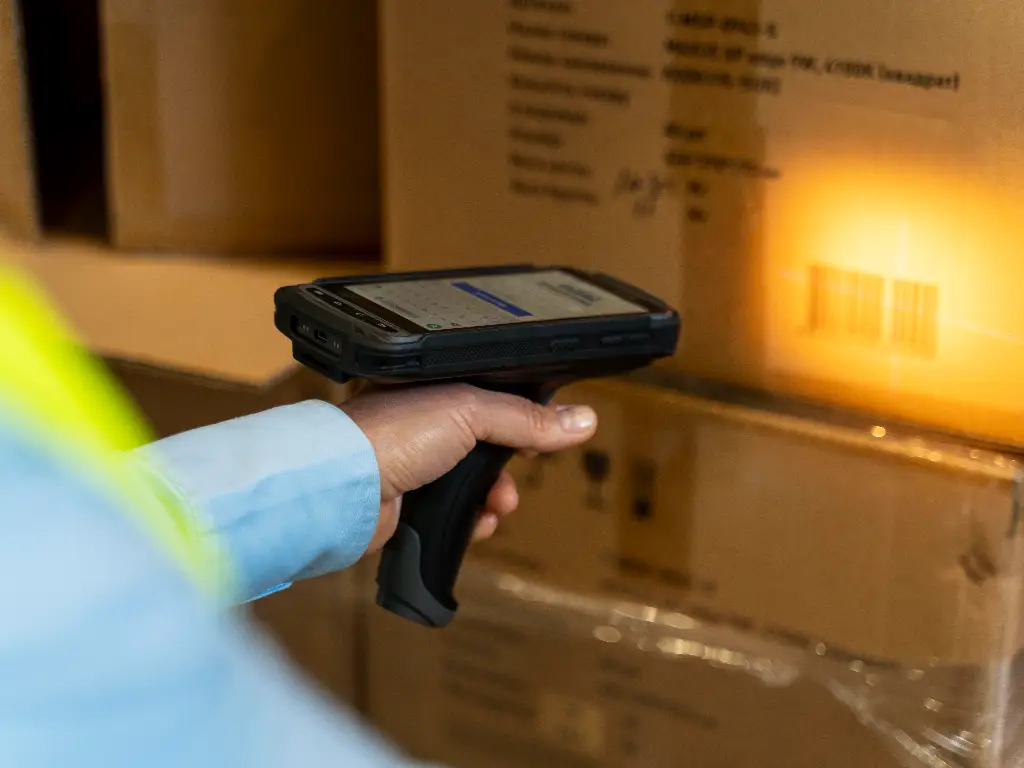
- Pour : Mature technology; relatively low cost compared to automation; high accuracy; flexible roaming.
- Cons : They are not hands-free. Picking up the scanner, scanning, and putting it down (or holstering) the item takes seconds for each pick. This translates to thousands of lost time. Moreover, the process of reading small text on a screen is a cause of cognitive fatigue.
Traditional Wired Pick-to-Light Systems
These systems make use of LED light modules that are hardwired into the racking shelves. The WMS illuminates a screen at the specific bin position to show where to pick and the number of items to collect. The picker takes the item and clicks a physical button on the light module to turn off the light and verify the pick.
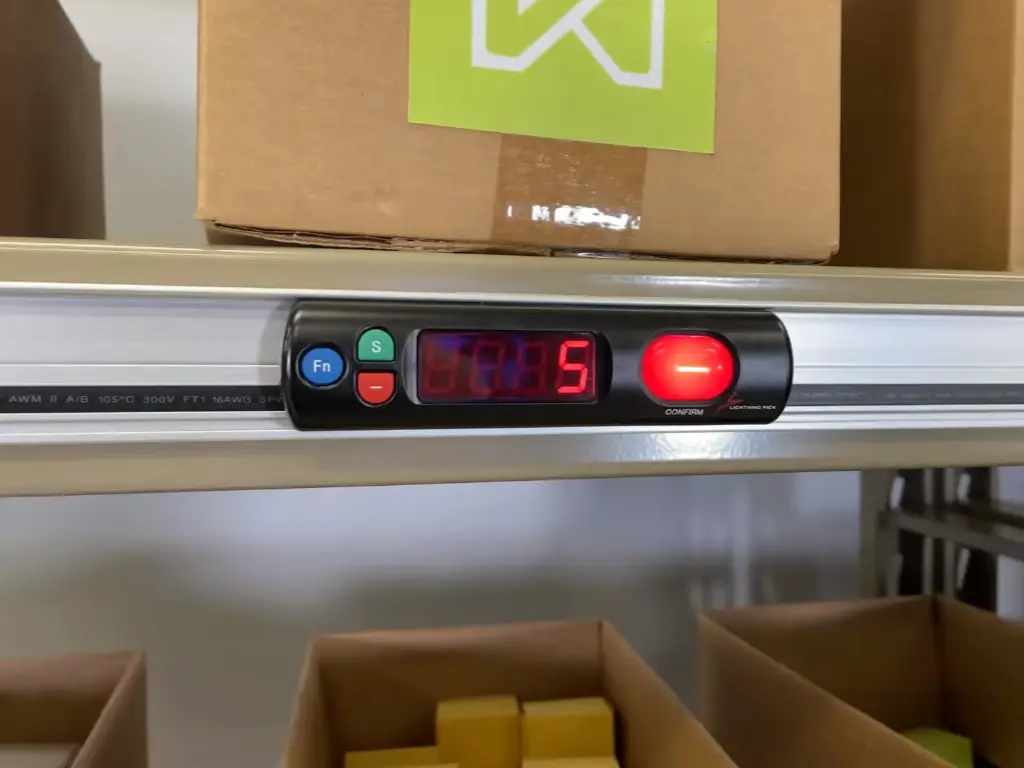
- Pour : Extremely fast. The visual cue removes the time of searching. It is driverless and needs practically no training.
- Cons : Rigidity. These systems need to be hardwired into the racking. You will have to physically re-install the wiring if you need to rearrange your warehouse layout or increase the size of shelf bins. This inflexibility renders them costly to operate in dynamic settings.
Electronic Shelf Labels (ESL) as Wireless PTL
This technology represents the next evolution of light-directed picking, solving the flexibility issues of wired systems. ESLs are digital displays that are battery-operated and are attached to the shelf edge. They are wirelessly communicating with the WMS. The particular label flashes (Pick-to-Light) when a picker enters an aisle to guide them. The picker is able to read the details of the items on the screen and press a button on the label to confirm the pick or report a shortage.
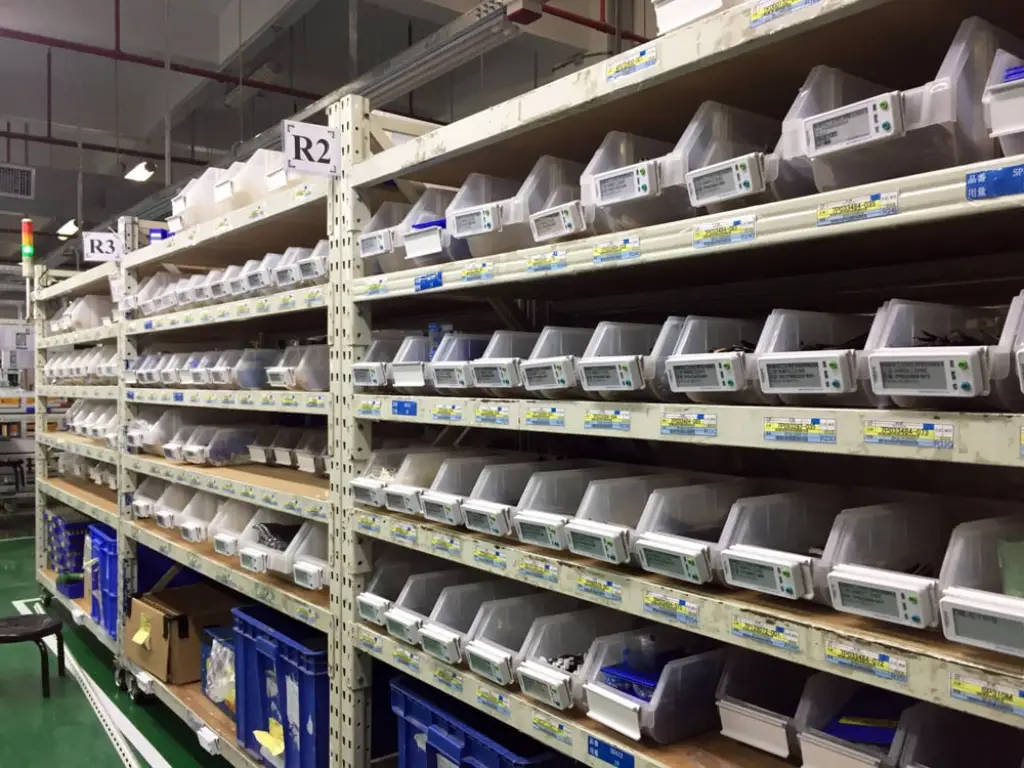
- Pour : No cables. You are able to relocate the label to any part of the shelf or to a different rack immediately (Peel & Stick). ESL e-ink screens are capable of displaying text, barcodes, QR codes, and images, unlike wired lights that display only numbers. In addition, ESLs also serve as a price tag, an inventory management tool, and a picking device at the same time.
- Cons : Requires battery management (though modern batteries last 5-10 years); relies on wireless network stability.
Although the conventional wired systems are fast, they do not meet the exponential increase in the complexity of the modern warehouse. Today’s fulfillment centers are no longer static storage facilities; they are dynamic, high-flux environments where SKU profiles churn rapidly and seasonal layouts demand constant reconfiguration. Hardwiring infrastructure to racking is now a major operational bottleneck in this volatile landscape, making any re-slotting project a costly maintenance event. The industry needs a solution that is as agile as the inventory itself. This is the essential requirement of wireless ESL technology: the digital signal is no longer tied to the physical infrastructure, and the managers of the warehouse can adjust the location of picking immediately to the changing demand without the constraints of the fixed cabling.
Zhsunyco’s ESL Solutions: Zhsunyco transforms standard shelving into a dynamic, intelligent picking environment. Our ESL devices feature high-contrast E-ink displays that remain readable under various warehouse lighting conditions, while their wide viewing angles ensure pickers can see instructions from different approaches. Unlike rigid wired systems, Zhsunyco supports stable communication via Wi-Fi, Bluetooth, or proprietary protocols, ensuring connectivity in large-scale metal-dense environments. By synchronizing in real-time with your WMS, the labels update instantly to show not just pricing, but critical picking data—SKU codes, batch numbers, bin locations, and scannable QR codes.
Voice Picking
Voice-directed warehousing involves the use of a headset and microphone to direct the picker. The system is vocal, and the picker verifies actions by voice.
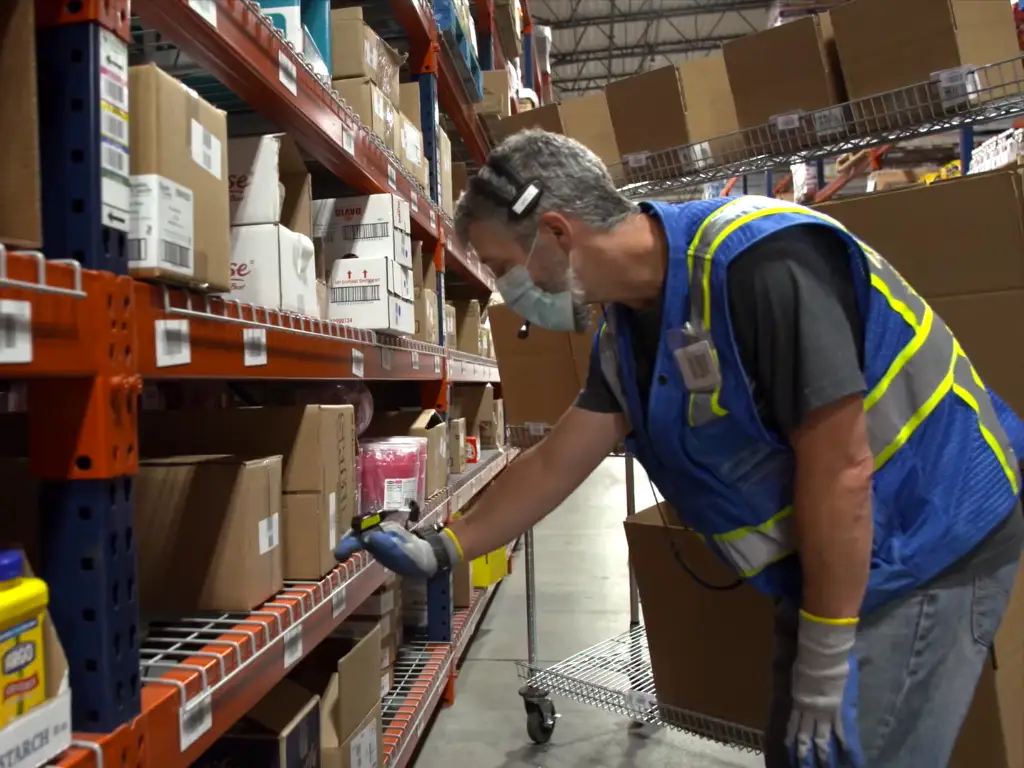
- Pour : 100 percent hands-free and eyes-free. It works especially well in cold storage facilities where gloves are worn, and it is hard to use touch screens or keypads.
- Cons : It may be costly to adopt. Voice recognition can sometimes be interfered with by background noise in industrial settings.
| Technologie | Speed | Flexibilité | Précision | Cost (Initial) | Hands-Free |
| RF Scanners | Modéré | Haut | Haut | Low/Mid | Non |
| Wired Pick-to-Light | Très élevé | Faible | Très élevé | Haut | Oui |
| Wireless PTL (ESL) | Haut | Très élevé | Très élevé | Mid | Oui |
| Voice Picking | Haut | Haut | Haut | Haut | Oui |
Hidden Efficiency Killers Most Managers Overlook
The operational audits frequently show that the cause of the inefficiency lies not in the speed of the workers, but in the structural defects of the data and human cognition management. These are the silent killers that are eating away at margins in warehouse order picking.
Cognitive Load and Micro-Decision Fatigue
The majority of productivity models presuppose that the human worker is a machine that works at a fixed rate. As a matter of fact, a picker makes thousands of micro-decisions in one shift: Is this a 6 or an 8? Is this the right box? Did I count 4 or 5?
This mental burden builds up as the shift advances, causing decision fatigue. The brain is prone to shortcuts when it is fatigued, and this leads to errors. Efficiency is not only physical (walking less); it is also cognitive (thinking less). This mental load is minimized by technologies that offer visual cues, such as lights or high-contrast digital displays. They enable the worker to work on visual reflex and not mental processing, and the accuracy rates are maintained even at the end of a shift.
The Impact of Master Data Integrity
The digital reality of the WMS should be matched with the physical reality of the warehouse. Master data is information that is not dynamic concerning products: dimensions (length, width, height) and weight.
When the master data indicates that a product is 10cm wide, but the supplier repackaged it in 12cm, the cubing logic of the WMS will not work. The system may instruct a picker to place 10 items in a box with a capacity of 8. The picker is then compelled to halt, locate a new box, reprint a label, and override the system. This exceptional treatment kills flow. The correct picking strategies are all dependent on the integrity of this underlying data.
SKU Velocity and Dynamic Slotting
In most warehouses, the products are slotted (placed) according to the available space at the time of arrival. This results in a fixed layout, which is not representative of the demand.
A fast mover (high velocity SKU) may be at the far end of an aisle, and pickers may have to walk the farthest distance hundreds of times per day. Moreover, velocity varies with season. Sunscreen is a fast mover in June and a slow mover in December. A warehouse that is not moving is an inefficient warehouse.
Dynamic slotting is a process that is done periodically to analyze the history of orders and relocate high-velocity similar items to the so-called golden zone (waist height, close to the shipping dock). This is made possible by wireless technologies such as ESL, whereby location codes and product information can be exchanged digitally without scraping paper stickers.
Replenishment Logic and Stock-outs
The picker of the world cannot pick something that does not exist. Another typical efficiency killer is the so-called short pick, where a picker comes to a place, and the bin is empty.
This occurs when replenishment logic is responsive as opposed to proactive. When the system merely activates a replenishment task when the bin is empty, then there is a lag time during which that location is dead. The picking needs a replenishment strategy that initiates prior to the pick face being emptied, depending on the speed of outbound orders. Picking and replenishment tasks are separated so that pickers will never see an empty shelf.
Best Practices for Order Picking Efficiency
Warehouse managers should adopt the following best practices in order to fight the above inefficiencies. These are process discipline and empowering the workforce.

- Minimize Travel Time
Travel may take up to half of the total working hours of a picker. Optimize pick paths using your WMS. Rather than a straightforward numerical sequence, use logic such as S-Shape (serpentine) routing or Largest Gap logic to avoid pickers walking down an aisle where they only require one item at the far end. The other major way of minimizing travel is through the consolidation of orders through batching.
- Touch Once Policy
Labor cost is added without value addition every time an item is put down and picked up. The aim is to pick directly into the shipping container (Pick-to-Box). This removes the process of the secondary packing station, whereby items are taken out of a tote, scanned, and put in a box. This involves proper master data to make sure that the system picks the correct box size at the beginning.
- Prioritize Ergonomics
Fatigue causes mistakes and reduced work rates. Put the most important items in the “Golden Zone” – the space between the shoulders and the knees. This minimizes bending and reaching. Moreover, embrace hands-free technology. When a worker is required to pick up a scanner, scan, holster the scanner, pick the item, and pick up the scanner again, he/she is making different, unnecessary movements. Voice systems or visual picking systems (such as ESL with button confirmation) enable the use of both hands to handle the product.
- Validate at Source
The more the distance that the error goes through the supply chain, the higher the cost of the error. It is costly to discover a mistake at the packing station; it is catastrophic to discover it once the customer has received the package. The validation should occur at the pick face. This may be done by barcode scanning or more effectively by visual confirmation systems, where the picker presses a button on the shelf edge to confirm the pick. This gives instant feedback and correction prior to the picker proceeding to the next task.
Future-Proofing Your Warehouse Order Picking Operations
The warehousing environment is evolving into dynamic throughput centers as opposed to the traditional warehousing, which is a static storage facility. In order to future-proof your operations, you need to think of picking as not a single task, but as a system of strategy, data, and technology.
The use of legacy processes and paper-based systems is no longer viable in a world of decreasing delivery windows and shortages of labor. To succeed, you need to go holistic: you need to make sure that your master data is clean, your strategies are aligned with your current order profile, and your technology does not impose a cognitive load on your employees.
Before investing in expensive robotics or heavy automation, start with the fundamentals. Audit your master data for accuracy and analyze your current workflow for human friction points. Once your data is sound, consider how visual technologies like Electronic Shelf Labels (ESL) can bridge the gap between your WMS and your workforce, solving the errors caused by human fatigue and outdated information.

 English
  Russian
  Spanish
  German
  Arabic
  French
  Bulgarian
  Polish
  Romanian
  Turkish