


The modern retailing world requires precision in operations and complete accuracy of customer data. Consumers demand a retail experience that works the same in a mobile application, a desktop browser, and a brick-and-mortar store setting to ensure a seamless shopping experience. Retail IT architectures have experienced massive structural transformations to satisfy these customer expectations and improve operational efficiency. The omnichannel commerce approach has been the industry standard over the years as a core retail strategy. Nevertheless, the constraints of operations in omnichannel systems are compelling a shift to unified commerce. The architectural differences between the two strategies are essential to the technology leaders and retail executives who have to make long-term investments in infrastructure. The choice determines software acquisition, hardware implementation, and the final capacity of the retail business to deliver customer satisfaction.
Defining Omnichannel and Unified Commerce
The difference between omnichannel et unified commerce is in the system architecture, namely, in the data storage, processing, and routing.
Omnichannel retail is a concept that aims at bridging the front-end customer experience across various channels. Within an omnichannel system, a retailer offers applications, e-commerce websites, and physical store settings that seem to be integrated for the consumer throughout their shopping journey. Through these different channels, a customer is able to engage with the brand, driving customer engagement. The technical infrastructure behind this is, however, a collection of standalone software systems that are disparate, creating internal data silos. The Point of Sale (POS) system is based on a single database, the e-commerce platform is based on a second database, and the Customer Relationship Management (CRM) software is based on a third database. These separate systems connect via application programming interfaces (APIs) or middleware.
Unified commerce is a structural, holistic approach that brings together all retail operations in one centralized platform. A unified commerce strategy is based on a single backend system, as opposed to integrating different software solutions. The enterprise has a single database that serves as the single source of truth for all customer information. The POS, the e-commerce platform, the inventory management system, order management systems, and the CRM all read and write to the same database in real time. The front-end touchpoints are just alternative display interfaces to the same underlying core system, effectively acting as a single platform.
The Evolution of Modern Retail Strategies
The evolution of the initial retail models to integrated commerce solutions is in line with technological development and change in consumer behavior. The first retailers were in a single-channel setting, which was made up of physical brick-and-mortar stores only. The multichannel era was brought about by the introduction of the Internet. The retailers created e-commerce websites, which were completely independent business units with their own dedicated inventory, their own supply chains, and their own management teams.
As smartphones became a common practice, consumers started engaging with brands via mobile browsers and specific applications, and at the same time, going to physical store locations. Consumers required the cross-channel capabilities, such as buying something on a mobile application and returning it to a brick-and-mortar store. In response to these evolving customer needs, the retail sector came up with the omnichannel strategy. The IT departments were assigned the responsibility of linking the hitherto disconnected e-commerce systems to the physical store’s POS and inventory systems. Since it was considered too costly to replace the entire software infrastructure, developers used middleware and batch-processing scripts to align data between the disconnected databases.
With the increase in the number of sales channels to social media platforms, third-party marketplaces, and automated checkout kiosks, the omnichannel architecture had to be pushed to its technical limits. The integration of dozens of different systems through APIs posed a serious technical debt, hindering true digital transformation. Latency was experienced in data synchronization. If a product was sold in a brick-and-mortar store, the e-commerce database may not be updated in a few minutes or hours, which will lead to incorrect inventory levels. The tradition of middleware usage to bridge the legacy systems led to a serious inventory mismatch and disconnected data blocks. These operational failures compelled the retail industry to realize that front-end connectivity is inadequate for a seamless customer experience. The sector is currently moving towards consolidated trade to carry out a total overhaul of the back-end infrastructure, removing the middleware altogether and adopting a centralized data design.
Core Differences: Omnichannel vs Unified Commerce
In order to assess the operational effects of the two strategies and understand their key differences, one will need to consider the technical mechanics in four major dimensions.
| Dimension | Omnichannel Architecture | Unified Commerce Architecture |
| Architecture des données | Multiple isolated databases connected via middleware and API integrations. Prone to synchronization failures. | A single, centralized database. One core system functions as the absolute source of truth for all enterprise data. |
| Visibilité des stocks | Subject to batch-processing delays. High risk of displaying inaccurate stock levels and causing overselling. | Absolute real-time visibility. Inventory deductions register instantly across all physical and digital channels, maintaining accurate inventory. |
| Tech Stack Complexity | High maintenance requirements. IT teams must manage multiple vendor contracts, updates, and complex integration points. | Streamlined maintenance. IT teams manage one core unified commerce platform. System updates apply universally across the enterprise. |
| Customer Profile | Fragmented data. Online purchase history and in-store order history are often stored in separate CRM modules. | Comprehensive data. A single of the unified customer profiles captures every transaction, preference, and interaction regardless of the channel. |
The variations go beyond the technical specifications and directly affect the day-to-day retail operations and customer service. Take the example of a product return along the customer journey. A customer who tries to make a physical store purchase after making an online purchase will find it difficult to do so in an omnichannel environment. The POS system of the physical store is based on a different database from the e-commerce platform. The store associates will have to search the online order number manually in a different terminal, confirm the transaction, and do the return in a complicated manual override. This adds to the checkout time and labor expenses, damaging the consistent customer experience.
The physical store POS and the e-commerce platform share the same transaction database in a unified system environment. Upon the customer showing the online order receipt, the store associate scans it with the standard POS scanner. The system identifies the transaction immediately, authenticates the purchase, and refunds the money in a few seconds, creating a truly seamless experience. The inventory database is updated at the same time, and the item returned is immediately sold on the e-commerce site. A unified commerce approach architecture eliminates the friction of operations that exists in omnichannel configurations.
A Realistic Transition Guide for Retailers
The shift of an omnichannel model to a single commerce platform architecture needs a lot of planning, technical analysis, and budgetary allocation as part of a core business strategy. There is no universal approach, as companies take different approaches. The deployment plan should be in line with the scale of the retail business, the present condition of the legacy infrastructure, and the capital expenditure budget to ensure the future of retail.
Pragmatic Steps for SMBs
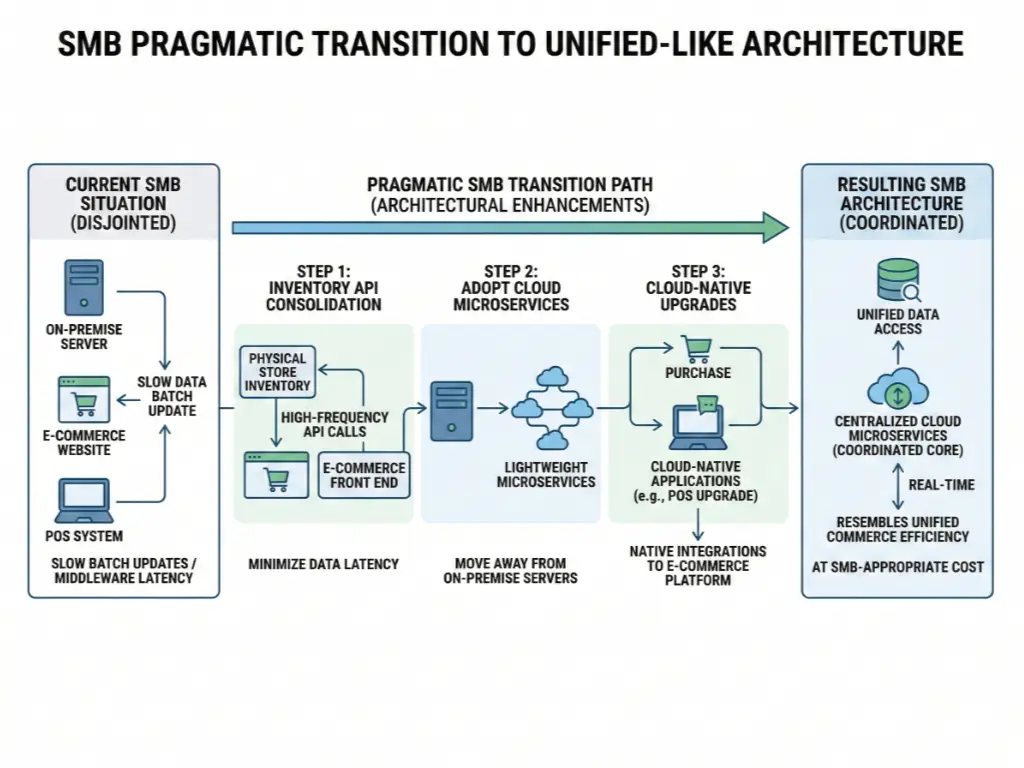
In the case of small and medium-sized businesses (SMBs), it is not always possible to afford to abandon the current software and deploy an enterprise-level unified platform. SMBs need to take the transition in small steps of architectural enhancements instead of a complete system overhaul. The short-term goal is to minimize data latency without having to spend colossal development expenses.
Inventory API consolidation should be a priority for SMBs. Instead of using slow batch processing, technical teams are supposed to set up the available systems to make high-frequency API calls between the physical store inventory and the e-commerce front end. Moreover, SMBs are able to start moving off of heavy, on-premise server software to lightweight cloud microservices. In the case of new software acquisition, e.g., POS upgrade, SMBs should focus on cloud-native applications that provide native integrations with their current e-commerce platforms. Through a carefully planned substitution of the remote software modules with cloud-based versions as time progresses, SMBs will be able to create a very coordinated architecture that resembles the efficiency of unified commerce without the enterprise-level cost.
Enterprise Architectural Overhauls
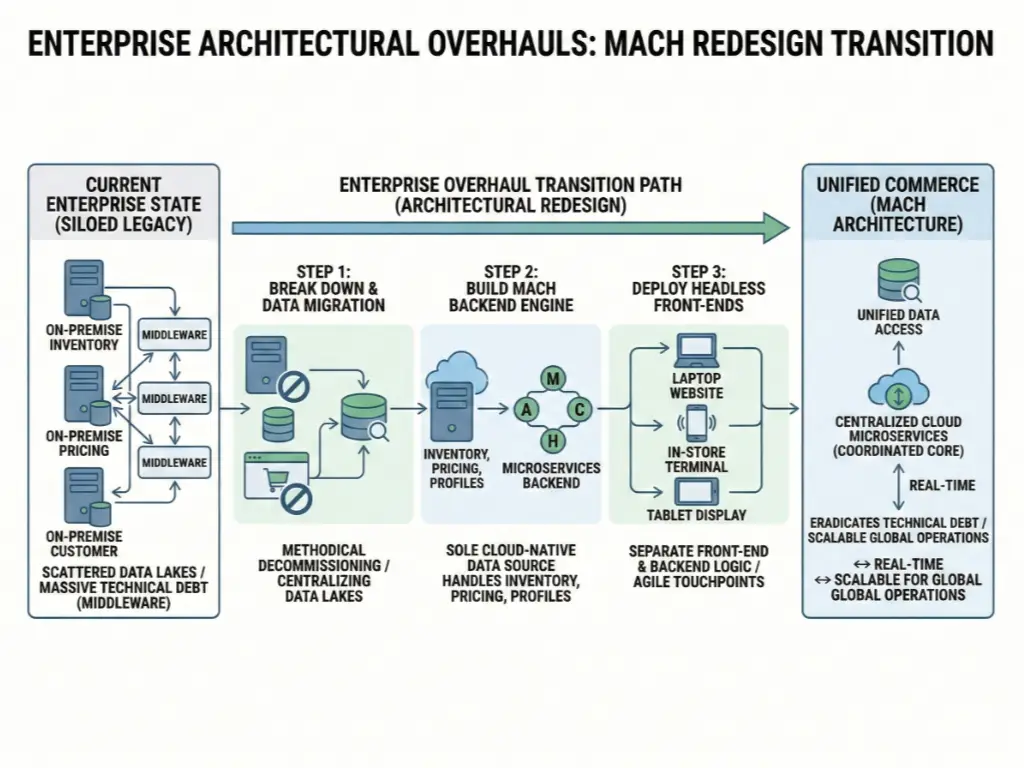
Big box retail businesses have the funds to undertake structural change, but have the difficulty of breaking down long-established legacy systems. In the case of these organizations, unified commerce can only be achieved through an extensive architectural redesign. The plan is to switch to a Composable Architecture model, namely, MACH principles (Microservices, API-first, Cloud-native, and Headless).
Businesses need to separate the front-end presentation layer (the websites, apps, and in-store displays) and the backend logic layer. With the introduction of a headless architecture, the enterprise creates one strong cloud-native backend that handles all inventory, pricing, and customer profiles. This central engine is then the sole source of data to all front-end touchpoints. This will involve a methodical decommissioning of the outdated, siloed on-premise servers. The IT department should implement massive data migration programs to centralize the scattered data lakes into the new centralized database. Although the transition requires a lot of resources and meticulous change management, it eradicates the technical debt of middleware permanently and creates a scalable base that can handle huge volumes of transactions in the global operations.
Overcoming Physical Boundaries at the Shelf Edge
Whether a retailer already has an omnichannel system or has already successfully implemented a unified commerce backend, data ultimately makes it to the physical store. At this stage, the digital infrastructure is faced with the physical constraints of the retail space. High-speed cloud computing becomes ineffective when the physical implementation at the shelf edge is based on manual human operations. In order to achieve the maximum benefit of the retail technology investments, retailers should implement an edge hardware ecosystem that can communicate with the central database.
Eliminating Data Latency in Pricing
Price changes are processed immediately by software platforms. A pricing algorithm is able to calculate a new promotional strategy and implement the change in the cloud database in milliseconds. But when the physical store is dependent on paper price tags, there is a drastic time lag. Store associates are required to physically print new labels, find the respective products on shelves, and replace the paper tags manually. This may require hours or days in a large network of stores.
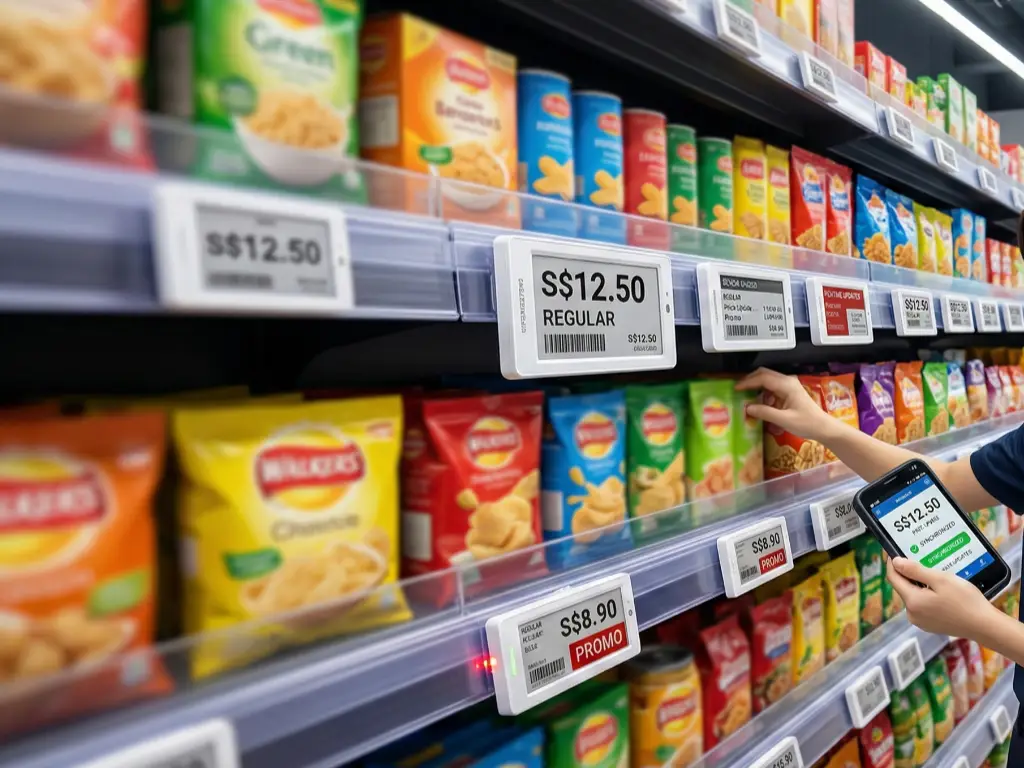
In this period of time, the physical store shows old prices. When the online price is lower, the store overcharges the physical customer, which may result in a violation of compliance and extreme dissatisfaction of the customer. When the digital price is more than the in-store price, the retailer loses direct profits on all in-store purchases. Retailers have to adopt a Dynamic Pricing Infrastructure. Electronic Shelf Labels (ESL) are the physical representation of cloud data. Through the incorporation of ESL hardware into the central unified database, the pricing updates are sent immediately to the shelf edge through secure wireless protocols. This not only gets rid of data latency but also gets rid of the manual labor requirement, and guarantees complete pricing consistency and a consistent experience across all physical and digital touchpoints at the same time.
Streamlining In-Store Fulfillment Workflows
With the changing retail strategies, physical stores are no longer display areas, but they are micro-fulfillment centers. Online order fulfillment via Buy Online, Pick Up In-Store (BOPIS) or ship-from-store procedures compel store associates to perform warehouse duties in a consumer-facing setting. The physical search for the specific items is very inefficient in retail stores because they do not have the systematic arrangement of distribution centers.
Retailers need to implement a set of edge technologies to address the physical search challenges. Radio Frequency Identification (RFID) offers precise location tracking and makes sure that the number of stock in the central database is exactly the same as the physical reality on the floor. Store associates need mobile Personal Digital Assistant (PDA) devices that are linked to the unified system to get the correct order management routing and inventory information. Lastly, the shelf edge itself should help in the fulfillment process. High-end ESL hardware has an LED flashing. The central system causes the appropriate ESL to produce a visual light signal when an associate is searching for an item. This hardware intervention will significantly decrease the time of physical search during the last ten meters, simplifying the overall in-store fulfillment process.
Bridging the Phygital Interaction Gap
Customers who have been trained in integrated business settings demand instant access to all product information. Shoppers online read specifications, origin information, customer reviews, and personalized suggestions. Physical store shelves, on the other hand, usually only give a product name and a price. This gap creates a huge interaction gap within the physical retail setting and limits customer interactions.

Bring Your Own Device (BYOD) strategies are applied by retailers to overcome this gap. The physical store environment is interacted with by consumers using their own smartphones. Scan and Go checkout and Augmented Reality (AR) navigation are made possible by retail applications. The physical shelf should offer effective digital access points to enable these interactions. Electronic Shelf Labels are convenient, real-time anchors of consumer interaction. The shelf edge is a direct gateway to the unified database by incorporating Near Field Communication (NFC) chips and dynamic Quick Response (QR) codes into the ESL hardware. A consumer swipes his smartphone to the ESL and immediately gets the rich product information, reviews, and individualized promotions created by the central system to support localized marketing campaigns. The hardware enables physical space to be a continuous digital shopping experience.
Future-Proofing Your Retail Architecture Today
The theoretical limit of the operational capability of a retailer is determined by the software architecture that they choose. Nevertheless, the actual implementation of that strategy is determined by the edge hardware implemented in physical stores. A retail environment cannot be optimized by a centralized database when the physical touchpoints are still analog. In assessing the shift to unified commerce, technology leaders should also audit their physical hardware infrastructure to make sure that it is capable of executing real-time data.
Zhsunyco operates as a dedicated partner in the retail Internet of Things (IoT) sector, focusing on the critical intersection between unified cloud data and physical store execution. With extensive manufacturing capabilities and a highly controlled supply chain, we engineer and produce the edge hardware necessary to overcome physical retail boundaries. The product portfolio encompasses comprehensive digital display solutions, including secure Electronic Shelf Labels and robust LCD displays.
We focus on stringent quality control protocols and deep customization capabilities, ensuring that the hardware integrates securely and seamlessly with existing POS systems and enterprise architectures. The development process prioritizes long-term reliability, offering hardware designed to support the continuous data demands of modern retail systems. By maintaining complete oversight of the manufacturing and design process, we deliver the physical infrastructure required to translate digital strategies into operational reality.
Evaluate your current retail infrastructure and hardware capabilities to ensure alignment with modern data demands. Contact us to discuss how specialized edge hardware and customized digital display solutions can integrate with your operational architecture to support the ongoing transition toward unified commerce.

 English
  Russian
  Spanish
  German
  Arabic
  French
  Bulgarian
  Polish
  Romanian
  Turkish