


The retail environment in recent years, leading up to 2026, is no longer characterized by mere transactions. It is characterized by the circulation of data. As the global retail Internet of Things (IoT) market scales toward a projected $130 billion valuation this year, the industry is moving past the “pilot phase.” To realize the full potential of this digital transformation, IoT has shifted away from being a collection of experimental smart devices to the backbone of contemporary business, fundamentally shaping the future of retail and the broader future of IoT in retail. This growth is, however, not even. We are experiencing a fractured digital environment where geography, size of the company, and technical debt of legacy provide a complicated environment to decision-makers.
Current State: A Global and Fragmented Digital Landscape
The retail IoT is in the state of Infrastructuralization. IoT sensors, tags, and connectivity are becoming as important as electricity in a physical store. However, the adoption of the IoT curve is not even, and it forms an apparent gap between the individuals who use data to make decisions and those who are reactive.
The Regional and Tiered Digital Divide
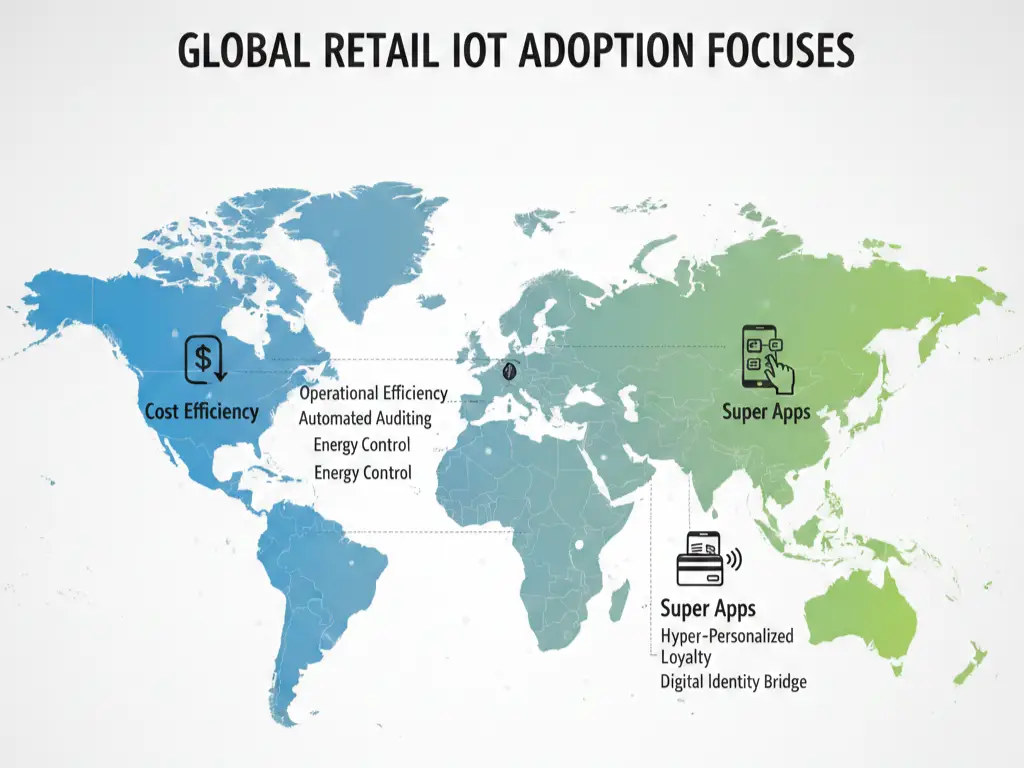
The adoption of the IoT technology is characterized by regional logic that is guided by the local economic pressures. Environmental, Social, and Governance (ESG) regulations and excessive labor expenses play a crucial role in North America and Europe. The retailers in these areas focus on energy control, automated auditing, and automation of retail operations to safeguard dwindling margins. On the other hand, the Asia-Pacific region, with a strong electronics supply chain, is the largest IoT laboratory in the world. In this case, it is about the combination of contactless payments, super apps, and hyper-personalized loyalty systems that will help bridge the digital identity and physical presence gap.
There is also a stratified separation. Tier 1 retail businesses, including Walmart and the Schwarz Group, are no longer content with simple connectivity. They are currently at the stage of Data Integration, where the IoT platforms and data streams are integrated into Enterprise Resource Planning (ERP) and Customer Relationship Management (CRM) systems. In contrast, approximately 65% of Small and Medium Enterprises (SMEs) remain in a “Digital Observation” phase. For these smaller players, the barriers are not the absence of interest, but the large initial Capital Expenditure (CapEx) and the perceived complexity of integrating the IoT systems.
Macro Drivers: Labor and Inflation
Retail executives in the retail sector are being driven by two external pressures:
- Labor Scarcity: According to Deloitte, the global retail market faces an average personnel gap of 15% to 20%. Retailers are no longer able to get sufficient personnel to carry out manual jobs or undergo extensive staff training. As a result, IoT is being re-packaged as a labor augmentation tool—a means of enabling fewer workers to operate in bigger, more complicated settings, thereby driving operational efficiency and significant cost savings.
- Inflationary Pressure and Dynamic Pricing: The speed of price reaction demanded in a volatile economy has fallen from days to hours. Manual price updates are not only inefficient anymore, but they are a source of great opportunity costs. When a retailer is unable to change the prices in real-time to reflect the costs of the supply chain management or competitor actions, they lose margin immediately.
The 80/20 Rule of the Current Tech Stack
There are three types of technology at varying levels of maturity that dominate the retail IoT stack:
- RFID and Barcodes (Mature): RFID technology has reached a 70% penetration rate in apparel and footwear. Its value has shifted from theft prevention to massive improvements in inventory accuracy via RFID tags. In 2026, achieving 99% inventory accuracy via RFID is the non-negotiable floor for any omnichannel operation seeking seamless inventory management.
- Computer Vision and AI Cameras (Explosive Growth): Roughly 42% of top-tier retailers now utilize artificial intelligence-powered smart cameras. These systems extend beyond security, offering real-time heatmaps to analyze customer behavior and detect out-of-stock items on shelves before a customer realizes it, protecting the overall customer experience.
- Edge Displays and Interactive Terminals (Evolutionary): Electronic Shelf Labels (ESL) are no longer mere price-changing devices, but are becoming advanced interactive nodes, elevating shopping experiences. Although they are ubiquitous in the high-end European grocery, they have enormous growth potential in the SME sector and the global market in general.
Trend 1: Store API-fication and Composable Architecture
The API-fication of the physical store is the most important architectural change in 2026. Retail hardware has been a black box for decades: closed systems that were not in communication. Software-Defined Retail is the future, in which all physical assets are considered software endpoints.
We are heading towards Composable Commerce in the physical world. A shelf, a refrigerator, or a camera is not a simple piece of equipment in this model; it is a data node that can be queried. These nodes can now be called by third-party developers and AI agents through APIs. As an example, smart shelves can be asked by an automated inventory agent to provide data from integrated weight sensors, compare it with a visual feed of a camera, and automatically place a restocking order, without human intervention, ensuring optimal stock levels.
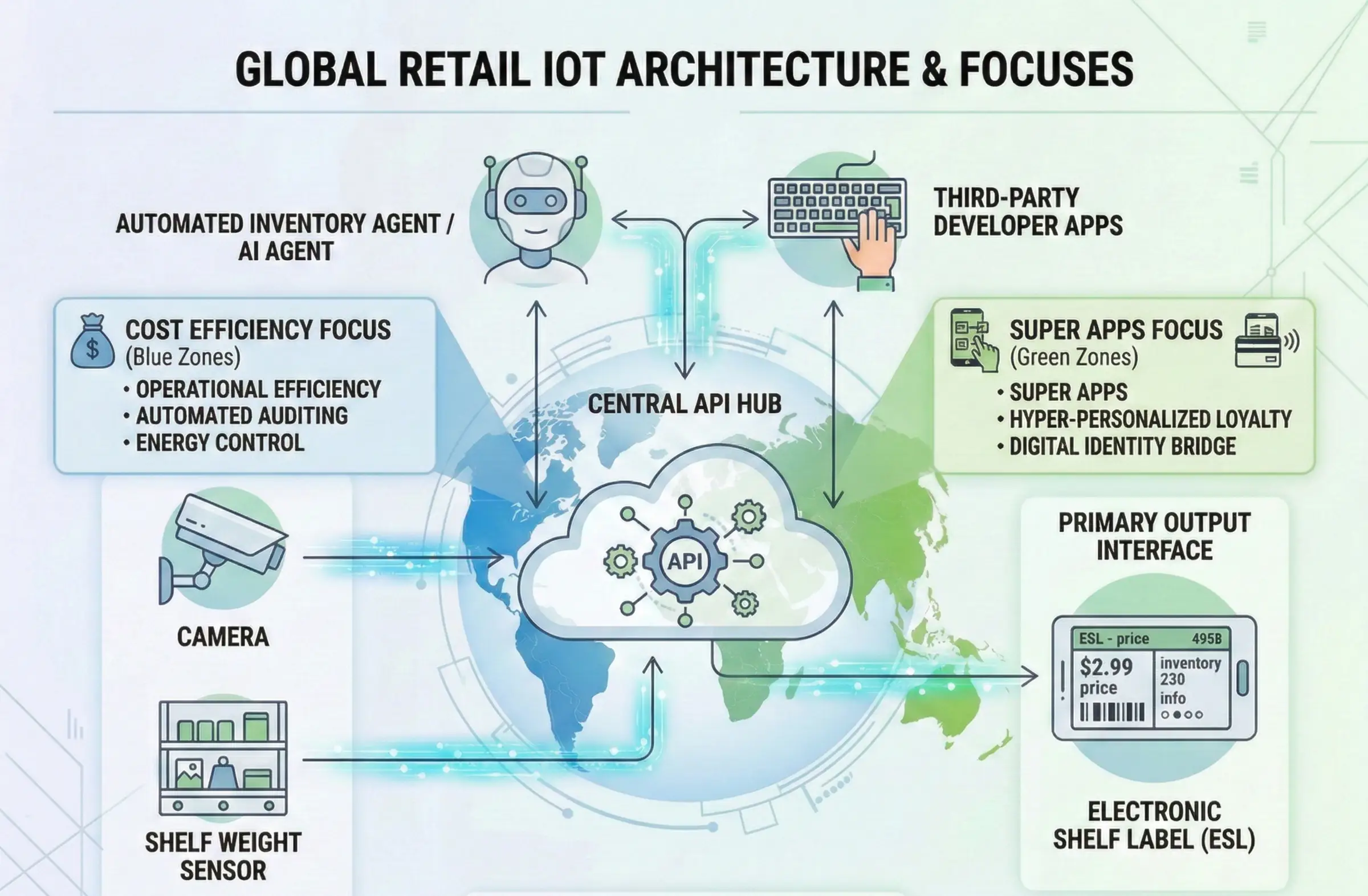
Electronic Shelf Labels (ESL) play a very important, objective role in this ecosystem: they are the Primary Output Interfaces. Although the input of data is done by sensors (cameras, weight mats), the ESL is the physical location where the digital system is able to communicate its decisions back to the world. It is the showcase of the API of the store, which not only displays prices, but also stock, detailed product information, pick-up points of online orders, and carbon footprint information. This change transforms a store into a dynamic, programmable space.
Trend 2: The Explosion of In-Store Retail Media Networks (RMN)
The retail profit model is transforming radically. Retailers are discovering that their main asset is not necessarily the products they are selling, but the audience’s attention they are getting. The physical store is being rediscovered as a high-value media channel as the cost of acquiring customers online is soaring, reshaping the retail experience.
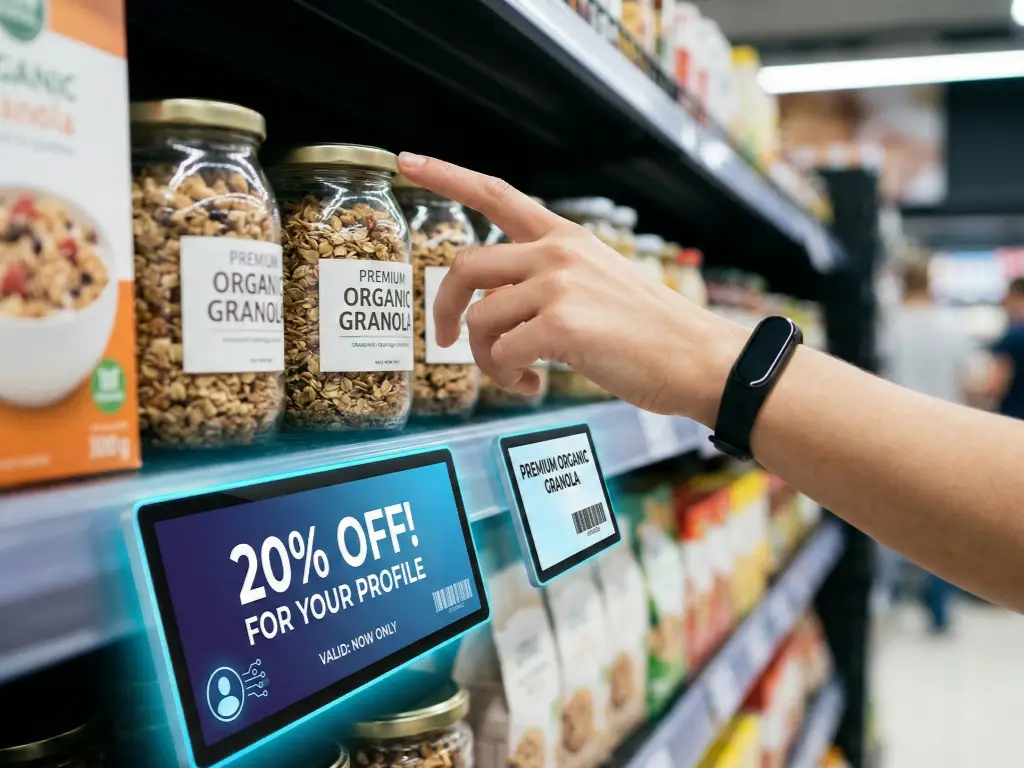
Retailers are becoming more like media owners than merchants. This is the emergence of the In-Store Retail Media Network (RMN). With the help of IoT devices like screens, digital signage, high-definition shelf-edge displays, and smart cart tablets, retailers are able to monetize the foot traffic in real-time.
The reasoning is straightforward: IoT sensors recognize the profile or behavior of the customer in front of a particular category. The system can be used to deliver a specific advertisement, tailored product recommendations, or a temporary coupon on a digital screen just before a hand reaches a product, anticipating customer needs. This is the most desirable advertising space for brand manufacturers (CPGs), boosting overall customer engagement. It is the only location where the advertisement and the product are physically inches apart. This opens a new, high-margin revenue stream to retailers that can sometimes be higher than the margins of the products themselves, providing valuable insights into purchasing triggers.
Trend 3: Edge AI vs. The Cloud Hegemony
The previous model of IoT, which transmits all the bits of IoT data to a centralized cloud to process them, is no longer sustainable. The bandwidth and the latency of cloud processing are prohibitive, with a single supermarket potentially containing tens of thousands of data points.
The future belongs to Edge AI. Intelligence is being taken to the edge of the network, directly into the cameras, the shelf sensors, and the store-level servers in 2026. These devices now have enough localized computing capabilities to do image recognition and data analytics on-site to generate actionable insights.
This change offers three essential advantages:
- Reduced Latency: Decisions, such as detecting a spill or an empty shelf, happen in milliseconds.
- Cost Efficiency: The summarized insights only (e.g., “Shelf B is 20% empty”) are transmitted to the cloud, which significantly lowers the cost of data transmission.
- Privacy and Compliance: Edge AI can be used to provide Privacy by Design, perhaps most importantly. Local processing of video feeds and customer data can be used to monitor behavior without ever storing or transmitting identifiable images, alleviating security concerns and ensuring data security and data privacy, which makes it far easier to meet the stringent global privacy regulations, such as GDPR.
Trend 4: Ambient IoT and the Extreme ESG Mandate
We are on the verge of a Battery Disaster as we roll out billions of IoT nodes. The operational cost of having a network of 50,000 battery-powered devices in a single store is enormous and has a huge environmental footprint, heavily impacting energy usage. Here, the Extreme ESG Mandate collides with technical innovation.
The industry is shifting to Ambient IoT (also referred to as Battery-less IoT). They are gadgets that draw power out of their surroundings, including indoor light, heat, or even stray radio frequency (RF) signals of Wi-Fi and cellular networks.
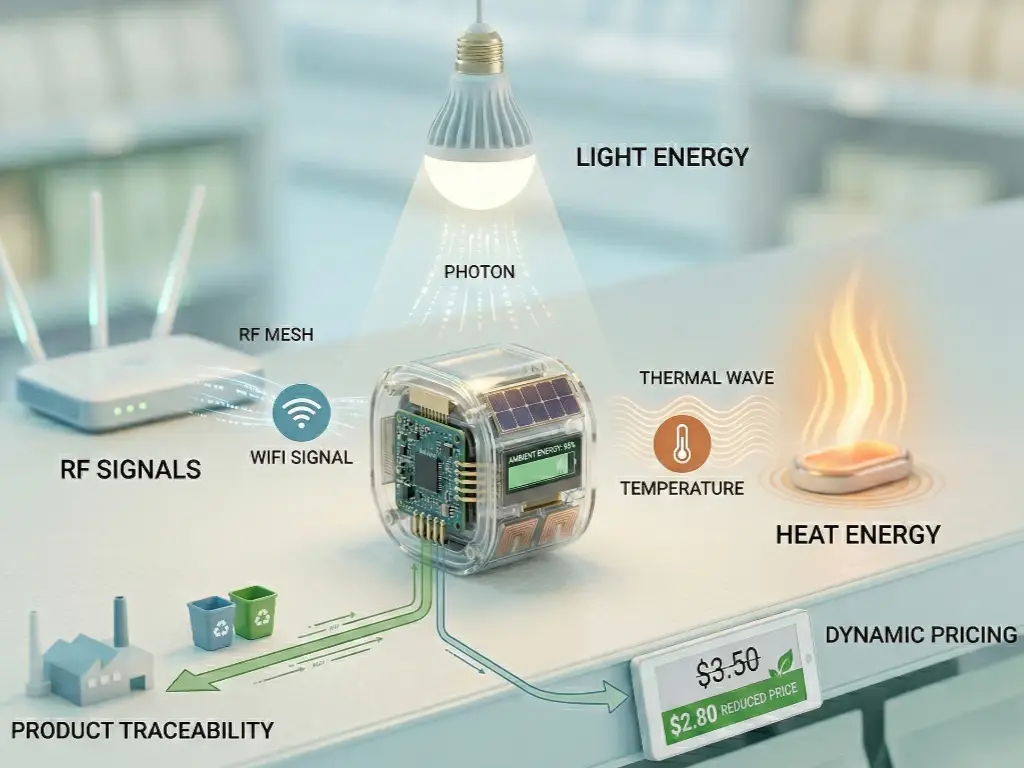
Scope 3 Carbon Tracking depends on this technology. Retailers need to trace the path of a product between the factory and the recycling bin to gain a real insight into the environmental impact of a product and optimize delivery times. Ambient smart sensors are affordable and environmentally friendly to an extent that they can be affixed to single objects or reusable crates.
Moreover, this Zero-Power solution is being incorporated in the dynamic pricing systems to fight Food Waste. IoT sensors are able to track the ripeness or temperature of perishables and, with an algorithmic connection to digital labels, automatically issue a markdown when a product is approaching its expiration date. This will make sure that the product is not wasted but sold directly, contributing to the global sustainability objectives and regaining the revenue lost.
Trend 5: Empowering an Augmented Retail Workforce
One of the myths is that IoT is created to substitute humans. The future of IoT in retail is, in fact, Human-Machine Collaboration. The IoT is the Co-pilot of the retail associate.
The model of the Augmented Workforce applies IoT applications to address the Labor Gap by eliminating low-value, repetitive jobs. The sensors are used to manage the Observation (checking stock, verifying prices, monitoring freezer temperatures), and the human beings to manage the Interaction (customer service, expert consultation, complex problem solving), ultimately driving higher customer satisfaction and customer loyalty.
An IoT system will send a specific notification to the wearable device of an employee when it notices that a refrigerated unit is malfunctioning or an item with high demand is out of stock. This does away with manual patrolling. Retailers can better retain employees and redirect their small workforce to the activities that actually lead to sales and customer loyalty by eliminating the grunt work of replacing thousands of paper price tags or walking the aisles to identify gaps.
Trend 6: The SME Revolution: Tapping the Retail Blue Ocean
The Retail Giants have been playing in the field of IoT for years. We are experiencing a Digital Democratization in 2026. The IoT market has become a growth engine for Small and Medium Enterprises (SMEs). This Blue Ocean market is now prepared to be transformed since the barriers to entry have been broken.
Lightweight IoT solutions are being implemented by SMEs. They do not require complicated, multi-year implementations. They require Plug-and-Play modules that will give them an immediate Return on Investment (ROI). The emergence of IoT-as-a-Service (IaaS) enables a local pharmacy or a local grocery store to install sophisticated digital labels and sensors at a predictable monthly payment, moving the expense of a heavy initial investment (CapEX) to a manageable operational cost (OpEX).
To the SME, the value proposition is on Survival and Agility. In community retail, the ability to change prices immediately to maintain a competitive edge against a local large-box competitor or a QR code on a digital label to connect the customer to an online store is the difference between success and failure. This Long Tail of retail is the next big thing in IoT implementation.
Conclusion: Building a Future-Proof Technology Stack
The shift to a digital-first smart retail model is unavoidable, but to succeed and harvest the true benefits of IoT, it needs to be approached strategically in terms of infrastructure. To decision-makers, it is not about purchasing the most costly hardware, but rather about creating an interoperable, scalable, and Sustainable stack. Extracting powerful insights through predictive analytics requires a solid foundation.
There are three criteria that are paramount when assessing the basis of a retail IoT strategy:
- Interoperability: Does the hardware use open protocols such as MQTT? A “closed” system is a dead end. Find partners that support open API/SDK so that your retail stores can communicate with future AI agents and ERP systems.
- Scalability and Reliability: Your network should be able to support thousands of nodes in a high-density environment without affecting the network. Mission-critical operations need systems that have a 99.99% success rate and have been deployed globally (serving tens of thousands of stores).
- ESG Compliance: With the increasing regulations, the cost of battery disposal and energy consumption should be part of the total cost of ownership.
For many retailers, Étiquettes électroniques de rayonnage (ESL) represent the most logical “First Step” in this transformation. It is a visible, high-impact upgrade that provides immediate labor savings and price agility. However, the choice of a partner is critical. Industry leaders like Zhsunyco have demonstrated that the most effective solutions come from a combination of deep R&D (over 12 years of experience) and massive supply chain scale.
We focus on high-quality E-ink displays, ultra-low power consumption, and seamless integration with POS systems via open MQTT base stations, which reflects the trends discussed in this analysis. By starting with a robust, scalable display foundation, retailers can build a digital asset that is ready for the “API-fied,” “Edge AI,” and “Sustainability-driven” future of 2026 and beyond, cementing their place in the future of IoT in retail.
The retail of tomorrow is not a far-off dream, but a programmable, efficient, and profitable reality for those who select the appropriate digital base today.

 English
  Russian
  Spanish
  German
  Arabic
  French
  Bulgarian
  Polish
  Romanian
  Turkish