


Communication barriers can be particularly damaging in retail and logistics, especially within inventory management. A basic example of confusion involves SKU codes (Stock Keeping Units) and Barcodes. While commonly understood as referring to the same thing in conversation, these terms occupy different positions in any business’s supply chain architecture.
The impact of confusion and misunderstanding in this case is even more serious. A failure to grasp the relationship between logical product identification (SKU) and its physical representation (Barcode) results in lost inventory levels, redundant data, and friction during payment. Understanding the core of the SKU vs barcode relationship is vital for operational success.
The rest of this guide is going to provide a structured explanation of SKUs and Barcodes, with their definitions, their different forms, and the particular architecture and strategy needed to ensure these live and work together harmoniously in retail store environments today.
What is a SKU? Defining the Digital Retail Identity
A Stock Keeping Unit is what we call the digital manifestation of a single product. Each SKU is a conceptual bead in an organization’s Enterprise Resource Planning (ERP) or warehouse management software (WMS). Distinct from global identifiers, a unique SKU is unique to the retailer that created it for internal use. Every SKU links a product to its corresponding product details in the database, such as pricing, color, size, stock location, etc.
A SKU is the digital building block of any business intelligence. Anything from forecasting sales to analyzing a profit margin period serves as the completion of the business intelligence model. Crucially, a SKU is designed for human readability and internal logic, often utilizing alphanumeric characters. A well-designed SKU of a product type like a blue medium cotton shirt example, may read SHT-CTN-BLU-MED. This sku number allows warehouse staff or the category team to find a product by looking up attributes in the system without having to use a barcode scanner.
To preserve data integrity when working with data history, the SKU should never change, irrespective of a change in supplier or packaging. This unique identifier is irreplaceable with respect to the inventory.
What is a Barcode? Types and Symbology Standards
A barcode is what we call the embodiment of a SKU’s identity. A barcode system is built to serve as a representation of what the SKU stands for. More profoundly, a barcode is a means of representation built to eliminate the need for manual data entry.
Unlike what most people think, most barcodes do not actually contain product information like product names, prices, or descriptions. What most barcodes do is contain a reference string—often a product code or item number— that a barcode reader uses to retrieve products with the same reference string. For each use case, the available surface area and the required data density, there is a type of barcode that works best.
Linear 1D Barcodes for Standard Checkout Operations
Linear, or one-dimensional (1D) barcodes, or what is most commonly known as the pattern of black vertical lines and white spaces, are designed for high speed and are perfect for high-throughput environments like grocery store checkout counters. For that reason, there are a few standards and variations that are used.
- EAN-13 (European Article Number): This is the standard for physical products worldwide, except for North America, as North America has its own standard. It has 13 digits and is globally unique and regulated by GS1.
- UPC-A (Universal Product Code): This is a 12-digit standard and the dominant UPC code in North America. It is used primarily for Point of Sale (POS) scanning.
- Code 128: This is different from UPC and EAN, as they only encode numbers. Code 128 can encode any character in the ASCII 128 character set, making it a versatile alphanumeric code. This makes it much more suitable for logistics and track products capabilities as it can encode an internal SKU right on the shipping label.

Matrix 2D Codes for Data-Dense Product Tracking
Two-dimensional (2D) codes use a grid of squares, dots, or hexagons to encode data both horizontally and vertically. This matrix structure enables them to encode far more data within a smaller area than a linear barcode.
- QR Code (Quick Response Code): This code was designed for tracking parts in automotive manufacturing. Now QR Codes are ubiquitous and can be scanned for consumer information.

- Data Matrix: This code is one of the highest-density codes and is often used in industries like electronics and healthcare, where there are high-security needs. A Data Matrix can be engraved or printed on a tiny label or directly on a microchip.

SKU vs Barcode: Analyzing the Core Differences
To design an optimal inventory management system, one must understand the differences of SKUs and Barcodes when used. One is a logical asset, and the other is a physical one.
- Control and Jurisdiction
You are entirely free to determine the SKU system configuration. It is your unique internal language, customized to your workflows, allowing you to create your own SKUs. Conversely, the barcode often involves a company prefix from the Uniform Code Council. The GS1 barcode must be compliant with international standards, especially for externally marketed items, to prevent clashes with other items in international trade. You control the SKU. The industry controls the barcode standard.
- Permanence and Continuity
The SKU is a permanent fixture in the system. It is possible for a product to be received with a different type of code because the vendor changed the packaging design, but for historical sales data to be accurately maintained, the internal SKU must remain unchanged. If you alter the SKU each time the barcode is changed, you will damage your historical data, thereby complicating long-term forecasting. The barcode is perishable; the SKU is permanent.
- Функционалност
The SKU solves the problem, “What is this item?” with unique data. The barcode provides the solution to the problem, “How do I efficiently log this item into the system?” It is nothing more than a data entry tool to track inventory.
| Функции | SKU (Stock Keeping Unit) | Barcode (UPC/EAN/Code 128) |
| Primary Dimension | Logical/Internal. Exists in the database. | Physical/External. Exists on packaging/labels. |
| Data Ownership | Retailer Controlled. You define the logic. | Standard Controlled. Dictated by GS1 or suppliers. |
| Lifespan | Permanent. Constant for historical tracking. | Variable. Can change with packaging updates. |
| Четивност | Human-Readable. Staff can read the code. | Machine-Readable. Requires barcode scanner. |
| Разходи | Machine-Readable. Requires a barcode scanner. | Variable. GS1 prefixes incur fees. |
How SKU and Barcode Work Together in Retail
In retail, each SKU and barcode has a symbiotic relationship where a physical retail barcode scan initiates a digital retrieval process. However, in a developed retail operation, this relationship is not a simple 1:1 relationship. A developed retail operation possesses a sophisticated Inventory Management System (IMS) where the internal identifying element (SKU) and the external scanning element (Barcode) can be separated, enabling the many-to-one mapping scenarios that are necessary for integrated supply chains and fulfillment centers.
Linking Physical Scans to Digital Records
- One Barcode to Many SKUs
There are instances when a retailer will define a “bundle” or a “kit,” such as a holiday gift set that includes a shampoo and a conditioner. The gift box will have one special and unique barcode. When the cashier scans the gift box, the system cannot just decrement one “Gift Box” from the inventory level, especially if you are tracking the shampoo and conditioner separately. The system must map that single barcode to a “Bill of Materials” in the back end, and this triggers a logic sequence that decrements the stock of the individual components for accurate order fulfillment. A 1-to-1 relationship, admittedly, would fail immensely in this case.
- Many Barcodes to One SKU
If a vendor sells a standard ‘6-foot HDMI cable’ to a retailer, but there are three different individual retailers or vendors to ensure stock, then Vendor A, Vendor B, and Vendor C, the retailer does not want three different SKU codes for the same commodity, as this splinters sales data and makes reordering difficult. Hence, for internal purposes, the retailer CBL-HDMI-6FT and for each vendor the barcodes in the retailer’s database are mapped to this one internal SKU. It doesn’t matter which vendor’s product number is scanned at the checkout; the system is programmed to recognize it as one of the same inventory items.
Which Barcode Format Should You Use for Your SKUs?
How and where scanning is done in the product lifecycle, and your geographical constraints, will determine what format to use.
- For External Sales (Пункт за продажба): If the product leaves the retail outlet and enters the consumer market for the first time, usage of Global Trade Item Number (GTIN) via a Universal Product Code (UPC) or European Article Number (EAN) is a requirement to ensure international retail system compatibility.
- For Internal Tracking (Warehouse/Storage): In the case of labeling stations, bins, shelves, or individual items that are not meant to depart the facility (like raw material), there is more flexibility.
- Code 128 is best if you want to encode the alphanumeric, human-readable SKU straight into the barcode (e.g., scanning SHT-BLU). It has greater versatility as well as higher density.
- Data Matrix works best with small items or harsh conditions. If labels are easily destructible or if there is limited space, Data Matrix has greater error correction. This guarantees that the SKU can still be read if there is a significant obstruction within the code.
Ensuring Scannability: Practical Barcode Management for Operations
The theoretical connection between the SKU and the Barcode is broken as soon as the physical scan is a failure. Operational efficiency depends on the First-Pass Read Rate: the proportion of time the scanner successfully reads the barcode on the first attempt. Scannability failures cause manual entry at checkout (which extends lines), miscounts during the inventory audit, and phantom inventory, where the system assumes the item exists, but it cannot be verified physically.
Operational Pitfalls
Many physical characteristics of the environment impede the integrity of the data link:
- Quiet Zone Violations: A Quiet Zone is the blank margin that must be left at the start and end of a barcode (on both sides). If there is any text or imagery within this space, the scanner will lose its ability to tell where the start and end of the code are.
- Improper Scaling: Scaling barcodes down to place on smaller label has the unintended consequence of making the width of the barcode bars too small to be read, often confusing the check digit.
- Curved Surfaces: With barcodes placed horizontally on a curved object’s surface (like a bottle), the outer ends of the barcode become unreadable.
The Durability Challenge
Paper labels encounter a variety of challenges in retail settings. Paper labels encounter a variety of challenges in retail settings. Paper labels encounter: a lack of moisture resistance in refrigeration units, fading from UV lighting, and physical damage from shelf stocking. If the barcode gets scratched or damaged by water, barcode scanning becomes impossible.
To eliminate the challenges posed by displaying a barcode on paper, high-quality display mediums are required. The high-quality display mediums required for displaying barcodes on paper must have a high contrast ratio. The contrast ratio required for barcode display must remain for the duration of the whole shelf life of the product.
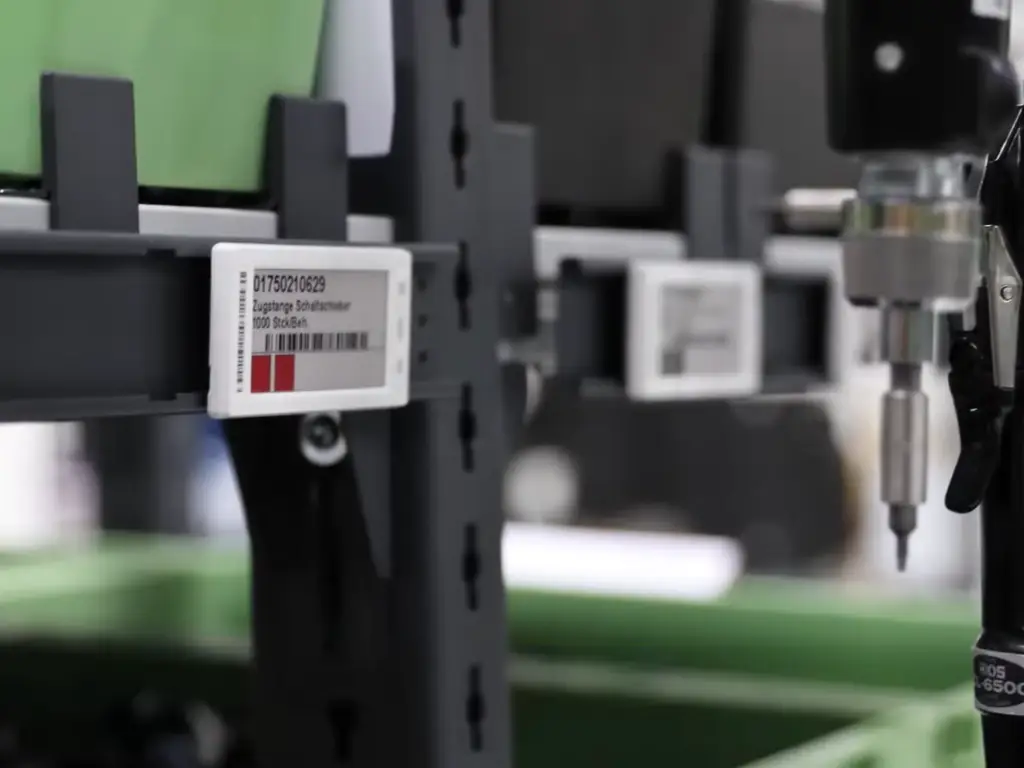
To eliminate the degradation issues associated with thermal paper, high-quality display carriers, including electronic paper (e-ink), are preferable. For high-quality display carriers, e-ink technology is preferable, especially for high-quality display carriers, including electronic paper (e-ink). Unlike backlit screens, which cause glare (reflection), e-ink displays maintain a high-contrast, matte finish that mimics paper but with superior durability to paper. This ensures that the physical entry point to your digital SKU data remains accessible.

Synchronizing Backend SKU Changes with Front-End Displays
In retail operations, there is always a waiting time, which is the most crucial gap to occur, which is the waiting time from the decision made in the headquarters to the decision made at the shelf.
In a traditional setup, if a category manager updates a SKU’s price or promotion status in the ERP system, that change is instant in the digital logic layer. However, the physical tag lags behind. Staff must print new labels, find the correct products, and manually replace them. This gap creates a period of “data dissonance.”
- Price Mismatch: The shelf says $10, but the POS scans $12. This leads to customer disputes and mistrust.
- Regulatory Risk: In many jurisdictions, retailers are legally bound to honor the lowest displayed price, leading to direct revenue loss.
- Inventory Drift: If a SKU is discontinued in the system but the shelf label remains, staff may continue to order or look for stock that should not exist.
Achieving Seamless Synchronization
To eliminate price ambiguity, the physical display becomes a dynamic extension of the digital database. The goal is to remove the manual labor step between a database update and a shelf update.
Zhsunyco addresses this critical disconnect with advanced Electronic Shelf Label (ESL) solutions. As a dedicated retail IoT partner, our Electronic Shelf Label (ESL) solutions integrate seamlessly with your existing POS and ERP systems, allowing you to synchronize SKU prices and promotions instantly across your entire network. Our open architecture and customizable 4-color displays give you full control over your visual merchandising. Instead of relying on manual updates, Zhsunyco empowers you to automate your pricing strategy—eliminating manual errors, ensuring regulatory compliance, and guaranteeing that the data in your backend system is exactly what your customers see on the shelf.
Future Evolution: The GS1 Digital Link and 2D Transition
The structure of retail inventory systems has remained largely the same since the 1970s, when the barcode was invented. With GS1 Sunrise 2027, the retail sector is set to undergo massive changes as the industry shifts from 1D linear to 2D barcodes and embraces the GS1 Digital Link standard.
This change moves the barcode from being a static lookup tool to a dynamic web gateway. One 2D scan will soon enable consumer engagement (by way of URLs), granular traceability (batch/lot tracking), and checkout at the point of sale instantaneously. For the retailer, the logical SKU now has to contain richer information, and the physical display hardware has to be able to draw complex and high-resolution 2D matrices. To be competitive in the future of data-driven retail, today you must prepare the inventory architecture for this change.

 English
  Russian
  Spanish
  German
  Arabic
  French
  Bulgarian
  Polish
  Romanian
  Turkish